Newton type-A and type-B hives share the same movable-frame concept, but they are designed for different environments. Both use ten foundation-free frames arranged in a lower brood chamber and an upper honey chamber. Type-A has a smaller body and flat roof for high-altitude or hilly locations, while type-B is larger with a house-roof-like structure for lowland regions.
The key selection rule is environmental suitability: choose Newton type-A for elevated, hilly apiaries and type-B for lowland operations. Matching the hive structure to the local climate and terrain supports thermal regulation, colony stability, inspection, and honey collection efficiency.
How the Newton Hive Design Works
Two chambers support movable-frame management
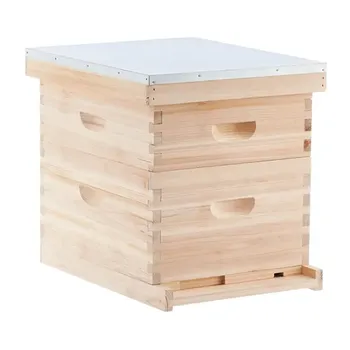
Newton hives are modular, movable-frame systems divided into two functional chambers.
The lower chamber is used for brood, while the upper chamber is used for honey. This separation is intended to simplify colony inspection and honey extraction.
Ten foundation-free frames provide flexibility
Each Newton hive uses ten foundation-free frames. Their movable design allows beekeepers to handle the colony and access honey stores without relying on fixed-comb construction.
For distributors and commercial users, this common frame arrangement helps maintain a consistent product category while the external hive structure varies by environment.
What Distinguishes Newton Type-A
Smaller body and flat roof
The Newton type-A hive has a smaller body and a flat roof. These features distinguish it physically from the larger, pitched-roof type-B design.
The compact structure is intended for high-altitude or hilly environments, where equipment selection must account for local terrain and conditions.
Best suited to elevated or hilly apiaries
Type-A is the more appropriate option when the apiary is located in mountainous, elevated, or uneven terrain.
Its recommended environment is not simply a matter of preference. Using an altitude-appropriate hive can help support thermal regulation and colony stability, both of which affect practical hive performance.
What Distinguishes Newton Type-B
Larger body and house-roof-like structure
The Newton type-B hive has larger dimensions and a house-roof-like structure. This creates a visibly different equipment profile from the compact, flat-roof type-A hive.
The larger format should be treated as a deliberate environmental adaptation rather than merely a higher-capacity version of type-A.
Best suited to lowland regions
Type-B is recommended for lowland environments. For beekeepers operating in these regions, selecting type-B aligns the hive structure with the conditions for which it was designed.
For commercial apiaries, this distinction is important when standardizing equipment across multiple locations. A lowland operation should not automatically use the same hive type as a high-altitude operation.
Why Environment Should Drive Equipment Selection
Thermal regulation affects colony stability
Hive design contributes to how the colony manages its internal conditions. The primary reference specifically connects altitude-appropriate movable-frame hive selection with thermal regulation and colony stability.
This makes the type-A versus type-B decision an operational issue, not only a product-specification issue.
Hive stability supports efficient management
A suitable hive can make routine colony management more practical. The two-chamber layout already supports inspection and extraction, while the correct external structure helps align the equipment with the apiary’s environment.
In commercial settings, this can contribute to more consistent handling and honey collection performance.
Location-based selection simplifies procurement
Distributors, wholesalers, and resellers should classify Newton hives by recommended environment, not only by size or appearance.
Clear product segmentation—type-A for high-altitude and hilly areas, type-B for lowlands—helps customers make faster purchasing decisions and reduces the risk of supplying unsuitable equipment.
Understanding the Trade-offs
Type-A is not the universal compact option
The smaller type-A body may be attractive where transport or limited space matters, but its primary recommendation is for high-altitude or hilly environments.
Choosing it solely because it is smaller could overlook the more important issue: whether the hive is suitable for the operating location.
Type-B is not simply the larger alternative
Type-B’s larger dimensions do not mean it should automatically replace type-A in every apiary. Its recommended application is specifically lowland beekeeping.
Using a larger hive without considering the environment may create a mismatch between the equipment and the colony’s local conditions.
Avoid mixing specifications during supply
Because both models use the same broad Newton movable-frame concept, product descriptions can become unclear if the external differences are not stated explicitly.
Commercial suppliers should identify the body size, roof structure, and recommended environment for each model in quotations, catalogs, and order confirmations.
Verify the operating region before ordering
A customer’s location should be confirmed before recommending a model. This is especially important for distributors serving multiple climates or supplying equipment across different geographic markets.
The correct purchasing question is not only, “Which hive is available?” but also, “Where will it be used?”
Making the Right Choice for Your Goal
Use the following criteria when selecting or sourcing Newton movable hive equipment:
- If your primary focus is high-altitude or hilly beekeeping: Choose Newton type-A, with its smaller body and flat roof, because it is designed for these environments.
- If your primary focus is lowland beekeeping: Choose Newton type-B, with its larger dimensions and house-roof-like structure, because it is recommended for lowland regions.
- If your primary focus is commercial apiary consistency: Match hive type to each apiary’s altitude and terrain before standardizing equipment across locations.
- If your primary focus is distribution and resale: Present both models as part of a full movable-hive portfolio, clearly labeling their structural features and recommended environments to support accurate, efficient fulfillment.
Selecting by environment first enables more reliable Newton hive sourcing, clearer customer guidance, and better long-term colony management.
Summary Table:
| Feature | Newton Type-A | Newton Type-B |
|---|---|---|
| Body Size | Smaller | Larger |
| Roof Type | Flat | House-roof-like |
| Recommended Environment | High-altitude, hilly areas | Lowland regions |
| Chamber Configuration | Lower brood + upper honey | Same as Type-A |
| Frame Count | 10 foundation-free frames | 10 foundation-free frames |
| Purpose | Thermal regulation & stability in elevated terrains | Thermal regulation & stability in lowlands |
Need reliable Newton hives for your commercial apiary? HONESTBEE offers a comprehensive range of movable hive equipment to match your operational needs. Contact us today to discuss your requirements and benefit from our fast response, dedicated support, and efficient order fulfillment. For distributors and wholesalers, we provide OEM/ODM support, competitive pricing, and certifications to boost your market edge. Get in touch now!
Related Products
- Heavy Duty Adjustable Hive Connector
- Durable Plastic Interlocking Hive Connector for Beekeeping
- High-Performance Langstroth Bee Hives for Global Professional Beekeeping
- Modern Flat-Mount Hive Number Set for Beekeeping
- Durable Plastic Hive Number Set for Beekeeping
People Also Ask
- Under what circumstance are beehive connectors particularly beneficial? Optimize Handling for Full Beehive Attachments
- What is the advantage of using the beehive connector when handling full attachments? Achieve Safe and Efficient Hive Transport
- What are the primary functions of a beehive connector? Ensure Hive Stability and Safe Colony Transport
- How can the connection length and strength of a beehive connector be adjusted? Master Tension with Threaded Mechanics
- What is the purpose of the beehive connector? Secure Your Hive for Safe Transport