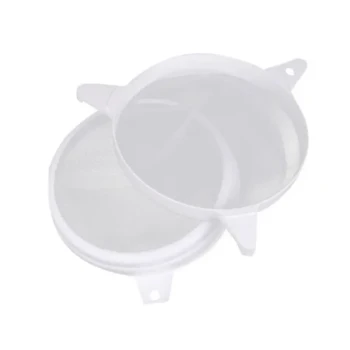
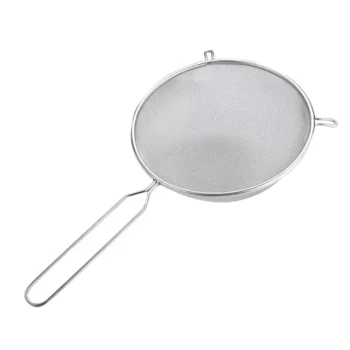
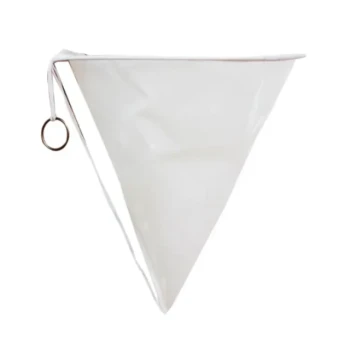
A double sieve honey strainer operates as a sequential, two-stage filtration system designed to gravity-feed honey through progressively finer screens. To use it, you place the unit over a collection bucket and pour raw honey through the top; a coarse upper mesh catches large debris, while a finer lower mesh captures minute particles to produce a clean final product.
The core advantage of this system is its ability to refine raw honey into a bottling-ready state in a single pass. By separating large and small impurities at different stages, it prevents the finer screen from clogging prematurely, ensuring a smoother and more efficient flow than a single screen could provide.
The Mechanics of Dual Filtration
The Upper Screen
The first stage involves a top screen constructed with a coarse mesh.
As you pour the harvested liquid, this layer acts as the primary barrier. It effectively catches larger impurities, such as wax cappings or bee parts, preventing them from reaching the second stage.
The Lower Screen
Directly beneath the coarse mesh lies a second screen featuring a much finer mesh.
This layer is responsible for polishing the honey. It separates the tiniest particles that slipped through the top layer, ensuring the final product is free of microscopic debris.
The Material Advantage
These strainers are typically constructed from stainless steel.
This material choice ensures durability and hygiene, allowing the strainer to hold the weight of the honey while remaining easy to clean and sanitize after use.
Operational Considerations
Gravity-Fed Flow
The system relies entirely on gravity to pull the honey through both mesh layers.
This means the speed of filtration is determined by the viscosity of the honey and the density of the mesh.
Potential for Bottlenecks
While the two-stage design improves flow, the lower fine mesh can eventually accumulate enough micro-debris to slow drainage.
Users must monitor the flow rate to ensure the honey passes through the bottom screen efficiently without backing up into the top chamber.
Making the Right Choice for Your Goal
This tool is best utilized when your objective is balancing high purity with a simple, manual workflow.
- If your primary focus is bottling for consumption: This strainer is ideal as it removes both wax and fine dust, rendering the honey visually clear and ready for the jar.
- If your primary focus is bulk processing: You may need to monitor the fine mesh for buildup to maintain a consistent processing speed.
By utilizing a double sieve, you ensure your honey retains its natural quality while achieving the clarity required for professional presentation.
Summary Table:
| Feature | Upper Screen (Coarse) | Lower Screen (Fine) |
|---|---|---|
| Mesh Density | Large openings | Micro-mesh openings |
| Primary Function | Traps wax cappings & large debris | Removes dust & tiny particles |
| Benefit | Prevents clogging of lower layer | Polishes honey for bottling |
| Material | Food-grade Stainless Steel | Food-grade Stainless Steel |
Elevate Your Honey Quality with HONESTBEE
At HONESTBEE, we specialize in empowering commercial apiaries and distributors with high-performance beekeeping solutions. From precision-engineered double sieve strainers to industrial honey-filling machines and specialized hardware, our comprehensive wholesale inventory ensures your production line remains efficient and hygienic.
Ready to scale your beekeeping business? Contact us today to discover how our premium machinery and essential industry consumables can streamline your workflow and enhance your product's market value.
Related Products
- Stainless Steel Double Layer Honey Strainer Sieve Filters
- Stainless Steel Honey Storage and Settling Tank with Double Strainer
- Stainless Steel Triangle Support Honey Strainer and Filters
- Two-Stage Plastic Honey Filter for Buckets
- Professional Stainless Steel Honey Filter with Support Handle
People Also Ask
- What are some typical mesh size combinations found in double sieve honey strainers? Expert Guide to Honey Filtration
- How is a double-layer honey filter used for monitoring Varroa mite infestation? Achieve Precise Pest Control Data
- How do double-layer honey filters and white blotting paper function together in Varroa mite detection? Expert Guide
- What is the function of honey sieves, strainers, and filters in processing? Master the 3 Stages of Honey Purity
- What mesh sizes are commonly used in double sieve honey strainers? Achieve Clean, Raw Honey Efficiently