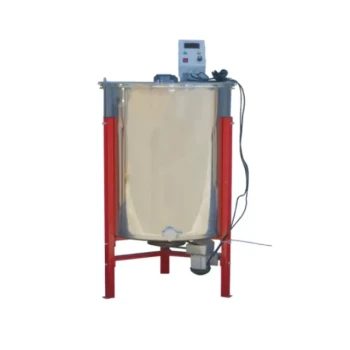
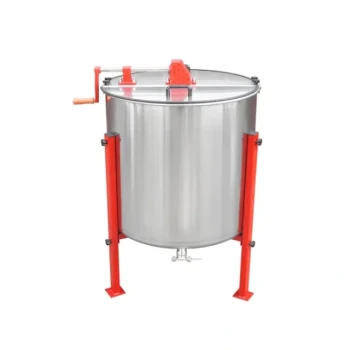
A honey extractor operates by utilizing centrifugal force to mechanically pull liquid honey from the wax comb. Once the wax cappings are removed, the frames are spun at high speeds, forcing the honey out of the cells and onto the inner wall of the drum while leaving the delicate wax structure physically intact.
The primary advantage of an extractor is that it separates honey without crushing the comb. This preservation allows the colony to reuse the wax, saving them significant energy and time that would otherwise be spent rebuilding the hive structure.
The Mechanics of Extraction
Generating Centrifugal Force
Whether powered by a hand crank or an electric motor, the extractor spins a central basket holding the frames.
This rotation creates centrifugal force, which acts outward from the center of rotation. This force overcomes the surface tension keeping the honey inside the hexagonal cells.
The Separation Process
As the basket spins, the honey is flung out of the uncapped cells.
It strikes the inner wall of the extractor drum and flows downward to the bottom, where it is collected through a drain or gate. Because this is a non-contact process for the comb itself, the wax walls of the cells remain undamaged.
Biological Benefits of Reuse
By using this method, the empty frames can be returned immediately to the hive.
This is critical because bees consume a significant amount of honey to produce wax. Eliminating the need to rebuild comb allows the colony to direct its biological energy toward foraging and honey production rather than construction.
Critical Operational Requirements
Uncapping is Essential
Before placing frames in the extractor, the wax cappings (the lids sealing the honey) must be physically removed.
The extractor cannot pull honey through these caps. If the frames are not uncapped first, the honey remains trapped regardless of how fast the machine spins.
Load Balancing
To ensure the safety of both the equipment and the harvest, the internal basket must be balanced.
Frames should be placed opposite one another with roughly equal weight. An unbalanced load can cause the extractor to wobble violently, potentially damaging the machine or shattering the combs inside.
Common Pitfalls to Avoid
Lack of Structural Support
Not all honeycombs are suitable for extraction.
The supplementary data indicates that this method should generally not be used for frames lacking wire or plastic foundation. Without this internal reinforcement, the intense centrifugal force can rip the wax comb apart, defeating the purpose of the machine.
Temperature and Viscosity
While the process relies on force, the physical state of the honey matters.
References imply the process works on "mature" honey. If the honey is too cold or viscous, it may require higher speeds to extract, which increases the risk of damaging the comb structure.
Making the Right Choice for Your Goal
To maximize the efficiency of your harvest and the health of your colony, consider these operational focus points:
- If your primary focus is Equipment Longevity: Ensure you strictly balance the load of frames inside the basket to prevent mechanical wear or catastrophic failure during the spin cycle.
- If your primary focus is Comb Preservation: Verify that your frames utilize wire or plastic foundations to provide the necessary support against the centrifugal force.
The correct use of an extractor transforms honey harvesting from a destructive process into a sustainable cycle that benefits both the beekeeper and the bees.
Summary Table:
| Feature | Mechanical Detail | Key Benefit |
|---|---|---|
| Force Type | Centrifugal Force | Pulls honey out without crushing cells |
| Energy Source | Manual Crank or Electric Motor | Scalable for small to large apiaries |
| Comb Support | Wire/Plastic Foundation | Prevents wax breakage at high speeds |
| Post-Process | Reusable Empty Combs | Colony saves energy on wax production |
| Requirement | Uncapping & Load Balancing | Ensures clean extraction & machine safety |
Scale Your Honey Production with HONESTBEE
Are you looking to optimize your commercial honey harvest while protecting your most valuable hive assets? HONESTBEE provides high-performance honey extractors, hive-making machinery, and specialized honey-filling equipment designed for maximum efficiency.
We cater specifically to commercial apiaries and distributors, offering a comprehensive wholesale range that includes everything from heavy-duty machinery to essential beekeeping consumables and honey-themed merchandise. Let us help you streamline your operation and increase your seasonal yield.
Contact HONESTBEE Today for Wholesale Solutions
Related Products
- HONESTBEE 72 Frame Industrial Electric Honey Extractor for Beekeeping
- Commercial Electric 12 Frame Honey Extractor Spinner Motorized Honey Extractor
- HONESTBEE 6 Frame Self Reversing Electric Honey Extractor for Beekeeping
- HONESTBEE 3-Frame Manual Acrylic Honey Extractor
- Stainless Steel Manual 8 Frame Radial Honey Extractor Machine for Beehives
People Also Ask
- What is the importance of balancing honeycomb frames within a honey extractor? Ensure Stability and Protect Machinery
- How is honey separated from the frames after they are uncapped? Efficient Extraction Methods for High Yields
- What are the main benefits of using a honey extractor? Maximize Yields and Protect Your Honeycomb
- What are the recommended methods for removing honey from the honeycomb? Top Extraction Techniques for Maximum Efficiency
- How do manual honey extractors compare to electric honey extractors? Choosing the Right Tool for Your Apiary Growth