Bee-space is the dimensional rule that makes movable-frame hives work. Manufacturers generally design wooden hive bodies and frames around a nominal clearance of 3/8 inch, or approximately 9.5 mm—with practical bee-space ranges sometimes expressed as roughly 7–9.3 mm depending on the hive design and bee population. Clearances that are too small invite propolis, while clearances that are too large encourage burr or bridge comb.
The manufacturing objective is not simply to build boxes and frames to a nominal size; it is to preserve the correct bee-space at every functional interface. Accurate frame spacing, frame rests, wall clearances, and component dimensions keep equipment movable, interchangeable, and suitable for efficient inspection and harvesting.
Why Bee-Space Controls Hive Design
Bees respond predictably to incorrect clearances
Honeybees naturally maintain a passage between comb surfaces and nearby hive structures. When a gap falls below the usable bee-space, bees tend to seal it with propolis, their resinous “bee glue.”
When a gap exceeds the usable bee-space, bees often fill it with burr comb, brace comb, or bridge comb. These additions connect frames to one another or to the hive body.
Both errors reduce equipment mobility
A narrow gap can glue frames to the sidewalls, frame rests, inner covers, or adjacent components. A wide gap can create irregular comb that must be cut away before a frame can be removed.
For beekeepers, the result is the same: slower inspections, damaged comb, disrupted colonies, and more difficult honey handling.
How the Principle Dictates Manufacturing Standards
Frame-to-frame spacing must remain consistent
The distance between adjacent frames is a primary bee-space control point. Frames must sit at consistent intervals so bees have usable passages without being given enough excess room to construct unwanted comb.
This requires accurate frame dimensions and reliable spacing features, such as correctly positioned frame shoulders, rests, or spacers where the hive system uses them.
Frame-to-wall clearance must be preserved
The outer edges of the frame and the inside walls of the hive body must maintain the intended clearance. If the frame is too wide, the side clearance becomes too narrow and propolis buildup is likely.
If the frame is too narrow or the hive body is oversized, the additional space can become a site for burr comb. The body and frame therefore need to be manufactured as a matched dimensional system.
Vertical clearances matter as well
Bee-space applies not only to side-to-side gaps. The clearance above and below frames, including the interfaces between hive bodies, supers, covers, and frame tops, must also be controlled.
Incorrect vertical dimensions can cause bees to attach comb between boxes or to the underside of covers. Correct manufacturing keeps these components modular and easier to separate.
Frame rests must locate frames accurately
A frame rest is more than a support surface: it establishes the frame’s position within the hive body. Its width, height, and placement influence both lateral and vertical bee-space.
Poorly positioned or inconsistent rests can make otherwise correctly sized frames sit too close to a wall, too far from neighboring frames, or at uneven heights.
What “Precision” Means for Wooden Equipment
Nominal dimensions are only the starting point
A design may specify a nominal bee-space of approximately 3/8 inch, but the finished product must preserve that relationship after assembly. The relevant measurement is the clearance created by the complete body-and-frame combination, not an isolated board dimension.
Manufacturers therefore need consistent component dimensions, accurate joints, and repeatable assembly. A frame that meets its own drawing but does not sit correctly in the hive body still fails the bee-space requirement.
Interchangeability is a direct quality outcome
Standardized clearances allow frames to be moved between compatible brood boxes and supers without creating new spacing problems. This is essential for commercial apiaries and for distributors supplying equipment to multiple beekeeping operations.
For B2B buyers, interchangeability is a practical specification, not merely a convenience. It reduces field complaints and allows customers to maintain, replace, and expand equipment more efficiently.
Wood movement must be considered
Wooden hive equipment is subject to changes in moisture and dimension. Manufacturing quality therefore depends on more than cutting parts to size; it also requires suitable material preparation, accurate machining, and assembly practices that keep dimensional variation under control.
The final inspection should focus on assembled hive bodies and frames, because that is where bee-space is actually established.
Quality-Control Priorities for Buyers
Inspect the assembled interface
Checking individual frames and boxes separately is insufficient. A meaningful quality check places the intended frames in the intended hive body and verifies that the clearances remain consistent around the full assembly.
This helps identify oversized frames, undersized bodies, misplaced frame rests, uneven walls, and other faults that can produce propolis or burr comb.
Check repeatability across production batches
A single well-made sample does not prove manufacturing consistency. Distributors and wholesalers should evaluate multiple units from the same shipment and, where possible, compare results across production batches.
Consistent dimensions support reliable stocking, fewer returns, and easier compatibility across a product portfolio.
Specify the complete hive system
Purchase specifications should identify the compatible body, frame type, and intended configuration rather than relying only on general terms such as “standard hive box.” Different hive formats can use different body heights, frame sizes, and spacing arrangements.
A clear system specification reduces the risk of combining components that are individually acceptable but dimensionally incompatible.
Understanding the Trade-offs
“Tighter” is not automatically better
Reducing every clearance does not improve hive performance. A gap below the bees’ usable passage is likely to be sealed with propolis, making frames difficult to remove.
The objective is controlled bee-space, not minimum possible space.
“More room” is not a safety margin
Oversizing a gap can be equally problematic. Bees may construct burr or bridge comb in the excess space, defeating the purpose of a movable-frame hive.
Extra clearance can also create inconsistency between boxes, covers, and frames, making equipment harder to manage at scale.
Precision does not eliminate maintenance
Correctly manufactured equipment minimizes unwanted construction, but it cannot prevent all propolis or burr comb under every colony condition. Beekeepers still need to inspect, clean, and maintain frames and hive bodies.
Manufacturing precision reduces the problem; it does not replace normal hive management.
Conflicting measurements require a defined standard
Bee-space is commonly identified with approximately 3/8 inch or 9.5 mm, while some references describe a broader practical range of roughly 7–9.3 mm. Measurements such as 5/16 inch and 1 cm are not equivalent and should not be treated as interchangeable specifications.
For commercial sourcing, the safest approach is to define the target hive system, reference dimensions, and acceptable tolerances in the purchase specification rather than relying on an ambiguous label.
How to Apply This to Your Project
Use bee-space as a system-level purchasing and quality-control requirement, not as a single measurement printed on a product listing.
- If your primary focus is product compatibility: Source hive bodies and frames as a defined, matched system with verified frame rests, internal clearances, and interchangeable dimensions.
- If your primary focus is commercial efficiency: Prioritize repeatable manufacturing tolerances that support fast frame removal, inspections, and honey harvesting.
- If your primary focus is distributor reliability: Require batch-level dimensional checks, clear product specifications, and responsive technical support for compatibility questions.
- If your primary focus is premium service: Work with suppliers able to provide a broad coordinated portfolio, rapid order response, and dependable fulfillment across compatible hive components.
When bee-space is treated as the governing manufacturing standard, wooden hive equipment becomes easier to use, easier to source, and more dependable in commercial operation.
Summary Table:
| Aspect | Manufacturing Standard | Effect of Incorrect Dimension |
|---|---|---|
| Frame-to-frame spacing | Consistent intervals (approx. 7–9.3 mm) | Propolis sealing if too narrow; burr comb if too wide |
| Frame-to-wall clearance | Matched body and frame dimensions (maintain 3/8 in or ~9.5 mm nominal) | Glued frames if too narrow; bridge comb if too wide |
| Vertical clearances | Controlled gaps above/below frames and between boxes | Attached comb between boxes or to covers |
| Frame rests | Accurate width, height, and placement | Frames sit too close, too far, or uneven |
| Material consistency | Controlled wood moisture and machining | Dimensional variation causing spacing errors |
Ensure your hive equipment meets precise bee-space standards for smooth inspections and productive colonies. HONESTBEE provides a full range of dimensionally accurate woodenware—from hive bodies and frames to complete compatible systems—for commercial apiaries and distributors. With our one-stop sourcing, rapid fulfillment, and dedicated support, you can stock with confidence. Contact us today to discuss your requirements and experience our premium trading service.
Related Products
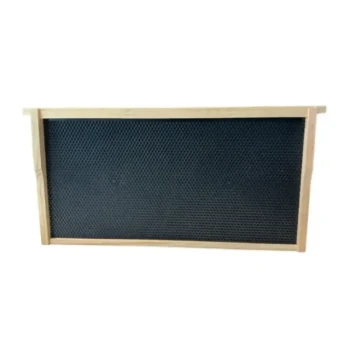
- Assembled Wooden Bee Frames with Plastic Foundation for Durability and Convenience by HONESTBEE
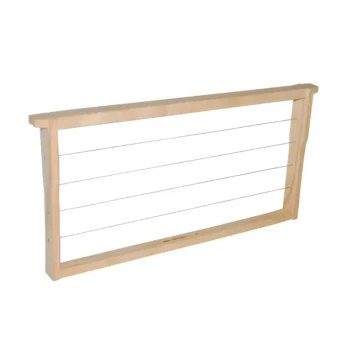
- Wooden Bee Hive Frames for Beekeeping and Wholesale
- HONESTBEE Wired and Assembled Wooden Bee Frames Foundation for a Thriving Hive
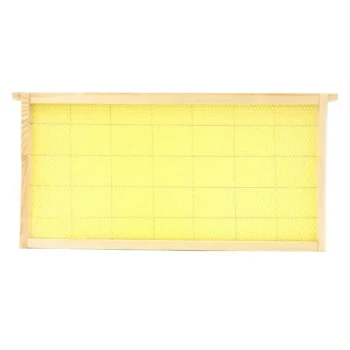
- Assembled Wooden Bee Frames with Beeswax Foundation Ready to Use by HONESTBEE
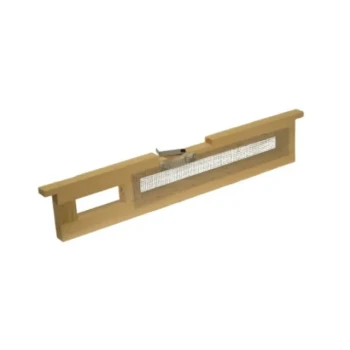
- Professional Wooden Requeening Frame for Beekeeping
People Also Ask
- What are the technical advantages of using bee frames with plastic foundation? Boost Hive Efficiency and Durability
- When should frames with new foundation be given to colonies? Master Timing for a Thriving Hive
- What types of bee frames can be cleaned and returned to service? A Guide to Safe Apiary Refurbishment
- How do you re-wax bee frames? A Simple Guide to Faster Comb Building
- Can beekeepers switch between wooden and plastic frames? Optimize Your Hive's Performance