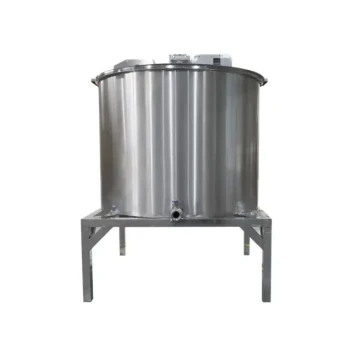
The Dyce process achieves a uniform texture by using precision equipment to manage a controlled crystallization environment. By mixing fine crystal seed honey with liquid honey and maintaining a constant 14 degrees Celsius through mechanized stirring, the equipment ensures the formation of microscopic crystal nuclei. This results in a smooth, spreadable, semi-solid texture that remains stable without the need for external additives or chemical stabilizers.
Core Takeaway: Utilizing specialized temperature-controlled equipment in the Dyce process transforms liquid honey into a premium, creamed product with superior shelf stability. This technological approach allows B2B resellers to offer a high-end, additive-free product that satisfies sophisticated consumer demands for texture and convenience.
The Engineering of Controlled Crystallization
Precision Temperature Regulation at 14°C
The most critical function of Dyce process equipment is maintaining a constant thermal environment. At 14 degrees Celsius, honey reaches its optimal rate for fine crystal growth, preventing the formation of large, "gritty" grains.
Mechanical Stirring and Seed Integration
Specialized machinery integrates fine crystal seed honey into liquid honey in exact proportions. The equipment provides continuous, controlled stirring to ensure the seed is distributed evenly throughout the entire batch.
Microscopic Crystal Nuclei Formation
By regulating both temperature and stirring frequency, the equipment guides the honey to form extremely small crystal nuclei. This microscopic structure is what creates the "silky" mouthfeel that differentiates premium creamed honey from standard crystallized products.
Strategic Benefits for the Global Supply Chain
Prevention of Stratification and Layering
High-performance emulsification equipment creates a stable crystallization structure that does not separate over time. For wholesalers, this means a longer shelf life and reduced waste caused by product sedimentation or layering during transit.
Expansion of Product Portfolios
This technology allows producers to create a comprehensive full-spectrum product portfolio. Distributors can offer diverse textures and flavors, ranging from traditional liquid honey to specialized, spreadable creamed varieties.
High-End Market Competitiveness
Utilizing the Dyce process positions products for high-end markets where consumers value spreadable convenience. The lack of chemical stabilizers or additives serves as a powerful selling point for B2B partners focused on "clean label" transparency.
Understanding the Trade-offs
Equipment and Energy Investment
The Dyce process requires a significant investment in specialized laboratory or industrial-grade equipment. Maintaining a constant 14°C environment for extended periods also increases energy consumption compared to standard liquid honey bottling.
Processing Time vs. Speed to Market
Achieving a perfectly uniform texture is not an instantaneous process; it requires patience and precision. While the final product is superior, the initial production cycle may be longer than traditional heating and filtering methods.
Sensitivity to Storage Conditions
Even after production, the fine crystal structure remains sensitive to extreme heat. To maintain the premium trading quality, distributors must ensure that the "cool chain" is respected during long-distance shipping and warehousing.
How to Leverage This for Your Distribution Business
The key to successfully trading creamed honey lies in understanding the technical expertise required to produce it consistently at scale.
- If your primary focus is market differentiation: Prioritize sourcing products made via the Dyce process to offer a "clean label" spread that outperforms competitors on texture and mouthfeel.
- If your primary focus is supply chain reliability: Partner with suppliers who utilize specialized crystallization equipment to ensure product stability and prevent the costly issue of honey stratification during long-term storage.
- If your primary focus is rapid order fulfillment: Select a trading partner with deep professional industry expertise and large-scale capacity to ensure fast delivery of these specialized honey categories.
By focusing on technologically-driven production methods, you can provide your clients with a consistent, premium product that stands the test of time.
Summary Table:
| Key Feature | Equipment Function | Product Benefit |
|---|---|---|
| Thermal Regulation | Maintains a constant 14°C environment | Prevents large crystals; ensures fine grain |
| Mechanical Stirring | Uniform integration of crystal seed honey | Creates a smooth, "silky" mouthfeel |
| Controlled Nucleation | Facilitates microscopic nuclei formation | Ensures long-term stability and no layering |
| Precision Seeding | Exact proportioning of seed to liquid honey | Guaranteed consistency across large batches |
Scale Your Honey Business with HONESTBEE Expert Solutions
Elevate your product line with HONESTBEE, the premier partner for commercial apiaries and B2B distributors. We offer a one-stop sourcing experience, providing a full spectrum of beekeeping tools and advanced machinery, including specialized honey-filling machines and crystallization hardware.
Why partner with us?
- Deep Industry Expertise: We understand the technical nuances of the Dyce process and high-end production.
- Supply Reliability: High-capacity fulfillment and ultra-fast delivery to keep your inventory moving.
- Comprehensive Portfolio: From essential consumables to honey-themed cultural merchandise and OEM/ODM support.
- Exceptional Service: Rapid response times dedicated to maximizing your profit margins.
Ready to enhance your supply chain with premium trading services?
Contact HONESTBEE Today to Discuss Your Wholesale Needs
References
- Rohini Sharma, Mangla Ram Bajiya. Honey, its Quality and Composition and their Responsible Factors. DOI: 10.23910/1.2023.3278a
This article is also based on technical information from HonestBee Knowledge Base .
Related Products
- Double Nozzle Small Honey Filling Machine Honey Sachet Packing Packaging Equipment
- Small Honey Filling Machine Sachet Packing Equipment Single Nozzle
- Manual Honey Filling Machine Bottling Machine for Honey
- 0.5T Capacity Honey Dehumidifier Dryer with Vacuum Heating and Thickening Filtering Machine
- Electric Honey Press Machine for Squeezing Honey Comb Press Equipment
People Also Ask
- How does industrial honey-filling machinery support Robinia pseudoacacia stands? Maximize Your Acacia Honey Yield
- What value do retail packaging equipment and filling technologies provide in the honey distribution process? Maximize ROI
- How does specialized honey filling equipment contribute to honey distribution? Scale Your Wholesale Efficiency Today
- How does high-precision honey filling equipment protect honey's biological activity? Safeguard Purity & Premium Value
- What is honey filling equipment used for? Optimize Your Bottling with Precision Automation