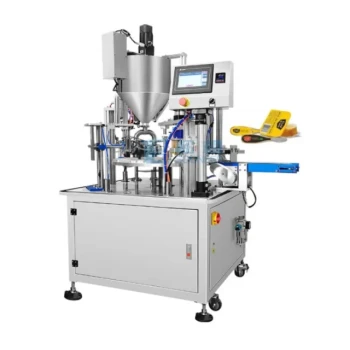
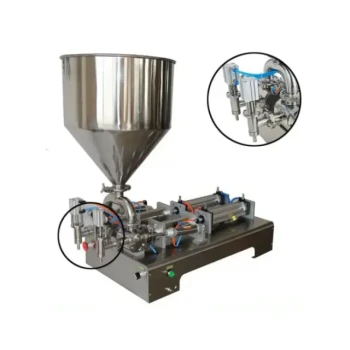
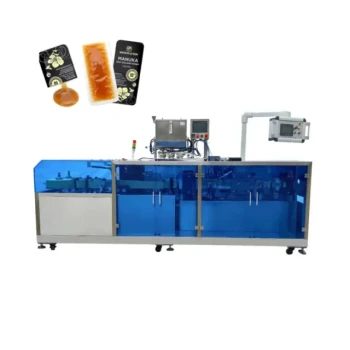
Precision filling equipment acts as the operational bridge between raw production and commercial profitability in honey packaging. It directly serves cost control by eliminating material waste through accurate volumetric or weight-based dosing, while simultaneously enabling a diversified market strategy by facilitating the production of various unit sizes for different consumer segments.
By eliminating the financial drain of product overfill and spillage, precision technology protects profit margins at the source. Crucially, it empowers apiaries to transition from selling bulk commodities to offering tiered product lines, capturing both economy buyers and the premium gift market.
Driving Cost Efficiency Through Accuracy
Eliminating "Product Giveaway"
The most immediate impact of precision filling is the reduction of material loss. High-precision machines utilize advanced metering control systems to ensure the loading volume of every unit is exact. This prevents the common issue of overfilling, where small amounts of excess product in thousands of jars result in significant cumulative financial loss.
Reducing Operational Waste
Beyond measurement, automated systems integrate anti-drip mechanisms designed specifically for high-viscosity fluids like honey. This technology prevents product from spilling onto the conveyor or the exterior of the jar between cycles. Keeping the operation clean reduces cleanup labor and preserves raw materials that would otherwise be washed away.
Ensuring Regulatory Compliance
Precision equipment guarantees that net content deviation remains within a minimal range. This ensures strict adherence to legal metrology requirements without requiring the producer to intentionally overfill jars just to be "safe" from penalties.
Strategic Market Segmentation
Unlocking Tiered Pricing Models
As highlighted in the primary reference, the ability to accurately fill diverse container sizes (e.g., 500g vs. 1kg) allows an apiary to adjust pricing strategies. You can target price-sensitive consumers with smaller, accessible jars while simultaneously offering larger or uniquely shaped containers for premium or gift-oriented segments.
Enhancing Brand Perception
Market strategy relies heavily on consumer trust and shelf appeal. Automated sealing and filling provide high repeatability and positioning accuracy, ensuring every jar looks uniform and professional. A consistent, clean appearance with airtight closures signals quality, helping local products compete with imported goods or established supermarket brands.
Safeguarding Product Integrity
Maintaining Sterile Conditions
Modern market strategies often hinge on certifications and food safety claims. Automated filling creates a closed operating environment, significantly reducing the contamination risks associated with manual handling. Features like Cleaning-in-Place (CIP) and Sterilization-in-Place (SIP) ensure the line remains sanitary between batches.
Preserving Quality Characteristics
Honey is heat-sensitive and susceptible to oxidation. Professional filling machines are engineered to handle this viscosity without degrading the product's components. By sealing the product quickly and effectively, the equipment creates a barrier against moisture and air, preserving the honey's shelf life and flavor profile.
Understanding the Trade-offs
While precision equipment offers significant advantages, it introduces specific challenges that must be managed.
Initial Capital vs. Long-Term Gain
High-precision machinery represents a substantial upfront capital expenditure. For smaller apiaries, the ROI calculation must account for volume; the cost savings from reduced waste may take time to offset the purchase price of industrial-grade sensors and automation.
Complexity of Maintenance
Moving from manual to automated systems increases technical complexity. The advanced sanitary piping and metering systems require skilled operators for maintenance and troubleshooting. If the CIP/SIP functions are not managed correctly, they can become bottlenecks rather than efficiency boosters.
Viscosity Variables
Honey viscosity changes drastically with temperature. While machines are designed for this, inconsistent ambient temperatures in the facility can still affect filling accuracy if the equipment does not have dynamic calibration capabilities.
Making the Right Choice for Your Goal
To select the right equipment, you must prioritize your business objectives.
- If your primary focus is Cost Control: Prioritize equipment with high-accuracy dosing sensors and anti-drip technology to minimize material "giveaway" and waste.
- If your primary focus is Market Expansion: Prioritize versatile machinery that allows for rapid changeovers between different container sizes and shapes to serve multiple customer segments.
Ultimately, precision filling transforms honey packaging from a manual bottleneck into a strategic asset that drives both operational margins and brand growth.
Summary Table:
| Key Feature | Impact on Cost Control | Impact on Market Strategy |
|---|---|---|
| Dosing Accuracy | Eliminates "product giveaway" and overfill waste. | Ensures consistent weight for legal compliance. |
| Anti-Drip Tech | Reduces cleanup labor and raw material loss. | Maintains clean, professional brand presentation. |
| Versatile Sizing | Optimizes packaging costs for different volumes. | Enables tiered pricing for economy and premium segments. |
| Closed Systems | Lowers risk of batch contamination and loss. | Enhances food safety claims and consumer trust. |
Scale Your Honey Production with HONESTBEE
At HONESTBEE, we empower commercial apiaries and distributors with the precision tools needed to dominate the market. From high-accuracy honey-filling machines that eliminate product waste to specialized hive-making equipment and essential industry consumables, our comprehensive wholesale offering is designed for your growth.
Ready to protect your margins and elevate your brand? Contact our team today to find the perfect equipment solution.
References
- Margit Csipkés, S. Nagy. INVESTIGATION OF THE COMMERCIAL SITUATION AMONG BEEKEEPERS IN HUNGARY FROM 2010 TO THE PRESENT. DOI: 10.47535/1991auoes30(1)001
This article is also based on technical information from HonestBee Knowledge Base .
Related Products
- Small Honey Filling Machine Sachet Packing Equipment Single Nozzle
- Double Nozzle Small Honey Filling Machine Honey Sachet Packing Packaging Equipment
- Precision Durable Efficient HONESTBEE Rotary Honey Filling Machine
- Economy Small Honey Filling Machine Honey Bottle Filler Packaging Machine
- Manual Honey Filling Machine Bottling Machine for Honey
People Also Ask
- Why is high-performance honey filling and packaging equipment essential? Boost Efficiency & Brand Value
- Why is high-precision honey filling equipment necessary? Secure the medicinal value and ROI of stingless bee honey.
- Why is precision temperature control necessary for red honey filling? Preserve Amorpha fruticosa Color and Aroma
- How does high-precision honey filling equipment protect honey's biological activity? Safeguard Purity & Premium Value
- What is honey filling equipment used for? Optimize Your Bottling with Precision Automation