Natural nesting behavior sets the commercial hive’s basic engineering parameters: Apis mellifera prefers a dark, enclosed cavity containing roughly 45 liters of usable nest volume, while generally avoiding spaces below about 10 liters or above 100 liters. Inside that cavity, it builds parallel combs separated by a consistent bee space, so commercial frame hives reproduce these conditions with standardized boxes, accurately spaced movable frames, and sufficient capacity for colonies that may reach 15,000 to 60,000 bees.
Commercial frame hives succeed because they imitate the two conditions bees control in nature: the size of the cavity and the spacing of the combs. Volume supports colony growth and honey storage; precise structure prevents wild comb, frame bonding, and management problems.
Why Nest Volume Determines Hive Capacity
The Preferred Cavity Is Approximately 45 Liters
A. mellifera naturally selects enclosed cavities close to an optimal nest volume of approximately 45 liters. This volume provides enough room for brood rearing, food storage, and seasonal population expansion without creating an excessively large cavity for the colony to defend and regulate.
A commercial box around 50 × 40 × 25 cm provides approximately 50 liters of gross internal volume before accounting for wall thickness, frames, and equipment. It is therefore broadly consistent with the biological preference identified in the reference material, although exact usable volume varies by hive model and internal dimensions.
Undersized Hives Restrict Colony Development
Spaces below approximately 10 liters are generally unsuitable as the primary nest for a strong A. mellifera colony. A hive that is too small limits brood expansion and food storage, increases congestion, and can encourage swarming or other forms of colony pressure.
For commercial operators, insufficient volume also creates a capacity problem. Even a productive colony cannot fully exploit a honey flow if the hive cannot accommodate additional comb and stored nectar.
Oversized Hives Are Also Inefficient
A cavity larger than approximately 100 liters may be difficult for a colony to regulate and defend, especially during periods of low forage or reduced population. Excessive internal space can increase the colony’s heating, cooling, and protection burden.
This is why commercial hive systems typically use modular boxes rather than one oversized enclosure. Additional boxes or supers can be added as the colony expands and removed when the colony contracts or honey is harvested.
How Bee Space Dictates Frame Structure
Parallel Comb Is the Natural Construction Pattern
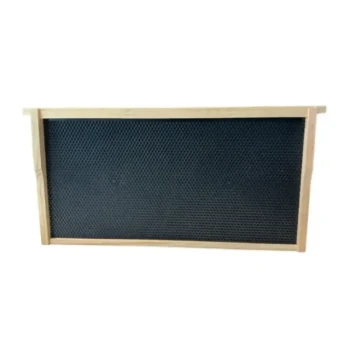
A. mellifera builds multiple combs in parallel inside a dark cavity. Commercial hives reproduce this layout by holding individual frames in fixed rows, allowing bees to build comb in predictable planes rather than across the entire interior.
This arrangement is the structural foundation of movable-frame beekeeping. Each comb can be removed, inspected, transported, and extracted without destroying the surrounding brood nest.
Uniform Spacing Prevents Unwanted Comb
Bees maintain a consistent distance between combs and between combs and hive walls, commonly described as bee space. Frame hives must preserve this spacing between adjacent frames and around the frame perimeter.
When the gaps are too wide, bees may fill them with brace comb or connecting comb. When the gaps are too narrow, bees may seal them with propolis or create a congested structure that makes frame removal difficult and increases the risk of crushing bees.
Frame Precision Supports Mechanized Handling
Commercial frame hives require consistent frame dimensions, straight alignment, and reliable spacing because extraction and uncapping machinery is designed around standardized comb positions. A small structural deviation can create problems during frame loading, inspection, uncapping, extraction, and downstream filling.
For distributors and apiary equipment suppliers, this makes manufacturing consistency as important as raw material durability. Frames, boxes, lids, floors, queen excluders, and extraction equipment must function as a coordinated system.
How Colony Size Shapes the Hive Design
The Hive Must Accommodate Seasonal Expansion
Peak A. mellifera populations may reach approximately 15,000 to 60,000 bees, depending on genetics, climate, management, and forage conditions. The hive must therefore provide enough comb surface for brood, pollen, nectar, and capped honey throughout the production cycle.
A fixed-volume system may be suitable for a small colony but restrictive during a major nectar flow. Modular commercial designs allow beekeepers to increase storage capacity without changing the core brood-nest arrangement.
Large Colonies Require Stable Comb Support
A larger colony builds and fills more comb, increasing the load placed on frames and hive components. Frames must remain rigid during lifting, transport, inspection, and centrifugal extraction.
Durable wood or other appropriately specified materials, secure joints, and accurately manufactured frame rests reduce comb damage and improve operational reliability. This is particularly important for migratory apiaries, where repeated transport exposes boxes and frames to vibration and handling stress.
Higher Production Requires Higher Processing Capacity
A. mellifera is selected widely for commercial production because its colonies can generate substantially greater honey yields than A. cerana under comparable managed conditions. The hive therefore becomes part of a larger production chain that includes uncapping equipment, high-capacity extractors, filters, storage tanks, and filling machinery.
The frame format must remain compatible across that chain. Standardized dimensions help wholesalers and resellers provide complete equipment packages rather than isolated components that may not work together.
Why Enclosure and Sealing Matter
Enclosed Walls Reproduce a Natural Nest Environment
Natural nests are located in protected, dark cavities. Commercial boxes provide a controlled enclosure that helps shield the colony from weather, light, and external disturbance while creating a defined space for comb construction.
The enclosure also gives the beekeeper control over the colony’s usable volume. Instead of allowing bees to expand randomly into a building, tree, or other cavity, the hive directs construction onto removable frames.
Propolis Seals Small Gaps
A. mellifera actively uses propolis to seal gaps and maintain the integrity of the nest environment. Hive components should therefore fit accurately while still allowing the small clearances required for bee space and practical assembly.
Poorly fitted lids, warped boxes, or inconsistent joints can create leaks, pest-entry points, and management difficulties. Regular inspection and maintenance of hive seals are part of maintaining the intended artificial cavity.
Structural Accuracy Reduces Colony Disturbance
When frames are correctly spaced and supported, beekeepers can remove them with less disruption to the brood nest and fewer crushed bees. This improves inspection efficiency and helps preserve brood comb for repeated use.
For commercial operations, reduced handling damage has a direct operational value: inspections become faster, comb lasts longer, and labor is used more efficiently across large apiaries.
Understanding the Trade-offs
A Standard Volume Is a Design Target, Not a Universal Dimension
The approximately 45-liter preference should be treated as a biological design target rather than a requirement for one exact box size. Different commercial hive formats divide brood and honey storage across multiple boxes, and the usable volume changes as boxes are added or removed.
Suppliers should therefore evaluate internal volume, frame count, frame dimensions, and compatibility together. Comparing only external box dimensions can produce misleading conclusions.
More Space Does Not Always Mean More Honey
Adding boxes can support colony growth and honey storage, but unused space may be difficult for a small colony to regulate and defend. Expansion should match colony strength, local climate, and the timing of available forage.
A hive system must provide flexibility without forcing colonies to occupy an unnecessarily large cavity. This is one reason modular equipment is more practical than a permanently oversized box.
Standardization Creates Compatibility Requirements
Standard frames and boxes simplify inspection and mechanized extraction, but they also create strict interchangeability requirements. A frame that fits one box but changes the intended bee-space relationship can lead to brace comb, propolizing, or extraction damage.
Commercial buyers should verify dimensional compatibility across all components, including frames, boxes, queen excluders, lids, floors, and processing machinery.
A. Mellifera Equipment Requires Ongoing Maintenance
A. mellifera offers strong commercial productivity but requires significant investment in hive hardware, feeding, disease management, and parasite control. Durable equipment reduces replacement costs, but it does not eliminate the need for regular inspections and repairs.
Warped boxes, damaged frame rests, loose joints, and poor sealing gradually undermine the biological conditions the hive was designed to reproduce.
Making the Right Choice for Your Goal
The most reliable purchasing decision is based on the complete operating system: nest volume, bee-space accuracy, frame strength, box compatibility, and processing capacity.
- If your primary focus is commercial honey throughput: Choose modular A. mellifera hive equipment with sufficient frame capacity and extraction machinery matched to the colony’s higher production potential.
- If your primary focus is colony management efficiency: Prioritize accurately spaced movable frames, rigid supports, and standardized components that allow fast inspection without destroying brood comb.
- If your primary focus is equipment distribution: Build a compatible product portfolio covering boxes, frames, queen excluders, sealing components, and extraction equipment rather than offering isolated hive parts.
- If your primary focus is migratory or large-scale apiary work: Select durable, dimensionally consistent hardware that tolerates transport and integrates with standardized uncapping, extraction, and filling systems.
Understanding the nest that A. mellifera builds in nature provides the clearest specification for designing, sourcing, and managing the commercial hive that replaces it.
Summary Table:
| Biological Factor | Natural Preference | Commercial Hive Implication |
|---|---|---|
| Nest Volume | ~45 liters; avoid <10L or >100L | Standard boxes ~50L; modular supers for expansion |
| Comb Spacing | Consistent bee space | Accurately spaced frames prevent brace comb |
| Colony Size | Peaks of 15,000–60,000 bees | Ample comb surface; modular capacity |
| Enclosure | Dark, sealed cavity | Enclosed boxes; propolis sealing of gaps |
Unlock the full potential of your apiary with HONESTBEE's precision-engineered hive systems. From volume-optimized boxes to bee-space accurate frames, our one-stop sourcing solution supports distributors and beekeepers with certified quality, rapid delivery, and dedicated service. Contact us today to explore our comprehensive range and boost your operational efficiency — Get in touch!
Related Products
- Wooden Bee Hive Frames for Beekeeping and Wholesale
- Plastic Bee Frame Beekeeping Hive Frames for Wholesale
- Professional Multi-Function Stainless Steel Hive Tool
- Professional Galvanized Steel Frame Rest for Beehives
- Professional Observation Hive: The Ultimate Portable Solution for Beekeeping Education, Exhibitions, and Colony Displays
People Also Ask
- How do wooden and plastic hive frames compare in terms of durability? Wood vs. Plastic Longevity & Repairability
- How does balancing the number of frames impact hive productivity? Optimize Your Apiary's Biological Output
- What are the main considerations when choosing between wooden and plastic bee hive frames? Optimize Your Apiary's Efficiency
- How should beehive frames be maintained to prolong their lifespan? 5 Pro Tips for Durable Beekeeping Equipment
- Can I reuse old beehive frames? Save Money and Boost Hive Productivity