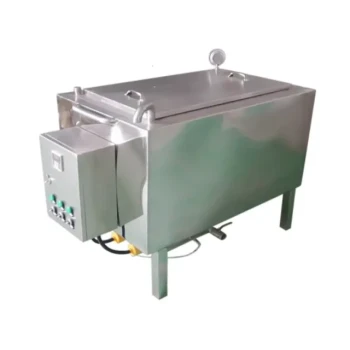
A high-temperature muffle furnace functions as a precision oxidation instrument in the analysis of bee pollen. Its primary role is to subject the pollen sample to a controlled temperature of approximately 550°C, which completely incinerates all organic components (such as proteins, fats, and sugars). The result of this process is a residual inorganic ash, which allows analysts to quantify mineral content and detect physical contaminants.
Core Takeaway The muffle furnace isolates the inorganic portion of bee pollen by burning away organic matter. The resulting ash weight is a dual-purpose metric: it indicates the nutritional mineral density of the sample while simultaneously serving as a red flag for external contamination like silica, sand, or heavy metals.
The Mechanism of Action
Complete Thermal Oxidation
The muffle furnace creates a stable, high-heat environment that forces the complete oxidation of the bee pollen.
At temperatures reaching 550°C, carbon-based structures within the pollen break down and volatilize.
This eliminates the complex organic matrix that makes up the bulk of the pollen grain, leaving only non-combustible material behind.
Isolation of Inorganic Residue
Once the heating cycle is complete, the only substance remaining in the crucible is the inorganic residue, commonly referred to as ash.
This residue represents the total mineral content of the sample.
By comparing the weight of this ash to the initial sample weight, analysts calculate a precise percentage of mineral content.
Why Ash Content Matters for Bee Pollen
Detecting Contaminants and Impurities
The most critical application of this process is quality control regarding external pollutants.
Because bee pollen is collected outdoors, it is susceptible to environmental contamination like airborne dust, soil, sand, and heavy metals.
If the ash content is abnormally high, it typically suggests the presence of these impurities rather than an exceptionally high nutritional mineral profile.
Assessing Nutritional Mineral Levels
Beyond contamination, the ash content provides a baseline measurement of the pollen's nutritional integrity.
It quantifies the essential dietary minerals present in the pollen, which is vital for evaluating its quality as a supplement for both human consumption and bee colonies.
This data helps standardise product quality and screen mineral supplements intended for agricultural use.
Understanding the Trade-offs
Temperature Precision vs. Mineral Loss
While high heat is necessary for oxidation, temperature control is the critical trade-off in this method.
If the furnace temperature exceeds the recommended range (e.g., significantly above 550°C-600°C), certain volatile minerals may vaporize and be lost, leading to an artificially low ash reading.
Conversely, if the temperature is too unstable or low, organic "black ash" (carbon) remains, leading to an artificially high reading and inaccurate contamination assessments.
Making the Right Choice for Your Goal
To utilize the data from a muffle furnace effectively, align your interpretation with your specific objective:
- If your primary focus is Quality Assurance: Look for lower ash percentages relative to the standard; high spikes usually indicate poor collection hygiene (sand/dirt) or heavy metal pollution.
- If your primary focus is Nutritional Analysis: Use the ash residue for further chemical assays to determine the specific profile of elements (calcium, magnesium, potassium) present in the total mineral content.
The muffle furnace is the definitive tool for stripping away the organic noise to reveal the inorganic truth of a bee pollen sample.
Summary Table:
| Process Phase | Temperature | Outcome | Purpose |
|---|---|---|---|
| Thermal Oxidation | ~550°C | Complete incineration of organic matter | Removes proteins, fats, and sugars |
| Ash Isolation | Controlled Cool-down | Inorganic residue (ash) collection | Quantifies total mineral content |
| Quality Assessment | Variable | Weight comparison | Detects sand, soil, and heavy metals |
| Nutritional Assay | Post-processing | Mineral profiling | Identifies calcium, magnesium, and potassium levels |
Elevate Your Hive Product Quality with HONESTBEE
For commercial apiaries and global distributors, maintaining the highest standards of purity is non-negotiable. HONESTBEE provides the professional-grade beekeeping tools and laboratory machinery needed to ensure your bee pollen meets rigorous industry benchmarks. From high-precision equipment for quality control to honey-filling machines and specialized hardware, we offer a comprehensive wholesale portfolio designed to scale your operations.
Ready to optimize your production and ensure product integrity? Contact our team of experts today to discover how our end-to-end equipment solutions can grow your beekeeping business.
References
- Bianca Rodrigues de S, Ligia Bicudo de. Physicochemical parameters and content of B-complex vitamins: an exploratory study of bee pollen from southern Brazilian states. DOI: 10.4067/s0717-75182018000400232
This article is also based on technical information from HonestBee Knowledge Base .
Related Products
- Solar Beeswax Melter Easy Solar Wax Melter for Beeswax
- Honey Tank Heater Drum Heating Blanket for Honey Barrel
- Professional Thermostatic Conical Honey Melter
- HONESTBEE AC Powered Wire Embedder with Alligator Clips
- Steam Beeswax Melter Wax Warmer for Wax Processing
People Also Ask
- How does a solar melter work to process beeswax? The Eco-Friendly Way to Pure Wax
- What is a solar wax melter and how does it work? Harness the Sun for Pure Beeswax
- What are the benefits of using a solar wax melter? Harness the Sun for Pure, Cost-Effective Beeswax
- What is the purpose of a solar wax melter in beekeeping? Sustainable Wax Processing for Modern Apiaries
- How does a solar-powered frame wax melter work? Harness the Sun for Sustainable Beekeeping