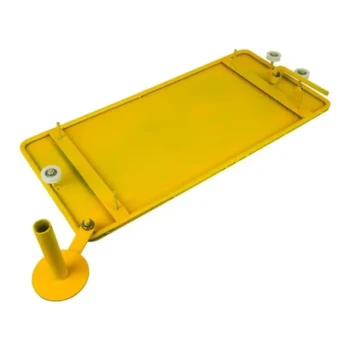
A standard grid frame functions as a precise quantitative instrument for measuring the reproductive strength of a honeybee colony. By overlaying a grid of known dimensions—typically 5x5 cm squares—onto a honeycomb frame, beekeepers can visually count the sections occupied by capped brood or larvae to generate hard data regarding the total brood area.
While visual inspections provide a general sense of hive health, the grid frame eliminates subjectivity. It converts biological volume into standardized metrics, allowing for the precise calculation of breeding efficiency and the objective comparison of reproductive performance across different colonies.
The Mechanics of Measurement
The Physical Setup
The evaluation begins by placing a standardized measurement frame directly over the surface of the honeycomb. This tool is divided into specific grid squares, usually measuring 25 square centimeters each (5x5 cm).
Visual Segmentation
The grid acts as a physical overlay that segments the complex, organic pattern of the comb into manageable units. This allows the observer to focus exclusively on reproductive areas, distinguishing them from honey or pollen stores.
Data Collection
Technicians manually count the number of full and partial grids occupied by capped brood or larvae. This process transforms a qualitative observation—how "full" a frame looks—into a specific numerical count of occupied grids.
From Observation to Biological Data
Calculating Surface Area
By summing the number of occupied grids, the observer obtains a precise total surface area dedicated to reproduction. For example, if ten grids are filled, the colony has 250 square centimeters of active brood on that face.
Deriving Population Metrics
To understand the actual reproductive output, a conversion factor is applied to the measured surface area. Scientific standards often estimate approximately four worker cells per square centimeter.
Final Population Estimation
By multiplying the total surface area by the cell density factor, the physical measurement is translated into a biological headcount. This provides an accurate estimate of the potential worker bee population currently in development.
Strategic Applications
Objective Colony Comparison
Standardization transforms subjective terms like "strong" or "weak" into comparable numerical values. This allows for rigorous benchmarking of breeding efficiency between different colonies or genetic lines to determine which queens are most productive.
Assessing Treatment Safety
This method is critical for determining if specific hive interventions have negative side effects. For instance, by quantifying brood area before and after applying treatments like lactic acid, beekeepers can objectively assess if the chemical has reduced the colony's reproductive rate.
Understanding the Trade-offs
Time and Disruption
While accurate, using a grid frame requires keeping the hive open and manipulating frames for longer periods than a standard inspection. This extended exposure can temporarily stress the colony or fluctuate internal temperatures.
Snapshot Limitations
The grid frame provides a static snapshot of measuring capacity (area covered), but not necessarily viability. It quantifies the number of capped cells but does not inherently account for disease presence inside the cells or the hatch rate of the brood.
Making the Right Choice for Your Goal
To effectively utilize a grid frame, ensure your measurement objectives align with the precision this tool offers.
- If your primary focus is genetic selection: Use grid counts to isolate and breed from queens that consistently produce the highest surface area of capped brood.
- If your primary focus is environmental impact: Use the grid to monitor changes in brood area over time to detect nutritional deficits or adverse reactions to chemical treatments.
By converting organic growth into standardized data, the grid frame empowers you to manage colonies based on facts rather than intuition.
Summary Table:
| Evaluation Metric | Description/Process | Purpose |
|---|---|---|
| Grid Dimensions | Typically 5x5 cm squares (25 cm²) | Provides a standardized unit for surface area measurement. |
| Data Collection | Counting full/partial grids of capped brood | Converts visual observation into hard numerical data. |
| Population Calculation | Total Area (cm²) × ~4 cells/cm² | Estimates the upcoming worker bee population headcount. |
| Breeding Benchmarking | Objective comparison of brood area | Identifies high-performing queens for genetic selection. |
| Intervention Testing | Pre- and post-treatment brood counts | Monitors the safety and impact of chemical hive treatments. |
Maximize Your Colony Productivity with HONESTBEE
Precise measurement is the first step toward superior apiary management. At HONESTBEE, we empower commercial apiaries and distributors with the high-quality tools necessary for scientific beekeeping.
Whether you need specialized standard grid frames, advanced hive-making machinery, or high-capacity honey-filling equipment, our comprehensive wholesale portfolio is designed to scale your operations. We supply everything from essential consumables to honey-themed cultural merchandise to help your business thrive in the global market.
Ready to upgrade your equipment? Contact HONESTBEE today to discuss our wholesale solutions and discover how our expertise can drive your reproductive success.
References
- V. M. Nedashkivskyi, Halyna Hutsol. The effectiveness of using protein mixed feed in feeding honey bees. DOI: 10.32718/ujvas3-1.06
This article is also based on technical information from HonestBee Knowledge Base .
Related Products
- Wooden Bee Hive Frames for Beekeeping and Wholesale
- HONESTBEE Durable Frame Wiring Board with Integrated Tensioner
- Assembled Wooden Bee Frames with Beeswax Foundation Ready to Use by HONESTBEE
- Precision Stainless Steel Frame Cleaner for Hive Grooves and Corners
- Assembled Wooden Bee Frames with Plastic Foundation for Durability and Convenience by HONESTBEE
People Also Ask
- How do wooden and plastic hive frames compare in terms of durability? Wood vs. Plastic Longevity & Repairability
- How does balancing the number of frames impact hive productivity? Optimize Your Apiary's Biological Output
- What are the main considerations when choosing between wooden and plastic bee hive frames? Optimize Your Apiary's Efficiency
- How should beehive frames be maintained to prolong their lifespan? 5 Pro Tips for Durable Beekeeping Equipment
- How are plastic frames different from traditional wooden frames? Choose the Right Frame for Your Apiary