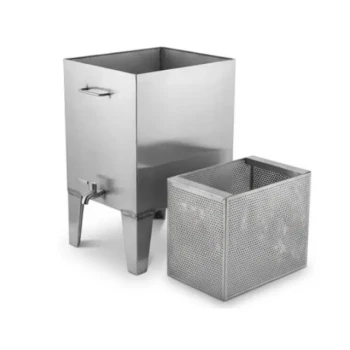
Effective post-extraction processing relies on immediate filtration and separation. You must drain the liquid honey from the extractor’s valve into collection buckets, passing it through a strainer to catch wax debris and bee parts. Simultaneously, you should squeeze the wax cappings through a strainer or clean calico cloth to recover the significant amount of honey trapped within them before processing the wax further.
Core Takeaway To maximize your harvest and ensure product quality, you must treat honey and cappings as two distinct workflows immediately after extraction. Prioritize mechanical straining for the liquid honey and physical compression for the cappings to reclaim every usable drop before cleaning the beeswax.
Processing the Liquid Honey
Initial Straining
As the honey accumulates at the bottom of your extractor, open the gate or valve to let it flow into a receiving bucket.
Do not pour it directly; it must pass through a strainer as it exits.
This initial step is critical for removing larger contaminants, such as pieces of wax comb or bee parts that inevitably mix in during extraction.
Fine Filtering
If your goal is a highly polished product, a standard strainer may not be enough.
For finer filtering, pass the honey through a piece of very clean calico cloth.
This tighter weave removes smaller particulate matter, resulting in a clearer final product in your jars.
Processing the Wax Cappings
Recovering Trapped Honey
Wax cappings are not waste; they are a byproduct rich in residual honey.
Do not wash them immediately. First, squeeze the cappings through a strainer or a piece of calico.
This manual compression extracts the "wet" honey, leaving you with "dry" wax and significantly increasing your total honey yield.
Cleaning the Residue
Once the usable honey is squeezed out, the wax must be cleaned of stickiness before storage.
You can wash, dry, and store the wax immediately, or you can utilize the bees to assist in the process.
By placing the extracted cappings in an area accessible to honeybees, they will consume the remaining honey residue. This biological cleaning simplifies subsequent rinsing and rendering by removing the bulk of the sticky material.
Final Wax Preparation
After the honey is removed (either by squeezing, washing, or bee cleaning), the wax is ready to be rendered.
This involves melting and clarifying the wax blocks.
The resulting high-quality beeswax can be used to create candles, soaps, lip balms, or even new foundation sheets for your beehive frames.
Understanding the Trade-offs
Mechanical vs. Biological Cleaning
When processing cappings, you must choose between immediate washing or allowing bees to clean the wax.
Allowing bees to clean the cappings reduces the manual effort required for rinsing and results in cleaner raw wax.
However, immediate washing and drying (as outlined in the primary method) is faster if you wish to store the wax immediately without setting up a feeding station for the bees.
Filtration Levels
Using calico provides a very fine filter, ensuring clarity.
However, extremely fine filtration can be slow, especially if the honey is cool or viscous.
Simple straining is faster and adequate for general consumption, but it may leave fine particles that some users prefer to remove for aesthetic reasons.
Making the Right Choice for Your Goal
Select your processing method based on your priorities for the final product.
- If your primary focus is Maximum Honey Yield: Ensure you squeeze all cappings through calico or a strainer to recover the honey saturated in the wax before washing it.
- If your primary focus is High-Quality Beeswax: Allow the bees to clean the honey residue from the cappings first, as this significantly reduces stickiness and simplifies the rendering process for candles or cosmetics.
Treat the separation of honey and wax not just as a cleanup task, but as a final harvest step to ensure zero waste.
Summary Table:
| Process Step | Primary Action | Key Benefit |
|---|---|---|
| Liquid Honey | Dual-stage straining (Strainer + Calico) | Removes debris for a polished, clear finish |
| Wax Cappings | Mechanical compression/squeezing | Recovers trapped honey to increase total yield |
| Wax Cleaning | Biological (Bees) or Manual washing | Reduces stickiness for easier rendering |
| Final Rendering | Melting and clarifying | Produces clean wax for candles, soaps, and tools |
Elevate Your Apiary Operations with HONESTBEE
Maximize your honey production and wax quality with professional-grade equipment from HONESTBEE. As a premier partner for commercial apiaries and distributors, we provide a complete spectrum of high-performance beekeeping tools and machinery.
Whether you need specialized honey-filling machines for your final product, hive-making machinery to expand your colony, or high-durability consumables, we deliver the industrial-strength solutions you need to scale.
Ready to optimize your harvest efficiency? Contact our wholesale experts today to discuss how our comprehensive equipment portfolio can support your business growth.
Related Products
- Electric Beeswax Flat Sheet Machine with Operating Tray for Wax Processing
- Manual Beeswax Flat Sheet Machine for Beeswax Processing
- Honey Wax Separating Wax Press with Metal Screw Wax Separator Machine
- Fully Automatic Beeswax Embossing Machine Foundation Mill
- Manual Beeswax Comb Foundation Machine Wax Foundation Mill Embossing Machine
People Also Ask
- What is the primary function of the double-roller extrusion system? Master Precision Beeswax Foundation Production
- How do cultural merchandise processing machines contribute to the economic value chain? Boosting Apiary Profitability
- How do specialized beeswax processing machines maximize the value of beekeeping by-products? Boost Your Apiary's ROI
- How does the machine flatten the beeswax? A Guide to Roller and Press Methods
- What are the key functions of a beeswax machine? Maximize Apiary Efficiency & Revenue with Professional Equipment