The yield gap is commercially significant: high royal jelly-producing colonies average 145.75 g over three collection cycles, compared with 66.75 g for low-producing colonies. That is a difference of 79 g, meaning the high-producing group delivers approximately 2.18 times as much royal jelly, or about 118% more. For commercial apiaries, this gap can materially affect output, labor efficiency, breeding value, and profitability.
Selective breeding can more than double royal jelly production, but the advantage is only useful when it is measured consistently. Accurate scales and standardized harvesting equipment convert colony performance into reliable data for stock selection, production planning, and quality control.
What the Yield Difference Means in Practice
High-producing colonies deliver substantially more
Across three collection cycles, high-producing colonies yielded an average of 145.75 g, with results ranging from 122 g to 177 g. Low-producing colonies averaged only 66.75 g, ranging from 33 g to 93 g.
The difference is not marginal. Even the lowest result from the high-producing group, 122 g, exceeds the highest reported result from the low-producing group, 93 g.
The commercial impact compounds over time
A difference of 79 g per measured period becomes more consequential when multiplied across many colonies and repeated harvest cycles. At apiary scale, the same genetic performance gap can affect inventory availability, customer contracts, processing utilization, and delivery planning.
This is especially important for distributors, wholesalers, and B2B resellers that require dependable supply rather than occasional peak production.
Yield is also a breeding and selection advantage
High-producing lines are associated with physiological adaptations in nurse bees, including larger and more numerous hypopharyngeal gland acini, longer gland structures, greater secretory activity, and higher mitochondrial density in gland cells.
These characteristics help explain why selective breeding can produce a stable performance advantage rather than a one-time production anomaly.
Why Precise Measurement Matters
Royal jelly production is difficult to compare without standardization
Colony yield can be influenced by genetics, colony strength, nutrition, weather, timing, grafting quality, and harvesting technique. If these factors are not measured and controlled consistently, producers may mistake environmental effects for genetic superiority.
Standardized collection cycles and harvesting procedures make comparisons between colonies more credible.
Small measurement errors can distort decisions
Royal jelly is often measured in grams or milligrams, depending on whether the producer is evaluating individual cups, batches, or colonies. A scale with insufficient resolution can hide meaningful differences or exaggerate apparent performance.
A high-precision electronic balance, including equipment capable of milligram-level accuracy or four decimal places, provides the resolution needed for reliable comparisons.
Accurate data supports better genetic selection
Precise weighing creates dependable phenotypic data: a measurable record of what each colony actually produced under defined conditions. Breeders can then distinguish inherited production potential from temporary effects caused by management or the environment.
This reduces the risk of propagating colonies that appear productive only because of unusually favorable conditions.
Measurement validates nutrition and management
Precision weighing also helps producers evaluate nutritional supplements, feed conversion, grafting performance, and production efficiency. Without accurate starting and ending measurements, claims about improved productivity remain difficult to verify.
For commercial operations, this data supports decisions about which inputs genuinely improve output and which merely increase cost.
Equipment That Supports Reliable Royal Jelly Production
Precision scales provide the measurement foundation
The weighing system should match the production scale and the size of the quantities being measured. It must offer adequate resolution, repeatable readings, a stable platform, and a practical workflow for weighing cups, batches, or colony-level output.
Consistent calibration and standardized weighing procedures are as important as the scale’s stated specification.
Harvesting equipment improves consistency
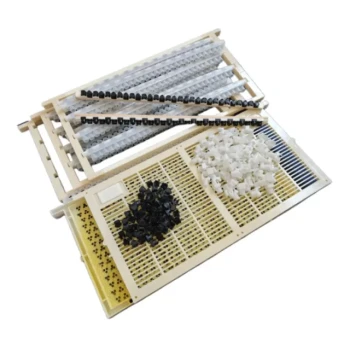
Dedicated royal jelly equipment can include queen-rearing system components, precision grafting tools, cell bar frames, and hygienic harvesting devices. These tools help reduce variation during larval transfer, cell preparation, and collection.
More consistent handling produces more reliable yield data and helps protect the quality of the harvested product.
Efficient tools matter at commercial frequency
High-frequency harvesting increases the value of equipment that reduces handling time without compromising hygiene or measurement accuracy. Automated or semi-automated extraction systems can support larger operations when they are properly matched to throughput requirements.
The objective is not simply to collect more royal jelly, but to collect it using a repeatable process that can be measured and audited.
Hardware quality supports colony performance
Precision-manufactured hive components can help maintain stable temperature, humidity, and bee space by reducing gaps and fit-related inconsistencies. A more stable internal environment may reduce the energy bees spend sealing gaps or regulating the hive.
This is a supporting factor rather than a substitute for genetic selection, nutrition, and sound colony management.
Understanding the Trade-offs
High yield does not automatically mean higher profit
A high-producing strain may require specialized grafting, harvesting, nutrition, labor, and quality-control processes. Producers should compare net output and operating cost, not yield alone.
The most valuable strain is the one that delivers stable, saleable production under the apiary’s actual management conditions.
Precision equipment requires disciplined use
A high-resolution scale cannot correct inconsistent sampling, uncalibrated equipment, contaminated containers, or irregular collection intervals. Measurement protocols should define tare procedures, sample identification, collection timing, and data recording.
Without process discipline, expensive equipment can create an illusion of precision rather than reliable information.
Genetic performance must be evaluated across conditions
The reported averages demonstrate a substantial difference between high- and low-producing groups, but production can still vary between colonies and collection cycles. Breeding decisions should therefore use repeated measurements and comparable management conditions.
This helps prevent selection based on isolated results.
Throughput and precision must be balanced
A laboratory-grade balance may provide excellent resolution but slow down a busy production line. Conversely, high-throughput equipment may be unsuitable if it lacks the precision needed for breeding evaluation.
Commercial producers should select equipment based on the required balance of accuracy, capacity, speed, hygiene, and serviceability.
Making the Right Choice for Your Goal
The appropriate equipment strategy depends on whether the priority is breeding improvement, production volume, or supply reliability.
- If your primary focus is genetic selection: Use calibrated high-precision balances and standardized collection cycles to identify colonies with consistently superior royal jelly output.
- If your primary focus is commercial production: Combine precise weighing with dedicated grafting and harvesting equipment to improve throughput while preserving repeatability and product quality.
- If your primary focus is nutrition and management evaluation: Record milligram- or gram-level output alongside feed inputs, colony conditions, and collection dates to validate productivity improvements.
- If your primary focus is dependable B2B supply: Build a standardized equipment and replenishment system that supports consistent output, rapid fulfillment, and reliable batch documentation.
Precise measurement turns a twofold production advantage into a dependable commercial and breeding decision.
Summary Table:
| Metric | High-Producing Colonies | Low-Producing Colonies |
|---|---|---|
| Average Yield (3 cycles) | 145.75 g | 66.75 g |
| Yield Range | 122 g – 177 g | 33 g – 93 g |
| Difference | +79 g | Baseline |
| Relative Yield | 2.18x (118% more) | 1x |
Maximize your royal jelly production with precision and reliability. At HONESTBEE, we cater to commercial apiaries and distributors, offering a comprehensive wholesale portfolio from precision scales and grafting tools to full hive-making and honey-filling machinery. Our one-stop sourcing capabilities, rapid response, and ultra-fast delivery ensure your supply chain stays efficient. Contact us today to discuss your needs and discover how we can boost your profitability. Get in touch with our experts now!
Related Products
- Plastic Chinese Queen Grafting Tool for Bee Queen Rearing
- No Grafting Queen Rearing Kit: System for Royal Jelly Production and Queen Rearing
- Digital Honey Refractometer for Precision Measurement of Optimal Honey Quality
- Precision Honey Refractometer Instrument for Quality Assessment
- Modern Stainless Steel Honey Dipper Stirrer
People Also Ask
- Why is it necessary for migratory beekeeping enterprises to utilize professional queen bee rearing tools? Boost Resilience
- What specialized tools and frame configurations are needed for larval grafting during queen rearing, and how are queen cells properly spaced? Master the essentials for efficient queen production
- What are the benefits of using a queen grafting tool for queen rearing? Master Precision for Superior Bee Genetics
- What is grafting in queen rearing? Take Control of Your Apiary's Genetics
- What are the steps involved in using a queen grafting tool? A Guide to Successful Queen Rearing