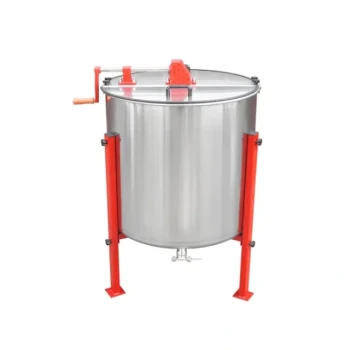
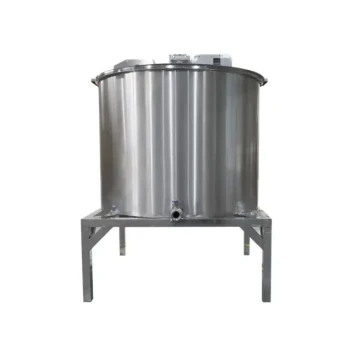
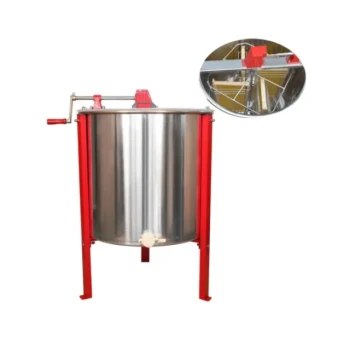
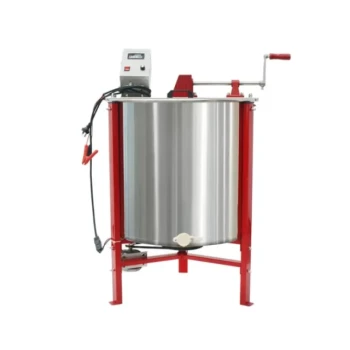
The primary advantage of industrial-grade stainless steel honey extractors lies in their ability to decouple high-volume production from quality degradation. By utilizing centrifugal force within a sanitary stainless steel environment, these machines significantly improve extraction efficiency while meeting strict food safety standards. Unlike traditional pressing or natural dripping, this method isolates the honey from the comb rapidly, maximizing the preservation of the honey's original color and critical physicochemical indicators.
The Core Insight While traditional methods prioritize simplicity, industrial centrifugal extractors prioritize the biological and chemical integrity of the product. They allow for the indefinite reuse of honeycomb infrastructure while protecting the honey from the oxidation and contamination risks inherent in slower, manual extraction processes.
Elevating Product Quality
The shift to industrial stainless steel equipment is fundamentally about preserving the honey's natural state during the transition from hive to bottle.
Minimizing Oxidative Stress
Traditional dripping exposes honey to the air for prolonged periods, leading to oxidation. Centrifugal extractors operate quickly, often in closed chambers, reducing the duration of air contact. This preservation of the chemical state protects the honey's original color and flavor profile.
Preserving Physicochemical Indicators
Honey contains sensitive biological components, including enzymes and antioxidants. Mechanical pressing can generate heat or stress that degrades these elements. Centrifugal force separates the liquid efficiently without compromising these bioactive properties, ensuring the final product meets the standards for premium natural honey.
Ensuring Strict Hygiene
Stainless steel is the gold standard for food safety. It is non-porous, resistant to corrosion, and easy to sterilize. This ensures that the extraction process introduces no contaminants and complies with rigorous industrial hygiene standards.
Optimizing the Biological Cycle
Beyond the quality of the honey itself, industrial extractors fundamentally change the economics of the beehive by preserving the wax foundation.
Non-Destructive Extraction
Manual pressing destroys the wax comb to release the honey. In contrast, centrifugal extractors spin the honey out while leaving the structural integrity of the comb intact. This allows the physical "furniture" of the hive to be reused immediately.
Redirection of Colony Energy
Bees consume a significant amount of honey and energy to secrete wax and build combs. When intact combs are returned to the hive, the colony does not need to rebuild. This allows bees to focus entirely on nectar collection and storage.
Shortened Production Cycles
Because the bees are spared the labor of reconstruction, the time between harvests is significantly reduced. This optimization leads to a higher overall yield per season compared to destructive extraction methods.
Understanding the Trade-offs
While industrial extractors offer superior efficiency and quality control, they introduce complexities that must be managed.
Higher Initial Capital Expenditure
Industrial-grade stainless steel machinery represents a significant financial investment compared to simple gravity-based setups. The return on investment relies on sufficient production volume to justify the cost.
Mechanical Maintenance Requirements
Unlike static filters or presses, centrifugal extractors have moving parts, motors, and speed controls. They require a regular maintenance schedule to ensure bearings and motors function correctly and to prevent mechanical failure during peak harvest.
Complexity of Operation
Operators must understand how to balance loads and control rotation speeds. Improper use, such as spinning too fast too early, can damage the very combs you are trying to preserve, negating the biological advantage.
Making the Right Choice for Your Goal
- If your primary focus is Commercial Scalability: Prioritize centrifugal extractors to maximize yield by reusing combs and reducing the bees' rebuilding time.
- If your primary focus is Premium Quality Certification: Rely on stainless steel construction to meet hygiene standards and minimize oxidation to preserve enzyme activity.
Ultimately, industrial stainless steel extraction transforms beekeeping from a resource-intensive harvest into a sustainable cycle of rapid reuse and high-purity production.
Summary Table:
| Feature | Traditional Methods (Pressing/Dripping) | Industrial Stainless Steel Extractors |
|---|---|---|
| Efficiency | Slow, manual process | High-speed centrifugal extraction |
| Honey Quality | High risk of oxidation & contamination | Low oxidation; preserves enzymes/flavor |
| Comb Integrity | Comb is destroyed during process | Comb remains intact and reusable |
| Hygiene | Difficult to sterilize materials | Non-porous, food-grade stainless steel |
| Production Cycle | Long (bees must rebuild comb) | Short (bees focus only on nectar) |
| Scalability | Limited to small-scale use | Designed for commercial apiaries |
Scale Your Honey Production with HONESTBEE
Are you looking to maximize your apiary's efficiency and product purity? HONESTBEE specializes in empowering commercial beekeepers and distributors with high-performance, industrial-grade honey extractors and automated machinery.
From durable hive-making equipment and precision honey-filling machines to a comprehensive range of stainless steel tools and consumables, we provide the end-to-end solutions your business needs to thrive.
Ready to upgrade your operation? Contact our expert team today to explore our wholesale offerings and discover how our equipment can transform your harvest into a high-purity, sustainable production cycle.
References
- Simone Cristina Camargo, Daniela Jessica Pereira. Implementation of a geographic information system (GIS) for the planning of beekeeping in the west region of Paraná. DOI: 10.1590/0001-3765201420130278
This article is also based on technical information from HonestBee Knowledge Base .
Related Products
- Commercial 48-Frame Stainless Steel Honey Extractor
- Stainless Steel Beekeeping Honey Extractor Lid
- 10L Stainless Steel Honey Wax Press Extractor for Wax Cappings
- Stainless Steel Manual 8 Frame Radial Honey Extractor Machine for Beehives
- Stainless Steel 3 Frame Manual Honey Extractor Spinner for Bee Honey Extraction
People Also Ask
- Who are commercial honey extractors designed for? Scaling Your Industrial Beekeeping Success
- What is a commercial honey extractor? The Essential High-Volume Solution for Large Apiaries
- What are commercial honey extractors used for? Boost Your Apiary's Efficiency & Profitability
- How is honey extracted commercially? Maximize Your Apiary's Efficiency and Honey Yield
- What is a stainless steel honey extractor? Boost Your Apiary's Efficiency with Professional Extraction