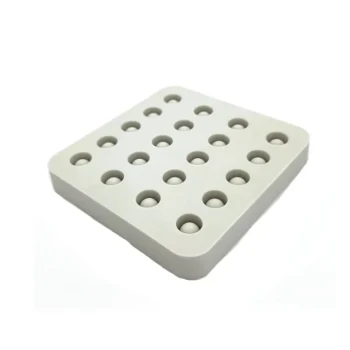
The primary design requirement for acrylic plates used in in vitro stingless bee queen rearing centers on precise well dimensions. Specifically, the wells must be machined to a diameter of 5.8 mm and a depth of 7.5 mm. These specific measurements are critical to successfully replicating the environment necessary for artificial rearing.
The effectiveness of an acrylic carrier plate relies on strict biomimicry. The design must physically replicate the internal volume of a natural queen cell to accommodate both the necessary larval food provision and the uninhibited physical growth of the developing bee.
Replicating Natural Architecture
Precise Dimensional Specifications
To create a functional carrier, the acrylic plate must feature wells that match the geometry of a natural queen cell.
Research establishes the optimal parameters at a diameter of 5.8 mm and a depth of 7.5 mm. Adhering to these specific metrics is the foundation of successful in vitro rearing.
Ensuring Sufficient Volume
The primary function of these dimensions is to establish a specific internal volume.
This volume serves a dual purpose: it acts as a reservoir for the liquid larval diet and a chamber for the organism. The design must ensure the well is large enough to hold the required quantity of food without overflowing or compromising the space available for the larva.
Biological Implications of Design
Facilitating Physical Growth
The growth trajectory of a stingless bee queen larva is significant relative to its initial size.
The acrylic well must provide adequate physical space to accommodate this expansion. If the dimensions are correct, the larva can reach its full physiological size without contacting the well walls prematurely.
Preventing Developmental Issues
The correlation between available space and biological health is direct.
Proper design prevents developmental issues caused by spatial restrictions. By ensuring the carrier plate mimics the natural cell's volume, you mitigate the risk of physical deformities or stunted growth associated with confined environments.
Understanding the Trade-offs
The Consequence of Deviation
While acrylic offers durability and visibility, it is a rigid material that does not expand like natural wax might.
Therefore, there is no margin for error in the machining process. Deviating from the 5.8 mm by 7.5 mm standard—even slightly—can result in a well that either starves the larva (insufficient food volume) or physically crushes it during pupation (insufficient growth space).
Balancing Depth and Diameter
Altering the ratio between depth and diameter to achieve the same volume is generally not recommended.
The larva requires a specific shape to orient itself correctly for feeding and spinning its cocoon. Design changes that alter the well's geometry, even if total volume is preserved, may disrupt these natural behaviors.
Ensuring Rearing Success
When manufacturing or selecting acrylic plates for stingless bee queen rearing, strict adherence to the reference specifications is required.
- If your primary focus is Standardization: Adhere strictly to the 5.8 mm diameter and 7.5 mm depth to ensure consistency across all rearing trials.
- If your primary focus is Biological Health: Verify that the total volume allows for the complete larval food provision without imposing physical constraints on the larva.
Precise replication of natural geometry is the single most critical factor in designing effective rearing plates.
Summary Table:
| Feature | Specification | Importance for Rearing |
|---|---|---|
| Well Diameter | 5.8 mm | Ensures proper larval orientation and feeding space |
| Well Depth | 7.5 mm | Provides volume for larval food and vertical growth |
| Material | Acrylic | Offers durability and visibility for monitoring |
| Design Principle | Biomimicry | Replicates natural queen cell volume and geometry |
| Critical Factor | Precision Machining | Prevents developmental deformities from spatial limits |
Elevate Your Queen Rearing Success with HONESTBEE
At HONESTBEE, we understand that precision is the difference between a thriving colony and a failed trial. As a leading provider for commercial apiaries and distributors, we offer a comprehensive wholesale range of professional-grade beekeeping tools and machinery. Whether you need specialized hive-making machines or precision-engineered rearing equipment, our portfolio is designed to meet the rigorous standards of modern apiculture.
Our value to you:
- Expert Manufacturing: From hardware to consumables, we supply everything needed for large-scale operations.
- Industry Expertise: We cater to the specific biological needs of honeybees and stingless bees alike.
- Scalable Solutions: Wholesale offerings tailored for global distributors and commercial bee breeders.
Ready to optimize your production? Contact us today to discuss your equipment needs!
References
- Charles Fernando dos Santos, Betina Blochtein. In vitro rearing of stingless bee queens and their acceptance rate into colonies. DOI: 10.1007/s13592-015-0398-2
This article is also based on technical information from HonestBee Knowledge Base .
Related Products
- Plastic Chinese Queen Grafting Tool for Bee Queen Rearing
- JZBZ Langstroth Queen Rearing Frame for Beekeeping
- JZBZ Type Wide Base Plastic Queen Cell Cups for Base Mounting and Queen Rearing
- Plastic Beekeeping Honey Bee Larvae Grafting Tools for Queen Rearing and Chinese Grafting
- Premium Nicot Style Queen Rearing Kit with Hair Roller Bee Cages
People Also Ask
- Why is it necessary for migratory beekeeping enterprises to utilize professional queen bee rearing tools? Boost Resilience
- What specialized tools and frame configurations are needed for larval grafting during queen rearing, and how are queen cells properly spaced? Master the essentials for efficient queen production
- What are the benefits of using a queen grafting tool for queen rearing? Master Precision for Superior Bee Genetics
- What is grafting in queen rearing? Take Control of Your Apiary's Genetics
- What are the steps involved in using a queen grafting tool? A Guide to Successful Queen Rearing