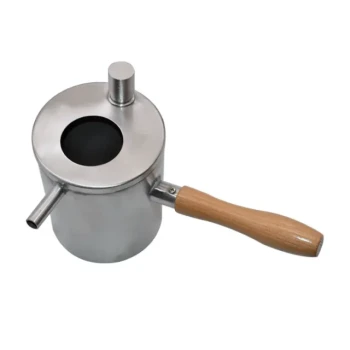
Pouring melted beeswax requires a balance of immediate action and patience. You must pour the wax carefully into prepared containers, filling them to just below the rim, and then allow substantial time for the material to cool. While the wax may appear hard on the surface quickly, the complete solidification process depends on the container's volume and can take up to a full day.
Core Takeaway: Success relies on "immediate action" once the wax melts, as beeswax begins to set the moment it leaves the heat source. However, true structural integrity requires patience; do not disturb the container until the full 24-hour setting window has passed.
Essential Preparation Guidelines
Readiness is Critical
Melted beeswax solidifies rapidly once removed from its heat source. You cannot pause to look for tools; ensure all molds and containers are prepared in advance before you take the wax off the heat.
Container Safety
If you are pouring into glass containers, they must be strictly heat-resistant. Standard glass may crack due to the sudden temperature change, creating a safety hazard and wasted material.
Personal Protection
Always wear oven gloves when handling the hot container. The process generates hot steam and risks wax splashes, which can cause significant burns.
Executing the Pour
Immediate Transfer
As soon as the beeswax has completely liquefied, remove it from the heat source. Pour it immediately into your molds or project containers to prevent premature hardening.
Filtration for Purity
If you observe large particles or debris in the melted wax, do not pour it directly. Strain the liquid through cheesecloth or a coffee filter as you pour to ensure a clean final product.
The Fill Line
Pour the wax carefully to avoid spills. Aim to fill each container until the wax level is just below the rim.
Understanding Solidification Dynamics
The "Full Day" Rule
Do not gauge the readiness of the wax by touching the surface. The total time required to set depends heavily on the volume of the container and the thickness of the wax.
Patience is Mandatory
For most standard containers, you should plan for a cooling period of up to 24 hours. Allowing the wax to sit undisturbed for a full day ensures it solidifies completely throughout the center.
Common Pitfalls to Avoid
Premature Setting
If the wax begins to set up or solidify before you have finished pouring, do not force it. Simply place the container back over the original heat source (double boiler, crock pot, etc.) to re-melt it before continuing.
Disturbing the Cool Down
Moving the container while the center is still liquid can ruin the structural integrity of the candle or balm. Once poured, the container should remain stationary until the full cooling time has elapsed.
Making the Right Choice for Your Project
- If your primary focus is safety: Prioritize using heat-resistant glassware and heavy-duty oven gloves to prevent burns or shattered containers.
- If your primary focus is product quality: Adhere strictly to the 24-hour cooling window to ensure the wax is dense and fully set before use.
- If your primary focus is workflow efficiency: Have all filtration and molding tools laid out beforehand, as the window between "liquid" and "setting" is extremely short.
Mastering beeswax involves moving quickly when hot, and waiting patiently when cooling.
Summary Table:
| Aspect | Guideline/Requirement | Key Consideration |
|---|---|---|
| Preparation | Pre-set all molds and tools | Wax begins to set immediately once removed from heat |
| Container Type | Heat-resistant glass or molds | Standard glass may crack under thermal shock |
| Safety Gear | Oven gloves & protection | Protects against hot steam and wax splashes |
| Fill Level | Just below the rim | Prevents spills and allows for slight shrinkage |
| Cooling Time | Up to 24 hours | Surface cooling is deceptive; core integrity takes time |
| Troubleshooting | Re-heat in a double boiler | If wax solidifies mid-pour, return to heat source |
Elevate Your Beekeeping Business with HONESTBEE
At HONESTBEE, we understand that commercial success in the beekeeping industry requires more than just knowledge—it requires the right tools. Whether you are a commercial apiary looking to scale production or a distributor seeking a reliable wholesale partner, we provide the full spectrum of industrial solutions to streamline your workflow.
Our Value to You:
- Advanced Machinery: From high-efficiency honey-filling machines to precision hive-making equipment.
- Premium Tools & Gear: A comprehensive range of beekeeping hardware and protective essentials.
- Industry Consumables: A wide array of high-quality consumables and honey-themed cultural merchandise to expand your retail footprint.
Ready to enhance your efficiency and product quality? Contact us today to explore our wholesale catalog and customized machinery solutions!
Related Products
- Beeswax Foundation Sheets Beehive Foundation for Wholesale
- Colorful Silicone Beeswax Foundation Mold Mould for Beekeeping
- Economy Manual Beeswax Embossing Mill Wax Foundation Machine Roller
- Beeswax Melter for Candle Making Honey Bee Wax Melter
- Electric Beeswax Flat Sheet Machine with Operating Tray for Wax Processing
People Also Ask
- What are the technical advantages of beeswax foundations and feeding tools? Optimize Your Bee Breeding Phase
- Why is the regular exchange and replacement of beeswax foundations encouraged? Boost Honey Yield & Hive Biosafety
- What are the negative consequences of using old or contaminated beeswax in foundations? Protect Your Hive Today
- Why is high-purity natural beeswax essential for foundations? Prevent Larval Mortality & Boost Colony Health
- What are the specific advantages of regular comb replacement? Boost Hive Health with New Beeswax Foundations