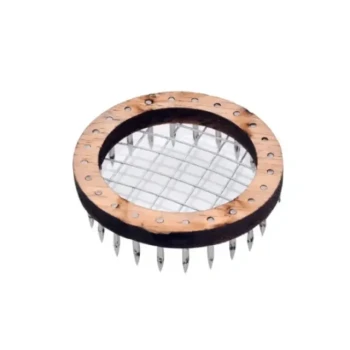
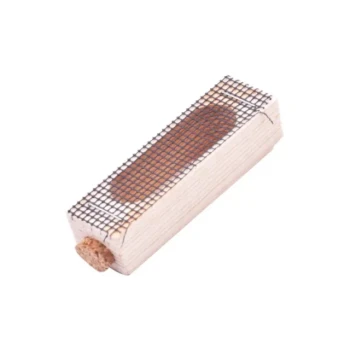
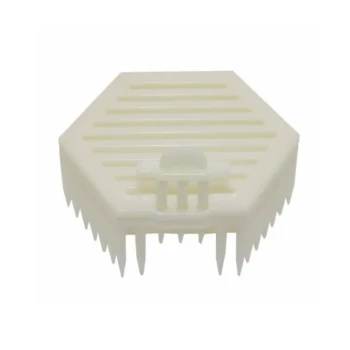
The decisive technical advantage is the creation of a defensive buffer zone. Unlike a standard queen excluder that merely acts as a doorstop, a perforated wire mesh cage physically distances the predator from the hive's threshold. This prevents hornets from landing directly at the entrance to ambush vulnerable worker bees.
Core Takeaway Traditional excluders protect the hive structure, but wire mesh cages protect the workforce. By extending the defensive perimeter outward, the cage neutralizes the hornet's hunting strategy of ambushing slow-moving foragers at the threshold.
The Limitation of Standard Excluders
Focused on Interior Security
A traditional queen excluder installed at the entrance operates on a single, flat plane. Its primary technical function is exclusion based on size, physically preventing a large hornet from squeezing into the hive.
The Ambush Vulnerability
While effective at stopping home invasion, standard excluders fail to manage the exterior space. Hornets can simply land on the excluder itself, waiting inches from the opening to snatch bees the moment they emerge.
The Mechanics of the Wire Mesh Cage
Extending the Defensive Radius
The technical superiority of the cage lies in its spatial defense mechanism. By projecting outward from the hive face, the cage forces the predator to maintain a distance from the actual entrance hole.
Denying the Landing Platform
Hornets often rely on a stable platform to capture prey efficiently. The wire mesh cage prevents hornets from landing directly at the "choke point" where bees are most concentrated.
Protecting Vulnerable Foragers
This distance is vital for foragers returning with heavy loads of pollen or nectar. These bees have slower reaction times due to fatigue and weight; the cage ensures they can land and enter without being intercepted immediately upon arrival.
Preventing Colony Depletion
By disrupting the hornet's ability to "camp" at the door, the cage drastically reduces worker bee mortality. This preservation of the workforce is critical for preventing the gradual decline and eventual collapse of the colony.
Understanding the Trade-offs
Increased Physical Footprint
Unlike a flat sheet, a cage adds bulk to the hive entrance. This requires a compatible landing board and may complicate hive transport or winterization preparations if not removable.
Maintenance Requirements
The three-dimensional structure of a cage creates more surface area. Beekeepers must monitor the mesh to ensure it does not become clogged with debris or dead bees, which could impede colony traffic.
Making the Right Choice for Your Goal
To select the correct defense mechanism, evaluate the intensity of the predation pressure you are facing.
- If your primary focus is stopping internal invasion: A traditional queen excluder is sufficient to prevent hornets from entering the hive to plunder resources.
- If your primary focus is preserving the workforce: The wire mesh cage is essential to stop hornets from picking off foragers and depleting the colony's population.
By pushing the predator back, you transform the hive entrance from a hunting ground into a protected sanctuary.
Summary Table:
| Feature | Traditional Queen Excluder | Perforated Wire Mesh Cage |
|---|---|---|
| Primary Function | Physical barrier at entrance | Spatial buffer zone creation |
| Defense Radius | Flat, single-plane security | Extended 3D perimeter |
| Hornet Management | Stops hive entry only | Denies landing & ambush points |
| Worker Protection | Low (foragers are exposed) | High (protects fatigued foragers) |
| Colony Impact | Prevents resource theft | Prevents population depletion |
Secure Your Colonies with HONESTBEE Professional Defense Solutions
Don't let hornet predation deplete your workforce and bottom line. HONESTBEE provides commercial apiaries and distributors with high-performance beekeeping equipment designed for maximum durability and colony safety. From advanced hive-making machinery and specialized honey-filling systems to high-quality mesh cages and essential consumables, we offer the comprehensive wholesale inventory you need to scale your operations.
Ready to upgrade your apiary's protection? Contact us today to discuss how our specialized hardware and tools can enhance your productivity and protect your bees.
References
- Mohamed S. Younis. New technique for protecting honey bee colonies from oriental wasp (Vespa orientalisL.) attacks at Dokki region, Giza, Egypt.. DOI: 10.21608/assjm.2016.104128
This article is also based on technical information from HonestBee Knowledge Base .
Related Products
- Wood and Mesh Push-In Queen Cage
- Classic Wooden and Mesh California Queen Cage
- Hexagonal Direct Comb Introduction Queen Bee Cage
People Also Ask
- When is a queen introduced with a push-in cage ready for full release? Key Signs for Maximum Colony Acceptance
- How are queen cages used to protect newly hatched queens? Secure Your Virgin Queens During Development
- Why are queen cages or grid cages used in bee studies? Achieve Precise Biological Data for Research
- What advantages do push-in queen cages offer? Boost Acceptance Rates for Artificially Inseminated Queens
- What is a push-in queen cage and how does it differ from a standard queen cage? Boosting Your Queen Acceptance Rates