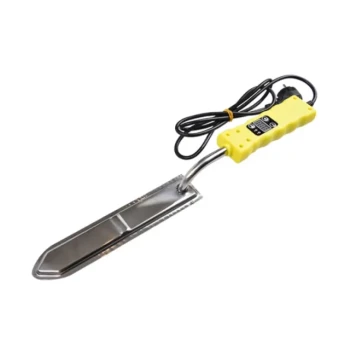
Technical precision defines effective harvesting. An industrial-grade Putty Knife, specifically configured with a 2 inch wide blade, serves as the foundational tool for manually scraping hardened propolis from hive structures. This specific width offers the necessary mechanical advantage to detach tightly bonded resins while preserving the structural integrity of the hive's wooden components.
Success in traditional harvesting relies on achieving balanced leverage. The correct tool allows for the efficient removal of tightly bonded propolis without gouging or degrading the hive hardware.
The Mechanics of Traditional Harvesting
Optimizing Blade Geometry
The primary technical consideration for this tool is the blade width. A 2 inch wide blade is identified as the optimal specification for this application.
This width provides balanced leverage, allowing the operator to apply sufficient force to dislodge hardened material without becoming unwieldy. It ensures the force is distributed effectively across the scraping surface.
Addressing Target Zones
The industrial-grade putty knife is designed to navigate specific high-deposit areas within the hive.
Operators focus scraping efforts on hive entrances, frame sides, and inner cover bottoms. These flat, accessible surfaces are where propolis tends to accumulate and harden most significantly.
Material Interaction
Propolis resins form a tight bond with wooden structures, requiring a tool capable of withstanding significant resistance.
The "industrial-grade" designation implies the durability needed to handle these hardened propolis resins. A standard consumer-grade tool may flex or fail under the pressure required to break this bond.
Critical Operational Trade-offs
Force Application vs. Equipment Preservation
The most significant challenge in manual scraping is removing the resin without damaging the substrate.
While the goal is harvesting efficiency, aggressive scraping can lead to gouges in the wooden frames or covers. The 2-inch blade is selected specifically to minimize this damage, but operator technique remains a variable.
Efficiency vs. Precision
A wider blade might cover more area, but it reduces the specific pressure applied to a single point.
Conversely, a narrower blade increases pressure but risks digging into the wood. The 2-inch specification represents the technical "sweet spot" between covering surface area quickly and maintaining control over the cut.
Maximizing Harvesting Efficiency
To ensure you are utilizing this tool effectively, align your technique with your specific operational goals.
- If your primary focus is Equipment Longevity: Prioritize the balanced leverage of the 2-inch blade to guide the tool across wooden surfaces without digging in.
- If your primary focus is Yield Volume: Concentrate scraping efforts on flat, high-density areas like inner cover bottoms where the blade width acts most efficiently.
The right tool does not just remove material; it preserves the ecosystem of the hive for future production.
Summary Table:
| Technical Feature | Specification | Operational Benefit |
|---|---|---|
| Blade Width | 2-Inch (Standard) | Optimal balance between force distribution and precision control. |
| Material Grade | Industrial-Grade | Prevents blade flexing or failure when scraping hardened resins. |
| Target Areas | Entrances, Frames, Inner Covers | Maximizes yield by focusing on high-density accumulation zones. |
| Primary Goal | Balanced Leverage | Ensures efficient resin removal while protecting wooden hive components. |
Scaling Your Propolis Production? Partner with HONESTBEE Today!
As a commercial apiary or beekeeping distributor, your efficiency depends on professional-grade equipment that survives the rigors of the field. HONESTBEE specializes in providing high-performance tools, from precision hand scrapers and hive-making machinery to specialized honey-filling solutions.
We understand the unique needs of wholesale clients, offering a comprehensive portfolio that includes essential industry consumables and honey-themed cultural merchandise to help you grow your brand.
Ready to upgrade your inventory or hive management tools? Contact us today to discover how our wholesale beekeeping solutions can drive your success.
References
- Montaser Elsayed Ali, A. Abdel- Khalek. Some Modified Methods for Bee Propolis Production in Honeybee Colonies (Hymenoptera, Apis mellifera L.) under Egyptian Condition. DOI: 10.21608/jppp.2021.220177
This article is also based on technical information from HonestBee Knowledge Base .
Related Products
People Also Ask
- Why are electric honey uncapping knives essential? Boost Efficiency & Preserve Comb for Professional Honey Extraction
- What is an electric uncapping knife and how is it used? Master Faster Honey Extraction with Heat
- What are the advantages and disadvantages of using an electric knife for uncapping honey frames? Boost Extraction Speed
- What are the drawbacks of using an electric knife for uncapping honey frames? Cost and Power Constraints Explained
- How should an electric uncapping knife be utilized? Master Efficient Honey Extraction with Heated Precision