Highly eusocial honeybees differ from primitively eusocial bees in colony scale, permanence, caste specialization, and food-storage behavior. Species in the genus Apis maintain large, perennial colonies with morphologically distinct queens and workers, overlapping generations, and substantial honey reserves stored in reusable wax comb. Primitively eusocial bees generally form smaller, shorter-lived colonies with less specialized castes and limited food stores, so their nests are not suited to the high-volume extraction and filling systems used in commercial apiculture.
Commercial honey machinery is designed around the biology of perennial honeybee colonies: large worker populations produce surplus honey in standardized, reusable comb frames, enabling mechanized extraction, filtration, and filling without destroying the colony’s core storage structure.
The Biological Divide Between the Two Social Systems
Colony permanence changes production patterns
Highly eusocial honeybees, especially Apis mellifera, maintain colonies across multiple seasons. A colony can preserve a large workforce and continue collecting and storing nectar when environmental conditions permit.
Primitively eusocial bees typically establish smaller, temporary colonies. Bumblebees, for example, generally form annual colonies in which the founding queen and workers die by the end of the season, while new queens survive to establish colonies later.
This difference determines whether honey production is a continuous commercial process or a short-term survival behavior.
Caste specialization supports large-scale work
In highly eusocial honeybees, queens and workers are morphologically and functionally distinct. Workers perform specialized tasks such as nursing brood, building comb, guarding the nest, foraging, processing nectar, and regulating hive conditions.
Primitively eusocial species may have reproductive and worker roles, but the differences are usually less pronounced. Colony members often have greater behavioral flexibility, and the colony lacks the large, permanently organized labor force found in Apis.
A large population of specialized workers allows honeybees to sustain the repetitive processing and storage activity required for commercial surplus production.
Overlapping generations create workforce continuity
Highly eusocial colonies contain multiple generations living together. Older workers forage and process nectar while younger workers tend brood, maintain comb, and support colony development.
Primitively eusocial colonies generally have fewer individuals and less extensive overlap between generations. Their social organization is sufficient for colony survival, but not for maintaining large-scale, long-term storage infrastructure.
Food stores serve different purposes
Honeybees collect nectar, convert it into honey, reduce its moisture content, and store it in dedicated non-brood comb cells. These reserves support the colony through periods when flowers are unavailable and can exceed the colony’s immediate needs under managed conditions.
Other social bees often store only enough nectar or food for short-term survival. Bumblebees use small wax pots rather than extensive reusable honeycomb, while solitary bees do not maintain worker-based colonies or produce harvestable surplus honey.
The key commercial distinction is therefore surplus stored in recoverable structure, not simply whether a species can collect nectar.
Why Honeybees Require Specialized Harvesting Equipment
Reusable comb makes centrifugal extraction practical
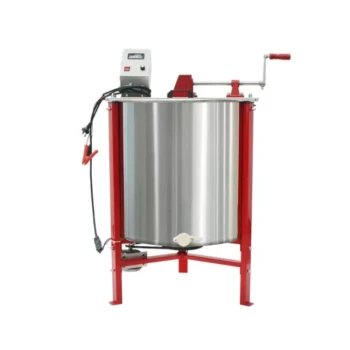
Commercial honeybees store honey in structured hexagonal wax comb, commonly held in removable frames. Once the wax cappings are removed, centrifugal extractors can spin honey from the cells while leaving the comb substantially intact.
The frames can then be returned to the colony. Bees repair and refill existing comb more efficiently than they would build an entirely new storage structure, improving colony productivity and reducing resource consumption.
Large colonies create high-volume harvest windows
A commercial honeybee colony may contain tens of thousands of workers and can produce substantial surplus during strong flowering periods. Harvesting must therefore process many frames and large volumes in a short, controlled period.
Manual handling becomes slow, labor-intensive, and inconsistent at this scale. Extractors, pumps, filters, holding tanks, and filling machines provide the throughput required by apiaries, packers, wholesalers, and contract processors.
Filtration protects product quality
Honey harvested from comb can contain wax fragments and other physical impurities. Filtration systems remove these materials efficiently while preserving the honey’s characteristic flavor, color, and consistency.
For high-output operations, rapid filtration is important because honey may be viscous and difficult to move through undersized or poorly matched equipment. System capacity must reflect both the expected volume and the product’s viscosity.
Filling machinery converts bulk yield into saleable units
After extraction and filtration, honey must be portioned into jars, bottles, tubs, or larger wholesale containers. Precision filling machines control fill volume, reduce product loss, and support consistent packaging across production batches.
Automated or semi-automated fillers are particularly valuable when an operation must process large seasonal yields quickly. Reliable sealing and container handling also help protect hygiene, shelf life, and order consistency.
Equipment Must Match Nest Architecture
Standard frame systems favor standardized machinery
Commercial Apis mellifera operations commonly use standardized frame hives. This creates predictable dimensions for uncapping equipment, extractors, conveyors, filters, and filling lines.
For distributors and resellers, compatibility across common hive and processing formats is a major purchasing requirement. A broad product portfolio can support the full workflow, from hive components and frames to extraction, filtration, and packaging.
Species-specific hives may require different hardware
Not every honeybee species uses the same nesting behavior or tolerates the same hive dimensions. Apis cerana, for example, may require precisely dimensioned hive bodies to reduce stress and discourage absconding.
Manufacturers and beekeepers may therefore need specialized hive-making equipment and accurately produced components. Correct dimensions support bee retention, colony health, and more reliable harvest planning.
Unusual storage structures need gentler tools
Stingless bees store honey in cerumen pots rather than conventional hexagonal comb. Their smaller volumes and fragile nest architecture make large centrifugal extractors unsuitable.
Negative-pressure suction systems or precision injectable tools can remove honey while minimizing damage to storage pots, brood areas, and larvae. This is a fundamentally different harvesting requirement from extracting honey from removable frames.
Why Primitively Eusocial Bees Usually Do Not Fit Commercial Lines
Small stores do not justify industrial throughput
A primitively eusocial colony may produce or store food, but its volume is generally too low to justify equipment designed for hundreds of standardized honey frames. Large automated lines would be inefficient, difficult to clean between small batches, and poorly matched to the nest structure.
Small-scale or semi-automated filling equipment is more appropriate where production volumes are limited.
Temporary nests cannot support repeated frame harvesting
Commercial frame extraction depends on returning intact comb to an active colony. Temporary nests and small storage pots do not provide the same reusable infrastructure.
Removing a significant portion of their food stores can damage the colony’s survival prospects, and rebuilding the nest may require resources that the colony cannot recover before the season ends.
Solitary bees have no harvestable honey system
Solitary bees, including mason and leafcutter bees, do not form worker-based colonies with queens, foragers, and communal honey stores. They provision individual brood cells rather than building surplus honey reserves for a large social group.
Consequently, centrifugal extractors, honey frames, comb foundations, and commercial filling lines are built for social honeybees, not for solitary pollinators.
Understanding the Trade-offs
Higher throughput can increase product stress
High-speed processing improves labor efficiency but can create problems if pumps, filters, or fillers are poorly matched to honey viscosity. Excessive handling, unsuitable flow rates, or inadequate temperature control can affect product quality and operational consistency.
Equipment selection should therefore consider throughput, viscosity range, filtration requirements, cleaning access, and the intended container format.
Automation depends on standardized inputs
Automated lines perform best when frames, uncapping dimensions, containers, and batch volumes are consistent. Operations using multiple bee species, hive formats, or nonstandard storage structures may need modular or semi-automated equipment instead.
A one-size-fits-all system can create downtime when dimensions and production methods vary.
High seasonal output requires fulfillment planning
Honey production is often concentrated around flowering seasons. A processor may need rapid equipment availability, replacement parts, technical support, and fast delivery before the harvest window begins.
For distributors and B2B resellers, dependable order fulfillment and responsive service can be as important as the machinery’s rated capacity. Customers need a coordinated supply source that can cover hive hardware, extraction components, filling systems, and consumables.
More extraction is not always better harvesting
Removing too much honey or disturbing brood comb can weaken a colony. Efficient machinery must support selective harvesting and preserve the reusable comb and active colony structure that make future production possible.
The correct objective is not maximum removal from one harvest, but reliable production over successive seasons.
Making the Right Choice for Your Goal
Select equipment according to the bee’s social biology, storage structure, production volume, and intended packaging workflow.
- If your primary focus is high-volume Apis mellifera production: Choose standardized frame-compatible extractors, efficient filtration systems, and precision filling machinery sized for seasonal surplus.
- If your primary focus is species-specific beekeeping: Match hive bodies, frames, and processing tools to the target species’ nesting dimensions and absconding behavior.
- If your primary focus is stingless-bee honey: Use low-volume, precision extraction tools that protect cerumen pots, brood areas, and larvae.
- If your primary focus is distribution or resale: Build a full-spectrum offering that combines hive equipment, extraction, filtration, filling, technical expertise, responsive service, and rapid order fulfillment.
- If your primary focus is product consistency: Prioritize controlled filtration, accurate dosing, hygienic cleaning access, and machinery capable of handling the honey’s viscosity.
Understanding the colony determines the equipment, and matching both is the foundation of efficient, responsible honey production.
Summary Table:
| Aspect | Highly Eusocial Honeybees | Primitively Eusocial Bees |
|---|---|---|
| Colony Scale | Large, perennial | Small, often annual |
| Caste Specialization | Morphologically distinct queens and workers | Less pronounced, more flexible |
| Food Storage | Surplus honey in reusable wax comb | Limited stores, small pots or cells |
| Harvesting Suitability | Designed for high-volume extraction and filling | Poor fit for industrial machinery |
At HONESTBEE, we provide a complete range of beekeeping machinery and supplies tailored to the unique biology of honeybees. From extractors and filling lines to hive components, our equipment maximizes efficiency while preserving colony health. Whether you're a commercial apiary, distributor, or B2B reseller, we offer rapid delivery, dedicated support, and a full-spectrum product portfolio. Contact us today to equip your operation for success!
Related Products
- Precision Durable Efficient HONESTBEE Rotary Honey Filling Machine
- Automatic Honey Filling and Filtering Machine for Beekeeping Bottle Filling
- Economy Small Honey Filling Machine Honey Bottle Filler Packaging Machine
- Fully Automatic Honey Filling Packaging Machine for Processing Line
- Commercial Rotary Honey Filling Machine for Production
People Also Ask
- How do honey filling and processing machines aid native bee product conservation? Boost Value with HONESTBEE Technology
- How do high-precision honey filling machines ensure quality? Optimize Your Commercial Production with HONESTBEE
- How do honey filling machines work? Achieve Precision & Speed for Your Apiary
- What are the common types of bottling machines used for honey? Choosing the Right Solution for Your Apiary
- What is a key feature of the new generation of the honey filling machine? The Advanced Electronic Control Unit