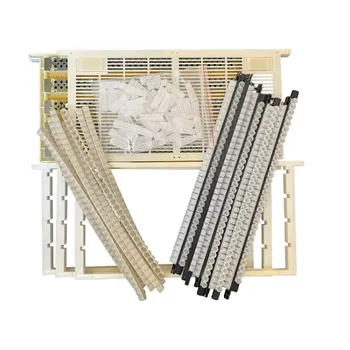
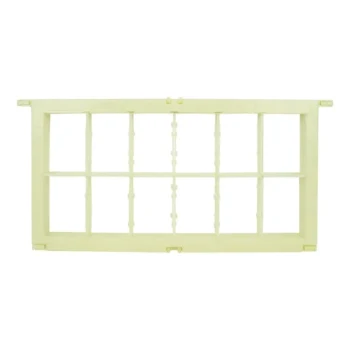
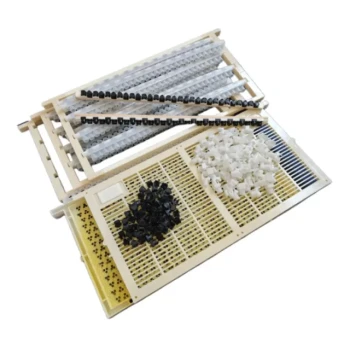
Nurse bee feeding behavior is shaped by sensory, metabolic, and glandular biology. Up-regulated dopamine receptors—especially Dop2—support antennal neuron development, helping nurse bees detect larvae quickly and deposit more royal jelly into queen cells. The best harvesting frames therefore provide standardized, high-capacity cells in a layout that makes larval access and repeated feeding efficient.
The frame does not create royal jelly production by itself; it captures the colony’s biological capacity. Frames with consistent spacing, vertically oriented cell cups, and efficient harvesting access are most effective when nurse bees have strong sensory activity, developed glands, adequate nutrition, and high genetic potential.
How Nurse Bees Decide Where and How Much to Feed
Dopamine receptors improve larval detection
Up-regulated dopamine receptor type D2, or Dop2, is associated with the development of honeybee antennal neurons. These neurons are central to the nurse bee’s ability to detect and evaluate larvae.
Faster or more effective larval detection allows nurse bees to identify queen-cell contents quickly and return more efficiently to feeding tasks. In commercial production, this can increase the amount of royal jelly deposited in individual cells.
Queen-cell structure changes feeding behavior
Honeybee queens and worker bees originate from the same type of fertilized egg. Their developmental pathway is influenced by the larva’s placement in a vertically hanging, thimble-shaped queen cell and its continuous provisioning with royal jelly.
Artificial cell cups and queen-rearing frames reproduce these key physical signals. When young worker larvae are transferred into vertically suspended cups, nurse bees are encouraged to treat them as queen-cell larvae and provide abundant royal jelly.
Nurse bee age affects secretory capacity
Young nurse bees between approximately 4 and 15 days of age are particularly important for royal jelly production. Their hypopharyngeal and mandibular glands are the primary organs responsible for secreting royal jelly.
Adequate protein intake from honey-and-pollen-based feed supports development and activity of these glands. A colony may therefore show reduced harvesting performance if its nurse bees lack sufficient nutrition, even when the production frame itself is well designed.
Why Metabolism Matters for Royal Jelly Yield
Royal jelly synthesis requires intensive cellular activity
High production is associated with increased activity in pathways involving protein synthesis, amino acid metabolism, fatty acid and sugar metabolism, and oxidative processes. These pathways reflect the substantial metabolic demand placed on nurse bees as they synthesize and deliver royal jelly.
Genes such as Dop2 and hexamerin storage proteins, including hex71, are linked to functions that support sensory behavior, nutrient storage, and intensive production activity. This means frame selection should be matched with colony condition rather than treated as an isolated equipment decision.
Nutrition supplies the production system
Protein-rich feed helps nurse bees maintain glandular activity, while stored nutrients support the energy and raw materials required for secretion. Feeding management is therefore complementary to frame design.
For commercial apiaries, the practical implication is clear: high-capacity harvesting equipment performs best when the colony has enough young nurse bees and sufficient protein resources to use it.
How Biology Should Guide Harvesting-Frame Selection
Choose standardized cell spacing
Frames, cell bars, and cup strips with standardized spacing help create a predictable feeding environment. Consistent placement makes it easier for nurse bees to access multiple queen cells and allows beekeepers to manage grafting, inspection, and harvesting more systematically.
Standardization is also valuable for distributors and commercial operators because it improves compatibility across a broader product portfolio. Frames, bars, cups, and grafting tools can be sourced and deployed as an integrated production system rather than as unrelated components.
Use high-capacity artificial cell cups
High-capacity cups provide more space for royal jelly accumulation and support rapid provisioning by nurse bees. They are especially useful in colonies with strong nursing activity, where individual cells may receive larger deposits.
The cup should still replicate the essential queen-cell condition: vertical suspension, suitable larval placement, and easy nurse-bee access. Capacity alone cannot compensate for poor orientation or weak colony acceptance.
Select frames that support rapid handling
Royal jelly is typically harvested from queen-cell production systems, so the frame should support efficient inspection, larval management, and removal of the accumulated product. Compatible cell bars and cup strips can reduce handling friction and help maintain a repeatable harvest cycle.
For B2B buyers, this makes system compatibility a commercial priority. A supplier that can provide frames, artificial cups, grafting tools, and hygienic extraction equipment offers more value than one supplying a single component without matching accessories.
Match frame design to colony potential
Colonies with strong genetic potential and elevated metabolic activity can generate more royal jelly, but they also require equipment capable of accommodating that output. High-performance frames and cell systems help prevent the production setup from becoming the bottleneck.
However, a premium frame should be evaluated alongside colony acceptance, nurse bee population, nutritional support, and harvesting workflow. The correct choice is the one that fits the entire operating system.
Understanding the Trade-offs
Higher-capacity cells are not automatically better
Larger or higher-capacity cups can support greater royal jelly accumulation, but they still depend on proper larval transfer and nurse bee acceptance. If larvae are poorly positioned or the cups are not presented in a natural vertical arrangement, the theoretical capacity may not translate into higher yield.
Equipment should therefore be assessed by usable production capacity, not just cup volume or the number of cells per frame.
More cells can increase management demands
A frame with a high number of cells may increase potential output, but it also raises requirements for grafting accuracy, colony strength, inspection, and harvesting speed. If the apiary cannot process the frame efficiently, labor and handling problems may reduce the practical benefit.
For wholesalers and resellers, product specifications should be presented together with the operational requirements. Buyers need to know not only what the frame can hold, but also what colony and workflow it is designed to support.
Genetics cannot replace management
Up-regulated Dop2, hex71, and related biological pathways may contribute to high production potential, but they do not guarantee consistent output under every condition. Nutrition, nurse bee age, colony organization, grafting quality, and hygiene remain decisive variables.
A frame should be marketed as a tool for capturing and improving biological performance, not as a substitute for sound beekeeping management.
Specialized equipment requires compatibility
Cell bars, cup strips, grafting frames, grafting tools, and extraction systems must work together. Incompatible dimensions or handling procedures can create delays, damage cells, or compromise product purity.
This is why one-stop sourcing, rapid technical response, and dedicated customer service are particularly important for commercial apiaries and distribution partners. Equipment compatibility directly affects fulfillment efficiency and production reliability.
How to Apply This to Your Project
Frame selection should begin with the colony’s biological capacity and end with the required harvesting workflow.
- If your primary focus is maximum royal jelly yield: Choose vertically oriented, standardized high-capacity cell cups and frames, then support them with strong nurse bee populations and adequate protein nutrition.
- If your primary focus is scalable queen rearing: Use compatible grafting frames, artificial cups, cell bars, and grafting tools that reproduce natural queen-cell conditions and streamline larval transfer.
- If your primary focus is operational efficiency: Prioritize standardized spacing, rapid-access frame designs, and integrated harvesting equipment that reduce inspection and handling time.
- If your primary focus is product purity: Pair suitable production frames with hygienic extraction systems and a controlled workflow that minimizes contamination during collection.
- If your primary focus is distribution and resale: Build a complete product offering around compatible frames, cups, bars, grafting tools, feeders, and extraction systems, supported by fast fulfillment and technical assistance.
The strongest royal jelly harvesting system aligns bee biology, cell design, nutrition, and workflow into one compatible production solution.
Summary Table:
| Biological Factor | Effect on Feeding Behavior | Frame Selection Implication |
|---|---|---|
| Dopamine receptors (Dop2) | Enhanced larval detection and feeding efficiency | Choose frames with consistent cell spacing to optimize access |
| Queen-cell structure | Triggers royal jelly provisioning | Use vertically oriented, thimble-shaped artificial cups |
| Nurse bee age (4-15 days) | Peak glandular secretion | Ensure colony strength with young nurse bees |
| Metabolic activity | High energy demand for synthesis | Provide adequate protein nutrition |
| Genetic potential (hex71) | Influences production capacity | Select high-capacity frames to match colony potential |
Optimize Your Royal Jelly Harvesting Today!
At HONESTBEE, we understand that maximizing royal jelly yield depends on both biological and equipment factors. As a comprehensive supplier for commercial apiaries and distributors, we offer a full spectrum of beekeeping tools, machinery, and consumables. Our portfolio includes hive-making and honey-filling machines, specialized hardware, and honey-themed cultural merchandise.
Our one-stop sourcing capability ensures you get compatible frames, cell cups, grafting tools, and extraction systems that work together seamlessly. With rapid response times, dedicated customer service, and ultra-fast delivery, we support your business efficiency. For distributors, we provide OEM/ODM support, certifications, and reliable supply to boost your profit margins.
Ready to enhance your production? Contact our team today for expert advice and high-quality equipment tailored to your needs!
Related Products
- 8 Frame and 10 Frame Propolis Trap Collector Screen for Propolis Collection
- HONESTBEE Improved No Grafting Queen Rearing Kit For Queen Rearing and Royal Jelly Production
- JZBZ Langstroth Queen Rearing Frame for Beekeeping
- Professional Sectional Comb Honey Frame with 250g Cassette System for Beekeeping
- No Grafting Queen Rearing Kit: System for Royal Jelly Production and Queen Rearing
People Also Ask
- Why is a specific wooden frame required when installing a propolis screen? Optimize Your Propolis Harvest Efficiency
- What are the advantages of using propolis collector screens? Elevate Your Harvest to Pharmaceutical Purity
- How do propolis collection screens work? Discover material specs for commercial harvesting equipment
- How does the mesh size of a propolis collection screen influence the efficiency of propolis harvesting? Optimize Yields!
- How do commercial-grade plastic screens compare to custom fine-mesh screens? Maximize Your Propolis Yield & ROI