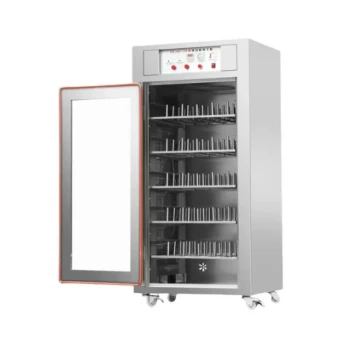
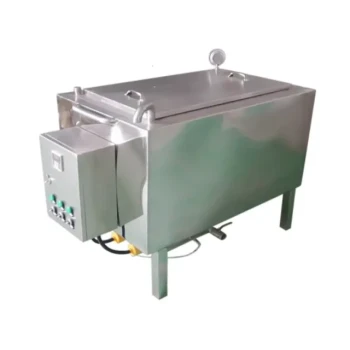
An electric blast drying oven establishes a stable thermal environment at 70°C to facilitate the dry basis calculation of honey moisture. It utilizes forced convection to accelerate the evaporation process, continuing until the honey sample reaches a constant weight.
The core purpose of this apparatus is to provide a definitive gravimetric measurement—calculating water content based on mass lost during heating—to verify moisture percentages obtained via faster methods like refractometry.
Key Experimental Conditions
The electric blast drying oven creates specific physical conditions to ensure the moisture removal is both complete and measurable without damaging the sample.
Controlled Temperature at 70°C
The primary condition provided is a constant temperature of 70°C. Maintaining this specific thermal baseline is crucial for evaporating water from the viscous honey matrix without inducing excessive thermal decomposition.
Forced Convection (The "Blast")
Unlike static ovens, this equipment uses forced convection (air circulation). This mechanism actively moves heated air over the sample, accelerating the evaporation rate and ensuring temperature uniformity throughout the chamber.
The "Constant Weight" End-Point
The experiment does not rely on a fixed duration but rather a fixed state. Samples are dried until they achieve a constant weight, meaning the mass reading no longer fluctuates, indicating that all free moisture has been removed.
The Role of Verification
While other methods exist for testing honey, the electric blast drying oven serves a specific role in quality assurance workflows.
Validating Refractometry
Technicians often use refractometers for rapid testing, but the oven method serves as the standard for verification. It physically separates water from the solids, providing a "true" dry mass calculation to cross-reference the optical readings from refractometers.
Ensuring Uniformity
The "blast" feature ensures that heat is distributed evenly. This temperature uniformity prevents hot spots that could burn the sugars or cold spots that would leave residual moisture, ensuring the final calculation reflects the entire sample.
Understanding the Trade-offs
While the electric blast drying oven provides a rigorous measurement standard, there are distinct variables to consider regarding efficiency and sample integrity.
Temperature Sensitivity vs. Speed
While some general laboratory ovens operate at higher temperatures (103°C–105°C), the 70°C set-point referenced here is deliberate. Lower temperatures reduce the risk of caramelizing the sugars (fructose), which would result in non-moisture mass loss and skew the results, though it extends the drying time.
Gravimetric Accuracy vs. Workflow Time
This method is time-intensive compared to optical methods. It requires weighing, drying for an extended period, cooling, and re-weighing, making it less suitable for high-throughput screening but essential for high-precision calibration.
Making the Right Choice for Your Goal
Selecting the correct moisture analysis method depends on whether you need immediate results or absolute validation.
- If your primary focus is rapid, daily screening: Rely on refractometry for immediate results, accepting a slight margin of error.
- If your primary focus is rigorous accuracy and verification: Use the electric blast drying oven at 70°C to obtain a precise dry basis calculation based on physical mass loss.
The electric blast drying oven provides the definitive "ground truth" for honey moisture by prioritizing thermal stability over speed.
Summary Table:
| Condition | Parameter/Mechanism | Benefit for Honey Analysis |
|---|---|---|
| Temperature | Stable 70°C | Prevents sugar caramelization while ensuring evaporation. |
| Airflow | Forced Convection (Blast) | Accelerates drying & ensures temperature uniformity. |
| End-point | Constant Weight | Provides definitive gravimetric accuracy for mass loss. |
| Function | Validation | Cross-references and calibrates refractometer readings. |
Elevate Your Honey Processing Precision with HONESTBEE
At HONESTBEE, we understand that precision is the backbone of any successful commercial apiary or distribution business. As a premier wholesale partner, we provide more than just equipment; we deliver the tools necessary for industry-standard quality control. From specialized honey-filling machines to professional-grade beekeeping tools and machinery, our portfolio supports your entire production chain.
Whether you are scaling up your honey-themed cultural merchandise or need robust hardware for large-scale processing, HONESTBEE offers comprehensive solutions tailored to your needs. Maximize your product quality and operational efficiency today—contact us at HONESTBEE to explore our full wholesale spectrum!
References
- Gülsüm YETKİN, Serdar Makbul. Melissopalynological and Physico-Chemical Properties of Cimil Plateau (Rize) Honey. DOI: 10.53501/rteufemud.1209594
This article is also based on technical information from HonestBee Knowledge Base .
Related Products
- Electric Bee Smoker European Style Bee Hive Smoker for Beekeeping
- HONESTBEE Professional Cabinet Bottle Dryer
- Solar Beeswax Melter Easy Solar Wax Melter for Beeswax
- Professional Electric Honey Uncapping Knife with Heated Digital Temperature Control for Beekeeping
- 12V Bee Mite Removal Evaporator Oxalic Acid Vaporizer for Bee Fumigation Treatment 180W Atomization
People Also Ask
- What is an electric bee smoker? A Guide to Automated Hive Management
- What is the purpose of using a beekeeping smoker during hive inspections and harvesting? Enhance Apiary Safety & Control
- What are bee smokers made out of? Choose the Right Material for Your Apiary
- What preparation is required before opening a bee hive? Essential Checklist for Safe Hive Inspection
- What is the primary function of a beekeeping smoker in the context of observing honeybee development? Expert Hive Guide