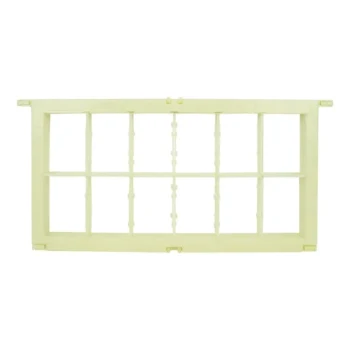
Standardized beehive frames serve as the uniform physical platform that supports the honeybee's transition from larva to pupa, while capped brood cells function as the essential biological micro-environment for parasite reproduction and interaction. By utilizing these structures, researchers can stabilize experimental conditions, ensuring that physical variability does not skew data regarding parasite impact or honeybee development.
Core Takeaway By combining the structural uniformity of standardized frames with the enclosed ecosystem of capped brood cells, researchers create a controlled "laboratory within the hive." This allows for the precise simulation of natural parasitic environments and the rigorous manipulation of variables, such as the exact number of mites introduced to a developing bee.
Establishing Experimental Control
To derive accurate data in parasite research, variables must be isolated. Standardized equipment converts a chaotic natural hive into a measurable grid.
Ensuring Physical Uniformity
Standardized frames provide consistent physical dimensions across all test groups. This uniformity is critical because it eliminates structural irregularities that could otherwise influence how bees build comb or manage space.
By using identical frame structures, researchers ensure that the "container" for the experiment remains constant. This allows the study to focus strictly on biological variables, such as the host-parasite interaction, rather than environmental anomalies.
Facilitating Rapid Manipulation
The precise gap control and dimensions of these frames allow for seamless removal and replacement. This logistical efficiency is vital during time-sensitive procedures, such as introducing parasites or splitting colonies for comparative studies.
The Capped Cell as an Incubator
The capped brood cell is the focal point of honeybee parasite research. It represents the specific developmental stage where parasites, particularly Varroa mites, are most active and destructive.
Simulating Natural Infection
Capped cells provide the natural, enclosed environment required for mites to feed and reproduce on developing pupae. Research designs often utilize this phase to observe the "continuous impact" of parasitism on bee morphology and longevity.
Precision in Variable Management
In experimental settings, the capped cell acts as an isolation chamber. Researchers can manually introduce a specific number of mites into a cell before it is sealed or shortly after.
This capability allows for the precise control of infection variables. Instead of relying on random natural infestation, scientists can dictate the exact parasitic load per bee to measure specific physiological outcomes.
Observation and Sampling Utility
Beyond hosting the experiment, these structures serve as the primary tools for data collection and behavioral analysis.
Measuring Hygienic Behavior
Frames containing capped brood serve as the "workspace" for observing social immunity. Researchers monitor these areas to see if worker bees detect and uncap infested cells to remove damaged larvae.
The integrity of the comb and the capping quality are the baselines for these observations. Any deviation in how bees manage these specific capped cells provides quantifiable data on the colony's resistance traits.
Accurate Infection Rate Sampling
Because parasites concentrate in capped cells for reproduction, these cells are the most reliable location for sampling.
Opening these standardized cells allows researchers to collect complete life-cycle samples—including adults, nymphs, and larvae. This yields high-quality data regarding parasite population growth and fertility rates that external hive inspections cannot provide.
Understanding the Trade-offs
While standardized frames and capped cell manipulation are industry standards, they introduce specific challenges that must be managed to maintain data integrity.
Mechanical Transmission Risks
While standardization aids logistics, moving frames between hives can mechanically transmit parasites if not managed with strict isolation protocols. Heavily infested combs must be physically isolated to prevent cross-contamination that could invalidate control groups.
Disruption of Colony Homeostasis
Extensive manipulation of frames and opening of capped cells can stress the colony. If the physical integrity of the comb is compromised during sampling, it may trigger an aggressive hygienic response from the bees, potentially skewing data on "natural" removal rates.
Making the Right Choice for Your Goal
To maximize the value of your experimental design, align your use of these structures with your specific research objectives.
- If your primary focus is Parasite Reproductive Biology: Prioritize the capped cell as an isolation chamber to manually introduce specific mite counts and measure reproductive success rates.
- If your primary focus is Colony Social Immunity: Focus on the standardized frame as a grid to map and track the uncapping and removal rates of infested brood over time.
- If your primary focus is Population Dynamics: Use the capped brood as your primary sampling point to calculate precise infection rates and gather complete parasite life-cycle stages.
Standardization in the hive is the bridge that turns anecdotal beekeeping observations into rigorous, reproducible scientific data.
Summary Table:
| Component | Primary Research Function | Key Experimental Benefit |
|---|---|---|
| Standardized Frames | Uniform Physical Platform | Eliminates environmental variables and ensures structural consistency. |
| Capped Brood Cells | Biological Micro-environment | Acts as an isolation chamber for precise parasite load manipulation. |
| Standardized Grid | Behavioral Workspace | Enables quantifiable measurement of hygienic behavior and social immunity. |
| Cell Cappings | Sampling Focal Point | Allows for accurate life-cycle sampling and infection rate calculation. |
Elevate Your Beekeeping Operations with HONESTBEE
At HONESTBEE, we understand that precision is the foundation of successful beekeeping, whether for commercial honey production or advanced apiary research. As a premier partner for commercial apiaries and global distributors, we provide more than just supplies—we provide professional-grade solutions.
Our comprehensive wholesale portfolio includes:
- High-Precision Machinery: Industrial hive-making and honey-filling machines.
- Premium Hardware: Standardized beekeeping tools and durable equipment built for scale.
- Essential Consumables: A full spectrum of industry-standard supplies to maintain colony health.
- Cultural Merchandise: Unique honey-themed products to expand your market reach.
Partner with a supplier that values scientific rigor and operational efficiency. Contact HONESTBEE today to discuss your wholesale needs and discover how our equipment can streamline your production and research goals.
References
- Heyan Yang, Xiaobo Wu. <i>Varroa destructor</i> mite infestations in capped brood cells of honeybee workers affect emergence development and adult foraging ability. DOI: 10.1093/cz/zoab002
This article is also based on technical information from HonestBee Knowledge Base .
Related Products
- Wooden Bee Hive Frames for Beekeeping and Wholesale
- Professional Galvanized Steel Frame Rest for Beehives
- Assembled Wooden Bee Frames with Plastic Foundation for Durability and Convenience by HONESTBEE
- HONESTBEE Wired and Assembled Wooden Bee Frames Foundation for a Thriving Hive
- Plastic Bee Frame Beekeeping Hive Frames for Wholesale
People Also Ask
- How do wooden and plastic hive frames compare in terms of durability? Wood vs. Plastic Longevity & Repairability
- How does balancing the number of frames impact hive productivity? Optimize Your Apiary's Biological Output
- What are the main considerations when choosing between wooden and plastic bee hive frames? Optimize Your Apiary's Efficiency
- How should beehive frames be maintained to prolong their lifespan? 5 Pro Tips for Durable Beekeeping Equipment
- What are frames and combs used for in beekeeping? The Foundation of Modern Hive Management