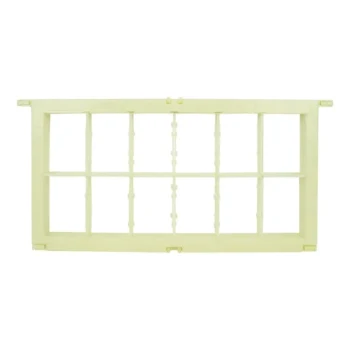
Standardized counting frames and measurement grids serve as the primary instrument for converting subjective hive observations into objective, actionable data. By overlaying these physical guides onto honeycombs, apiarists can precisely calculate the surface area of brood and food stores, allowing for a rigorous assessment of a colony's biological potential and response to its environment.
Core Takeaway By transitioning from visual estimation to grid-based measurement, beekeepers can convert abstract concepts of "colony strength" into concrete statistical units (such as square centimeters of brood). This quantification is essential for accurately calculating queen fecundity, evaluating the success of feeding programs, and determining how well specific honeybee ecotypes adapt to forage-scarce regions.
From Abstract Observation to Concrete Metrics
Eliminating Estimation Errors
Without standardized tools, assessing a hive's status is prone to human error and subjective bias. Measurement grids—typically wire or wooden frames divided into units like $5 \times 5$ cm squares or 2 $\text{cm}^2$ cells—mechanically standardize the viewing area. This hardware removes guesswork, enabling technicians to derive precise numerical data rather than relying on qualitative descriptions like "strong" or "weak."
Standardizing Units of Measure
These tools allow for the translation of biological mass into mathematical values. Whether using a square-inch scale or a metric grid, the tool divides the honeycomb surface into precise statistical units. This facilitates the conversion of surface area directly into offspring counts, based on standard densities (e.g., approximately 418 cells per $10 \times 10$ cm square).
Quantifying Biological Performance
Calculating Reproductive Rates
The primary function of these grids is to measure the area of capped and uncapped brood. By counting the grid squares covered by larvae or pupae, beekeepers can mathematically determine the daily egg-laying rate of the queen. This provides a direct reflection of queen fecundity and the rate of colony proliferation.
Assessing Colony Development
Counting frames monitor the total population dynamics, including the number of frames covered by adult bees. This data tracks the colony's growth trajectory over time, particularly during critical buildup periods like spring. It identifies the exact rate at which a colony is expanding its workforce.
Evaluating Management and Environment
Measuring Foraging and Adaptation Capacity
In arid or forage-scarce regions, the ability of a colony to sustain brood rearing is a key indicator of foraging success. Standardized measurement allows researchers to compare the adaptation capacity of different honeybee ecotypes objectively. It reveals which genetic lines maintain colony strength despite environmental stressors.
Verifying Intervention Success
These tools provide the objective data needed to evaluate human interventions, such as supplementary feeding or antioxidant treatments. By measuring brood area before and after specific feeding programs, technicians can quantify the impact on larval development. This confirms whether an investment in resources is yielding a tangible increase in colony strength.
Understanding the Trade-offs
Intrusiveness and Disruption
While accurate, using measurement grids requires opening the hive and physically handling frames for longer periods than a visual inspection. This disrupts the colony's internal climate and stress levels, potentially interrupting normal hive activity. Technicians must balance the need for data precision with the potential cost of colony disturbance.
Labor Intensity
Grid-based measurement is significantly more time-consuming than standard inspections. It requires manual counting and calculation for every frame assessed, making it resource-heavy for large-scale commercial operations. This method is often best reserved for research, breeding selection, or troubleshooting specific hives rather than routine management of thousands of colonies.
Making the Right Choice for Your Goal
To effectively utilize standardized counting frames, align your usage with your specific management objectives:
- If your primary focus is Genetic Selection: Use high-precision grids (e.g., $2 \text{cm}^2$ cells) to calculate exact egg-laying rates and select queens with superior fecundity.
- If your primary focus is Resource Management: Use larger grid squares (e.g., $5 \times 5$ cm or $10 \times 10$ cm) to quickly assess brood coverage and determine the efficacy of expensive feeding supplements.
- If your primary focus is Environmental Research: Use the grids to document brood area changes in arid regions to identify ecotypes that thrive in forage-scarce conditions.
Precision in measurement transforms beekeeping from an art of estimation into a science of calculated management.
Summary Table:
| Metric Monitored | Measurement Tool Function | Key Benefit |
|---|---|---|
| Queen Fecundity | Calculates daily egg-laying rates | Identifies high-performance genetic lines |
| Brood Area | Converts surface area to cell counts | Quantifies colony growth and expansion |
| Foraging Capacity | Measures food stores & brood support | Evaluates adaptation to forage-scarce regions |
| Intervention Impact | Tracks pre/post-feeding brood levels | Verifies ROI on supplements and treatments |
Elevate Your Apiary Management with HONESTBEE
Precision measurement is the foundation of a successful commercial beekeeping operation. At HONESTBEE, we empower commercial apiaries and distributors with the high-quality tools needed to transform hive management from estimation into a precise science.
Our comprehensive wholesale portfolio includes:
- Specialized Machinery: From hive-making to honey-filling machines for industrial efficiency.
- Precision Tools: Professional counting frames, measurement grids, and essential hardware.
- Industry Consumables: A wide array of supplies to sustain colony health and development.
- Cultural Merchandise: Honey-themed products to expand your brand's reach.
Whether you are scaling a breeding program or optimizing honey production, HONESTBEE provides the specialized equipment and machinery to drive your growth.
Partner with HONESTBEE today – Contact us to explore our wholesale solutions!
References
- Atilla ÖZTOKMAK, Oznur Çaglar. Conservation of Local Honeybees (Apis mellifera L.) in Southeastern Turkey: A Preliminary Study for Morphological Characterization and Determination of Colony Performance. DOI: 10.3390/ani13132194
This article is also based on technical information from HonestBee Knowledge Base .
Related Products
- Assembled Wooden Bee Frames with Beeswax Foundation Ready to Use by HONESTBEE
- Wooden Bee Hive Frames for Beekeeping and Wholesale
- 8 Frame and 10 Frame Propolis Trap Collector Screen for Propolis Collection
- JZBZ Langstroth Queen Rearing Frame for Beekeeping
- Professional Sectional Comb Honey Frame with 250g Cassette System for Beekeeping
People Also Ask
- Under what circumstances should bee frames be destroyed? Protect Your Apiary from American Foulbrood
- How should frames be rearranged as a bee colony grows? Master Hive Expansion and Nest Management
- Do bee frames need foundation? Choose the Right Approach for Your Apiary
- What types of bee frames can be cleaned and returned to service? A Guide to Safe Apiary Refurbishment
- When should frames with new foundation be given to colonies? Master Timing for a Thriving Hive