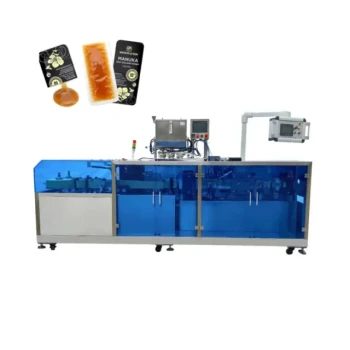
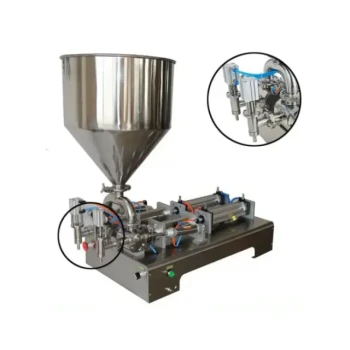
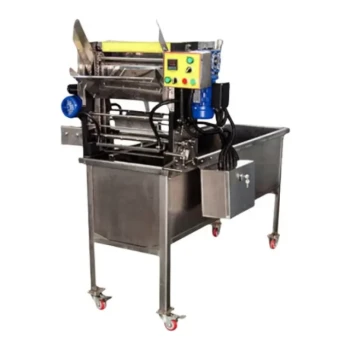
Automated honey-filling machines function as the essential bridge between raw honey production and the consumer market. These industrial systems are responsible for efficiently and hygienically packaging high-purity honey into sales containers with strict adherence to accuracy and volume standards.
The core function of these machines is to transform honey production from a manual craft to a scalable industry by ensuring precise filling accuracy and preventing secondary contamination. They act as the vital link that allows operations to move from laboratory-level development to large-scale commercial supply.
Ensuring Commercial Viability
Precision Dosing and Consistency
The primary role of an automated filling machine is to guarantee filling accuracy for every unit produced.
By utilizing advanced metering controls—often servo-driven or pneumatic—these machines ensure that every container receives an exact, consistent volume of product. This standardization gives the final product a professional appearance essential for retail shelves.
Minimizing Material Waste
Handling viscous fluids like honey often leads to significant product loss during manual transfer.
Automated machines mitigate this through anti-drip mechanisms and precise volumetric control. This ensures that high-value honey ends up in the jar rather than on the production floor, allowing for accurate unit cost accounting.
Maintaining Product Integrity
Preventing Secondary Contamination
As honey moves from extraction to packaging, it is vulnerable to external pollutants.
Automated fillers serve as a defensive barrier, operating as closed-loop systems that prevent secondary contamination. By enclosing the process, often within stainless steel piping, the machine protects the honey from dust, debris, and human contact.
Reducing Oxidation
Exposure to air can degrade the organic integrity of honey over time.
These machines function to minimize air exposure during the filling process. By reducing the risk of oxidation, they help maintain the honey's quality and, when paired with integrated sealing equipment, significantly extend the product's shelf life.
Operational Efficiency
Scaling for Mass Markets
The transition from a local apiary to a pharmaceutical or consumer market supplier requires speed that manual labor cannot match.
Automated fillers replace labor-intensive manual processes, allowing producers to meet large-scale market supply demands. This automation is the key driver that enables a facility to increase production rates while simultaneously reducing overall labor costs.
Understanding the Trade-offs
Calibration Complexity
While automation provides consistency, it introduces technical rigidity.
High-precision machines, particularly those using servo-driven systems, require precise calibration. Changing container sizes or honey viscosities often necessitates technical adjustments, which can be less flexible than manual pouring for small, custom batches.
Viscosity Management
Honey is a non-standard fluid; its thickness changes with temperature.
Automated machines depend on consistent viscosity to function correctly. If the honey crystallizes or becomes too thick, the anti-drip and metering mechanisms may struggle, potentially requiring additional heating or agitation components within the system to maintain flow.
Making the Right Choice for Your Goal
To select the right automation level, you must verify your specific production targets.
- If your primary focus is Market Scalability: Prioritize machines with high-speed servo-drives to replace manual labor and meet large-scale distribution quotas.
- If your primary focus is Product Purity: Prioritize machines with fully enclosed stainless steel piping systems to eliminate oxidation and secondary contamination risks.
Automated filling is not just about speed; it is the mechanism that secures the purity and consistency required for a professional honey brand.
Summary Table:
| Core Function | Key Benefit | Technical Mechanism |
|---|---|---|
| Precision Dosing | Minimizes waste & ensures consistency | Servo-driven or pneumatic metering |
| Hygienic Packaging | Prevents secondary contamination | Closed-loop stainless steel systems |
| Oxidation Control | Extends product shelf life | Minimized air exposure during filling |
| Operational Scaling | Increases output & reduces labor costs | High-speed automated throughput |
| Viscosity Management | Maintains steady flow | Integrated heating & anti-drip nozzles |
Scale Your Honey Business with HONESTBEE
Transitioning from manual bottling to industrial-scale production requires the right technology. HONESTBEE empowers commercial apiaries and honey distributors with world-class honey-filling machines, hive-making equipment, and a full spectrum of beekeeping tools.
Our specialized machinery ensures your product maintains peak purity while meeting the rigorous demands of the global market. Whether you are expanding your wholesale operation or outfitting a high-volume honey-packing facility, our experts provide the equipment and consumables necessary for success.
Ready to elevate your production capacity?
Contact HONESTBEE Today for Professional Solutions
References
- A. Shaji George, A.S.Hovan George. Lab Grown Honey: The Next Generation of Sustainable Alternative Nutritional Novel Food. DOI: 10.5281/zenodo.6726700
This article is also based on technical information from HonestBee Knowledge Base .
Related Products
- Fully Automatic Honey Filling Packaging Machine for Processing Line
- Automatic Honey Filling and Filtering Machine for Beekeeping Bottle Filling
- Precision Durable Efficient HONESTBEE Rotary Honey Filling Machine
- Precision Automated Packaging Turntable Honey Spoon Filling Sealing Packing Machine
- Semi Automatic Small Honey Bottle Filling Machine Honey Filler
People Also Ask
- Why are fully automatic honey filling and packaging lines essential? Boost Your Honey's Market Value and Quality
- What is a fully-automatic honey filler? Streamline Your Production with High-Precision Automation
- How do automated honey filling and packaging machines affect profitability? Boost Margins with HONESTBEE Technology
- How do automated honey filling and packaging machines contribute to the market value of honey products? Maximize Your ROI
- How do industrial-grade automated honey filling and packaging machines mitigate the risk of physical contamination?