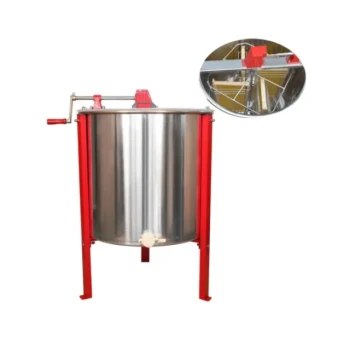
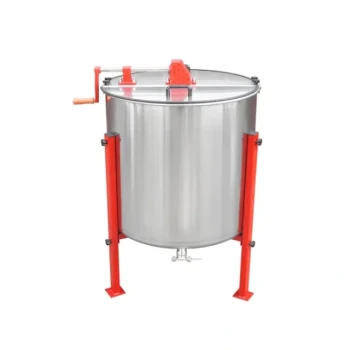
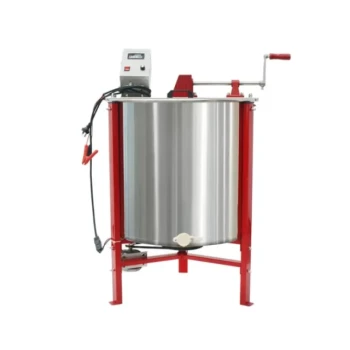
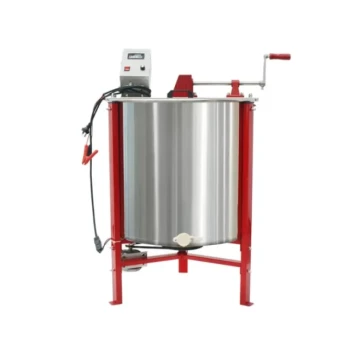
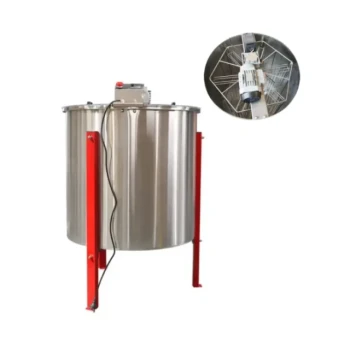
The primary disadvantages of a manual honey extractor are the significant physical effort required and limited frame capacity. Because these devices rely entirely on a hand-crank mechanism to generate centrifugal force, they are physically demanding to operate and significantly slower than motorized alternatives, making them inefficient for large-scale processing.
Core Takeaway While manual extractors are cost-effective and portable, they trade financial savings for "sweat equity." They are ideal for hobbyists but become a bottleneck for efficiency due to the labor-intensive nature of hand-cranking and their inability to process large volumes quickly.
The Physical and Operational Limitations
High Labor Intensity
The most immediate drawback is the need for continuous physical exertion. You must manually turn a hand crank to spin the basket, which requires sustained arm strength and endurance.
For a few frames, this is manageable, but the repetition becomes physically tiring during prolonged use. This fatigue can lead to inconsistent spinning speeds, potentially affecting how thoroughly the honey is extracted from the comb.
Reduced Processing Speed
Manual extraction is a time-consuming process. Unlike electric models that maintain a high, consistent RPM automatically, a manual extractor is only as fast as the operator.
You cannot multitask while extracting; your hands must be on the crank at all times. This extends the total time spent in the honey house, particularly if you are harvesting a large yield.
Limited Scalability
Manual extractors generally have a lower frame capacity per batch compared to commercial electric models. They are designed for smaller loads, which necessitates stopping frequently to unload empty frames and reload full ones.
This limitation makes them unsuitable for large-scale operations. If you manage many hives, the combination of small batch sizes and manual labor quickly becomes tedious and inefficient.
Understanding the Trade-offs
Cost vs. Effort
The main reason beekeepers accept these disadvantages is affordability. Manual extractors are significantly cheaper than electric versions, serving as a low-cost entry point for beginners.
However, you must recognize that you are paying with time and energy rather than capital. As your operation grows, the value of the money saved diminishes against the time lost.
Portability vs. Power
A distinct advantage that stems from this manual design is portability. Because they do not require electricity, they can be used in remote locations or directly in the field.
However, the trade-off is that you cannot rely on a motor to do the heavy lifting. This makes them excellent for off-grid hobbyists but impractical for stationary, high-volume honey houses.
Making the Right Choice for Your Goal
If you are deciding between sticking with a manual unit or upgrading, consider the scale of your operation.
- If your primary focus is budget or small-scale hobby beekeeping: A manual extractor is the logical choice for managing fewer than 10 hives, as the low cost outweighs the physical labor required.
- If your primary focus is efficiency or commercial expansion: You should invest in a motorized extractor to eliminate physical fatigue and drastically reduce the time spent per frame.
Choose the tool that respects both your budget and your physical limits.
Summary Table:
| Feature | Manual Honey Extractor Drawback | Impact on Efficiency |
|---|---|---|
| Labor Intensity | Requires continuous hand-cranking | High physical fatigue and inconsistent RPM |
| Processing Speed | Slow, manual operation only | Cannot multitask; significantly longer processing time |
| Frame Capacity | Limited to small batches | Frequent stopping/starting; unsuitable for large harvests |
| Scalability | Not viable for commercial growth | Becomes a bottleneck as the number of hives increases |
| Power Source | Manual/Human power | High "sweat equity" required compared to electric models |
Scaling Your Honey Production? Partner with HONESTBEE
Transitioning from hobbyist to commercial success requires the right equipment. HONESTBEE specializes in supporting commercial apiaries and distributors with professional-grade solutions that eliminate manual labor bottlenecks. From high-capacity motorized honey extractors to automated honey-filling machines and precision hive-making hardware, we provide the full spectrum of beekeeping machinery and consumables you need to thrive.
Don't let manual extraction slow down your growth. Contact HONESTBEE today to explore our comprehensive wholesale offerings and discover how our expertise can streamline your operations!
Related Products
- HONESTBEE 4 Frame Manual Self Reversing Honey Extractor for Beekeeping
- Stainless Steel 3 Frame Manual Honey Extractor Spinner for Bee Honey Extraction
- HONESTBEE 3-Frame Manual Acrylic Honey Extractor
- Stainless Steel Manual 8 Frame Radial Honey Extractor Machine for Beehives
- 2 Frame Stainless Steel Manual Honey Spinner Extractor for Beekeeping
People Also Ask
- What is the primary function of a DC motor in a self-reversing honey extractor? Master Precision Honey Extraction
- What is a manual honey extractor? The Essential Guide to Cost-Effective Beekeeping for Beginners
- Why are manual extractors popular among beginner beekeepers? A Guide to Starting Simple & Saving Money
- Which type of honey extractor is generally more durable? Focus on Material & Build Quality for Longevity
- What are the advantages of a manual extractor? Essential for Small-Scale & Hobbyist Beekeepers