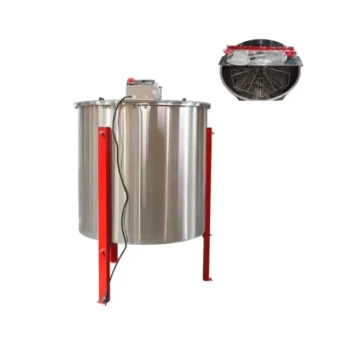
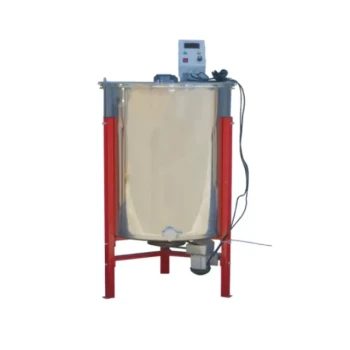
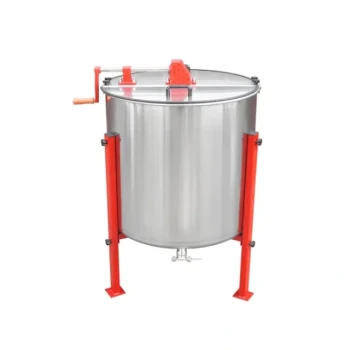
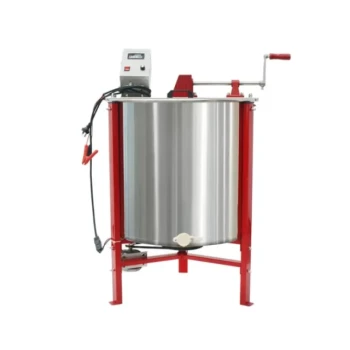
The primary function of a DC motor in a self-reversing honey extractor is to serve as the core drive unit that delivers torque to the turntable. Its critical technical value, however, lies in its ability to execute smooth, stepless speed regulation, allowing the device to accelerate gradually rather than subjecting the payload to immediate, full-speed rotation.
While the motor provides the physical force to spin the extractor, its true purpose is preservation. By utilizing Pulse Width Modulation (PWM), the motor enables a controlled "soft start" that extracts honey without destroying the delicate structure of the honeycomb.
The Mechanics of Controlled Extraction
To understand why a DC motor is the preferred choice for this application, we must look beyond simple rotation. The motor functions as part of a precision system designed to balance force with fragility.
Providing Precise Torque
The DC motor acts as the muscle of the extractor. It connects directly or via a belt to the turntable, providing the rotational force (torque) necessary to spin heavy, honey-laden frames.
Stepless Speed Regulation
Unlike simple motors that may only offer "High," "Low," and "Off" settings, the DC motor in this context utilizes Pulse Width Modulation (PWM) technology.
This technology allows for stepless speed regulation. Instead of jumping between fixed speeds, the motor can adjust its rotation in minute, smooth increments.
Protecting the Harvest
The structural integrity of a honeycomb is relatively weak, especially when weighted down by honey. The DC motor's operation is specifically tuned to address this vulnerability.
The Danger of Initial Inertia
If an extractor were to jump immediately to high speed, the sudden centrifugal force would likely shatter the wax combs.
This would ruin the frames and contaminate the harvested honey with wax debris.
Implementing the Soft Start
The DC motor facilitates a gradual ramp-up curve. It begins with a low-speed start to gently initiate the flow of honey.
Once the bulk of the weight is reduced, the motor can safely transition to high-speed centrifugal drying. This ensures the frames are thoroughly emptied without risking breakage during the initial spin.
Understanding the Operational Trade-offs
While the DC motor offers superior control, it relies heavily on the accompanying control electronics.
Dependency on Modulation Technology
The benefits of this system are not inherent to the motor alone but to its pairing with the PWM controller.
Without a functioning PWM driver, a DC motor loses its ability to provide that critical "soft start." A failure in the electronic control module results in a loss of the protective regulation that makes this system safe for honeycomb frames.
Making the Right Choice for Your Apiary
When evaluating extraction equipment, the motor type dictates how you manage your workflow and protect your yield.
- If your primary focus is honeycomb preservation: Prioritize a DC motor system with PWM, as the gradual acceleration is the only way to ensure non-destructive extraction.
- If your primary focus is process efficiency: Look for the ability to reach high-speed centrifugal drying quickly after the initial "soft start" phase to minimize cycle times.
By controlling the spin, you control the quality of your harvest.
Summary Table:
| Feature | DC Motor Benefit in Extraction | Impact on Honey Quality |
|---|---|---|
| Speed Control | Stepless Speed Regulation (PWM) | Prevents frame breakage via gradual acceleration |
| Torque Delivery | High starting torque for heavy loads | Ensures consistent rotation of honey-laden frames |
| Soft Start | Controlled ramp-up curve | Protects delicate wax structures from inertia damage |
| Finishing | High-speed centrifugal drying | Maximizes yield by thoroughly emptying the frames |
Elevate Your Beekeeping Efficiency with HONESTBEE
Are you looking to upgrade your apiary’s productivity or source high-quality equipment for your distribution network? HONESTBEE specializes in catering to commercial apiaries and distributors with our comprehensive wholesale range. From advanced honey-filling machines and specialized hive-making hardware to the precision-engineered motors and beekeeping tools discussed above, we provide the full spectrum of industry-essential machinery.
Why partner with HONESTBEE?
- Wholesale Excellence: Access a wide array of essential industry consumables and honey-themed cultural merchandise.
- Commercial Grade: Our equipment is built to withstand the demands of large-scale operations.
- End-to-End Support: We supply everything from basic tools to complex automated machinery.
Ready to enhance your yield and protect your harvest? Contact us today to explore our wholesale catalog!
References
- О.М. Логунов. Aдаптивна система управління електроприводом самооборотної медогонки. DOI: 10.33216/1998-7927-2022-272-2-42-45
This article is also based on technical information from HonestBee Knowledge Base .
Related Products
- HONESTBEE 4 Frame Manual Self Reversing Honey Extractor for Beekeeping
- HONESTBEE 6 Frame Self Reversing Electric Honey Extractor for Beekeeping
- 8-Frame Electric Self-Reversing Honey Extractor Spinner for Commercial Honey Extraction Equipment
- Professional 4 Frame Self Reversing Electric Honey Extractor for Beekeeping
- Stainless Steel 3 Frame Manual Honey Extractor Spinner for Bee Honey Extraction
People Also Ask
- What are the disadvantages of a manual honey extractor? Overcome Efficiency Bottlenecks in Your Apiary
- What is a manual honey extractor? The Essential Guide to Cost-Effective Beekeeping for Beginners
- Why are manual extractors popular among beginner beekeepers? A Guide to Starting Simple & Saving Money
- Which type of honey extractor is generally more durable? Focus on Material & Build Quality for Longevity
- What are the advantages of a manual extractor? Essential for Small-Scale & Hobbyist Beekeepers