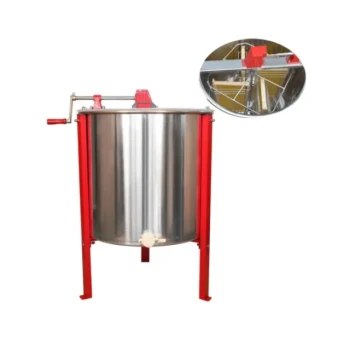
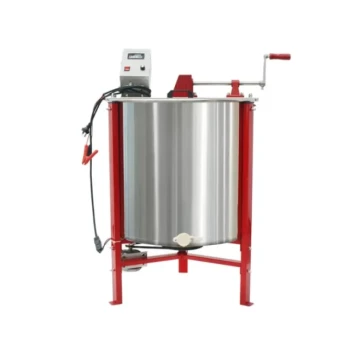
The basic working principle of a honey extractor is centrifugal force. Ideally, the device consists of a round drum containing a central rotating cage or basket designed to hold frames of honeycomb. By spinning this cage rapidly, the machine generates sufficient outward force to fling liquid honey out of the wax cells and onto the inner walls of the drum, where it drains to the bottom for collection.
The primary advantage of this mechanical separation is that it extracts honey without destroying the wax honeycomb structure, allowing beekeepers to return intact frames to the hive for immediate reuse.
The Mechanics of Extraction
Generating Centrifugal Force
The core mechanism relies on physics rather than heat or crushing. When the central cage spins, it creates centrifugal force, which acts outwardly away from the center of rotation.
This force overcomes the surface tension keeping the thick honey inside the comb. It pulls the liquid out of the cells at high speed, projecting it against the interior wall of the drum.
The Collection System
Once the honey strikes the inner wall of the drum, gravity takes over. The honey runs down the sides of the extractor and pools at the bottom of the tank.
Most extractors feature a honey gate or tap at the base. From here, the honey can be drained into buckets for filtering and bottling, or pumped into larger storage tanks.
Frame Orientation
The efficiency of the principle depends on how frames are positioned relative to the center. In radial extractors, frames sit like wheel spokes, allowing force to empty both sides of the comb simultaneously.
In tangential designs, the frame faces the wall directly. This empties one side quickly, but the operator must stop and flip the frame to extract the other side.
Operational Requirements
Uncapping is Mandatory
The extractor cannot pull honey through sealed wax. Before placing frames in the basket, the beekeeper must remove the thin layer of wax cappings from the cells using a hot knife or uncapping fork.
The Necessity of Balance
Because the principle relies on high-speed rotation, the load inside the drum must be perfectly balanced.
If frames are not distributed evenly by weight, the extractor will wobble violently. This can damage the machine's bearings or destroy the honeycomb frames inside.
Understanding the Trade-offs
Structural Integrity Risks
While extraction preserves the comb, the centrifugal force is significant. This method is generally unsafe for foundationless frames or combs that are not reinforced with wire.
Without the support of a plastic foundation or cross-wiring, the force required to remove the honey will often tear the wax comb apart, ruining the structure you intended to save.
Manual vs. Motorized Limits
Manual extractors rely on a hand crank and gear system. While effective for small harvests, maintaining the consistent speed required for thorough extraction can be physically exhausting.
Electric extractors use a motor to spin the basket. They provide consistent force and speed control, but they introduce higher costs and complexity to the operation.
Making the Right Choice for Your Goal
- If your primary focus is efficiency: Choose a radial extractor, as it uses centrifugal force to empty both sides of the frame simultaneously without manual flipping.
- If your primary focus is budget or small-scale hobbyist beekeeping: A manual, hand-crank extractor is sufficient to generate the necessary force for a few hives.
- If your primary focus is preserving fragile comb: Ensure your frames are wired or use a lower spinning speed, as the force can easily destroy combs lacking structural support.
The honey extractor transforms a messy, destructive harvest into a clean, repeatable cycle that benefits both the beekeeper and the colony.
Summary Table:
| Feature | Radial Extractor | Tangential Extractor |
|---|---|---|
| Mechanism | Frames sit like spokes | Frames face the wall directly |
| Efficiency | High (both sides at once) | Moderate (must flip frames) |
| Best For | Commercial & large scale | Small-scale hobbyists |
| Comb Safety | Good for reinforced frames | High risk for foundationless |
| Requirement | Uncapping & balanced load | Uncapping & balanced load |
Maximize Your Honey Yield with HONESTBEE
As a dedicated partner to commercial apiaries and global distributors, HONESTBEE provides the professional-grade equipment needed to scale your operations. From high-capacity radial honey extractors and honey-filling machines to durable hive-making hardware, we supply a full spectrum of beekeeping tools and industry consumables.
Why choose HONESTBEE?
- Comprehensive Wholesale Offering: Everything from specialized machinery to honey-themed cultural merchandise.
- Built for Scale: Industrial-strength equipment designed for longevity and high-speed efficiency.
- Global Supply Chain: Reliable sourcing for all your beekeeping needs.
Ready to upgrade your harvesting efficiency? Contact us today to explore our wholesale catalog and see how our expertise can grow your business.
Related Products
- HONESTBEE 72 Frame Industrial Electric Honey Extractor for Beekeeping
- Commercial Electric 12 Frame Honey Extractor Spinner Motorized Honey Extractor
- HONESTBEE 3-Frame Manual Acrylic Honey Extractor
- electric honey extractor honey centrifuge 3 frame honey extractor stainless steel honey frame extractor
- HONESTBEE 6 Frame Self Reversing Electric Honey Extractor for Beekeeping
People Also Ask
- What is the importance of balancing honeycomb frames within a honey extractor? Ensure Stability and Protect Machinery
- How is honey separated from the frames after they are uncapped? Efficient Extraction Methods for High Yields
- What are the main benefits of using a honey extractor? Maximize Yields and Protect Your Honeycomb
- What are the recommended methods for removing honey from the honeycomb? Top Extraction Techniques for Maximum Efficiency
- How do manual honey extractors compare to electric honey extractors? Choosing the Right Tool for Your Apiary Growth