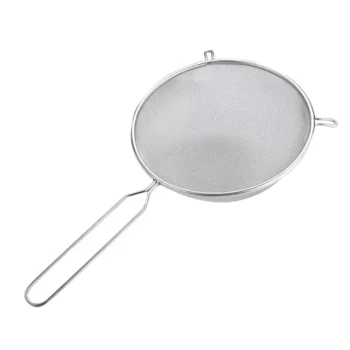
The primary function of a fine-mesh sieve in the initial pretreatment of honey samples is physical filtration. It serves as a mechanical barrier designed to remove solid impurities—specifically wax particles, bee debris, and honeycomb fragments—while allowing the liquid honey component to pass through for analysis.
Core Takeaway Sieving is a critical standardization step, not merely a cleaning process. By removing solid contaminants that are not part of the honey's liquid matrix, this step prevents foreign matter from skewing subsequent physicochemical measurements and ensures the sample is chemically representative of the batch.
Ensuring Sample Integrity
Elimination of Physical Contaminants
The most immediate role of the sieve is the removal of macro-impurities.
Raw honey often contains suspended solids resulting from the extraction process, such as dead bees, plant tissues, and hive fragments.
The fine-mesh sieve acts as a primary filter to separate these non-honey elements from the sample matrix.
Protection of Analytical Accuracy
The presence of solid debris poses a significant risk to physicochemical property detection.
If a sample contains wax or foreign solids, measurements regarding moisture content, sugar ratios, or enzymatic activity will be inaccurate.
Filtration ensures that the substance being tested is pure honey, guaranteeing that biochemical component measurements reflect the product's actual quality.
Optimization for Microscopy
For analyses involving pollen classification, the sieve plays a vital role in reducing background noise.
While the mesh removes large debris, it is typically sized to allow microscopic pollen grains to pass through (in standard pollen analysis contexts).
This creates a "cleaner" substrate, preventing large contaminants from obscuring pollen sediment on microscope slides and improving the efficiency of pollen counting.
Understanding the Trade-offs
Mesh Size Sensitivity
The definition of "fine-mesh" dictates the outcome of the filtration.
A standard sieve (e.g., 0.5mm) removes wax but allows pollen and natural particulates to remain, preserving the honey's botanical profile.
However, an ultra-fine filter (e.g., 30 micrometers) may capture everything, including pollen and potential microplastics. You must select the aperture based on whether you intend to analyze the solids or discard them.
Thermal vs. Mechanical Constraints
Sieving highly viscous or crystallized honey can be mechanically difficult.
While heating honey facilitates faster filtration, excessive heat destroys sensitive enzymes like diastase.
Therefore, "cold filtration" through a sieve is often preferred to maintain biological activity, even if it lengthens the processing time.
Making the Right Choice for Your Goal
To apply this to your specific project, consider your downstream analytical targets:
- If your primary focus is Physicochemical Analysis: Use a mesh that removes all visible solids to prevent wax or debris from altering mass and chemical readings.
- If your primary focus is Pollen Classification: Ensure the mesh aperture is large enough to let pollen pass while stopping larger hive debris to clear the visual field.
- If your primary focus is Microplastic or Residue Detection: Use an ultra-fine mesh (approx. 30 micrometers) to deliberately capture and concentrate all solid particulates for examination.
Effective pretreatment transforms a raw, variable substance into a consistent, reliable analyte.
Summary Table:
| Feature | Function in Honey Pretreatment | Analytical Benefit |
|---|---|---|
| Physical Filtration | Removes wax, bee debris, and hive fragments | Ensures a pure liquid matrix for testing |
| Contaminant Removal | Eliminates macro-impurities from extraction | Prevents skewing of moisture and sugar data |
| Sample Standardization | Creates a consistent, uniform honey substrate | Improves reproducibility of chemical assays |
| Aperture Control | Allows pollen passage while blocking debris | Enhances clarity for microscopic classification |
| Cold Processing | Filters without requiring high heat | Preserves sensitive enzymes like diastase |
Elevate Your Honey Processing Efficiency with HONESTBEE
Maintaining sample integrity starts with the right equipment. At HONESTBEE, we specialize in supporting commercial apiaries and distributors with a comprehensive range of professional-grade beekeeping tools and machinery. Whether you need specialized honey-filling machines for high-volume production or robust hive-making hardware, our wholesale solutions are designed to optimize your workflow.
From essential industry consumables to advanced honey-themed cultural merchandise, we provide the full spectrum of equipment needed to scale your operations and ensure product quality.
Ready to upgrade your apiary or distribution business?
Contact our expert team today to discuss your wholesale needs!
References
- Osuagwu OS. Comparative Studies of the Physicochemical Properties and Mineral Elements of Honey Produced in the Guinea Savannah Zones of Nigeria. DOI: 10.26717/bjstr.2020.24.004105
This article is also based on technical information from HonestBee Knowledge Base .
Related Products
- Professional Stainless Steel Honey Filter with Support Handle
- Stainless Steel Triangle Support Honey Strainer and Filters
People Also Ask
- Why are stainless steel filters essential during the initial purification phase of honey processing? Ensure Purity
- What are the benefits of using a high-quality honey filter? Elevate Purity and Preserve Natural Flavor
- What is the primary purpose of honey filters? Achieve Professional Clarity & Pure Honey Quality
- What micron filter should I use for honey? Choose the Right Filter for Sales or Competitions
- Why do people filter honey? For Clarity, Stability, and Consumer Appeal