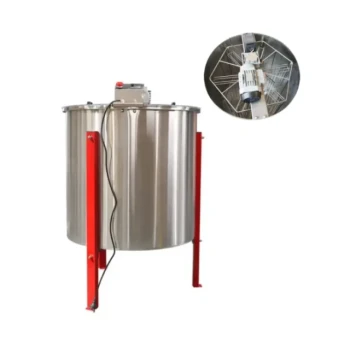
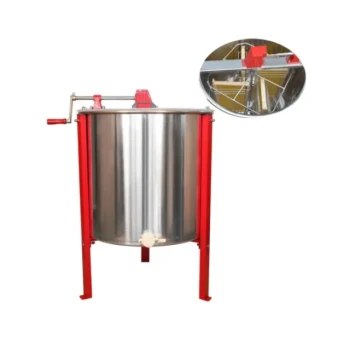
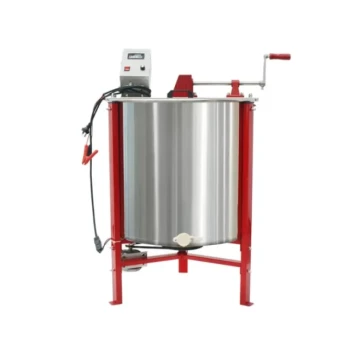
A honey extractor is a specialized mechanical device designed to remove honey from honeycombs using centrifugal force. Its defining function is to separate liquid honey from the wax cells without destroying the structural integrity of the comb, enabling the frames to be immediately reused by the colony.
Core Takeaway: The honey extractor changes beekeeping from a destructive harvest to a sustainable cycle. By preserving the wax comb, you eliminate the bees' need to rebuild their infrastructure, allowing them to redirect massive amounts of energy solely toward honey production.
The Mechanics of Extraction
Generating Centrifugal Force
The extractor functions by spinning honeycomb frames inside a drum or container at high speeds.
This rotation generates centrifugal force, which pulls the liquid honey out of the open cells.
The honey is flung against the inner walls of the extractor, where it then flows down to the bottom to be drained through a tap or pump.
Preservation of the Wax Comb
Unlike traditional methods that crush and strain the honeycomb, an extractor leaves the wax structure intact.
This is the primary technical benefit of the device: it separates the harvestable product (honey) from the production infrastructure (wax).
This method also tends to be more hygienic, as it reduces the likelihood of larvae or other impurities mixing into the final honey product.
The Impact on Production Efficiency
Reducing the Energy Cost of Wax
Bees must consume a significant amount of honey to produce beeswax, often cited at a ratio of roughly 8 pounds of honey to produce 1 pound of wax.
If a beekeeper destroys the comb to harvest honey, the bees must consume their own stores to rebuild the hive before they can store new surplus.
Shortening the Production Cycle
By returning wet, intact sticky frames to the hive immediately after extraction, you provide the bees with "ready-to-fill" storage.
This significantly shortens the turnover time, allowing the colony to focus entirely on foraging and nectar collection.
This efficiency gain is critical for achieving large-scale, high-volume output in commercial or serious hobbyist beekeeping.
Critical Operational Requirements
Uncapping is Mandatory
Before frames can be placed in the extractor, the wax cappings—the thin seals bees place over ripe honey—must be removed.
If the cells are not uncapped, the centrifugal force cannot release the honey, regardless of the speed.
Load Balancing
When loading frames into the basket, the weight must be evenly distributed across the extractor.
An unbalanced load will cause the machine to wobble violently, potentially damaging the equipment or destroying the frames inside.
Understanding the Trade-offs
Structural Support is Required
Not all honeycomb is suitable for a honey extractor.
The intense force generated by spinning can tear apart fragile combs that lack reinforcement.
Frames generally require a wire or plastic foundation to withstand the pressure; foundationless natural comb often breaks apart during this process.
Equipment Maintenance
Extractors are more complex than simple strainers and require thorough cleaning to prevent crystallization or contamination.
Whether manual or motorized, the moving parts (bearings, gears, and motors) introduce a maintenance requirement that simpler harvesting methods do not have.
Making the Right Choice for Your Goal
- If your primary focus is maximum honey yield: You must use an extractor to preserve drawn comb, saving the bees the energy cost of wax production.
- If your primary focus is producing comb honey: An extractor is unnecessary and counterproductive, as the product is sold with the wax structure intact.
- If your primary focus is low-cost entry: Be aware that extractors require an upfront investment and specific frames (wired/plastic foundation) to function correctly.
Ultimately, the honey extractor is the key to transforming a hive from a construction site back into a production facility.
Summary Table:
| Feature | Function & Benefit |
|---|---|
| Core Mechanism | Uses centrifugal force to pull honey from cells without crushing combs |
| Sustainability | Preserves wax infrastructure, allowing bees to reuse frames immediately |
| Energy Efficiency | Saves bees from consuming 8lbs of honey to produce 1lb of replacement wax |
| Production Speed | Shortens the honey turnover cycle by providing 'ready-to-fill' storage |
| Product Quality | Enhances hygiene by separating honey without mixing in wax or impurities |
| Requirement | Needs prior uncapping and balanced loading for optimal performance |
Scale Your Honey Production with HONESTBEE
Are you looking to transition from destructive harvesting to a high-volume, sustainable cycle? HONESTBEE specializes in supporting commercial apiaries and distributors with professional-grade beekeeping solutions.
From high-efficiency honey extractors and honey-filling machines to specialized hive-making machinery and essential consumables, we provide the full spectrum of tools needed to optimize your operations. Our equipment is designed to protect your wax infrastructure and maximize your yield, ensuring your colony stays focused on production.
Ready to upgrade your apiary’s efficiency? Contact us today to explore our comprehensive wholesale offerings and discover how our expertise can grow your beekeeping business!
Related Products
- HONESTBEE 72 Frame Industrial Electric Honey Extractor for Beekeeping
- Commercial Electric 12 Frame Honey Extractor Spinner Motorized Honey Extractor
- HONESTBEE 3-Frame Manual Acrylic Honey Extractor
- electric honey extractor honey centrifuge 3 frame honey extractor stainless steel honey frame extractor
- HONESTBEE 6 Frame Self Reversing Electric Honey Extractor for Beekeeping
People Also Ask
- What is the importance of balancing honeycomb frames within a honey extractor? Ensure Stability and Protect Machinery
- How is honey separated from the frames after they are uncapped? Efficient Extraction Methods for High Yields
- What are the main benefits of using a honey extractor? Maximize Yields and Protect Your Honeycomb
- What are the recommended methods for removing honey from the honeycomb? Top Extraction Techniques for Maximum Efficiency
- How do manual honey extractors compare to electric honey extractors? Choosing the Right Tool for Your Apiary Growth