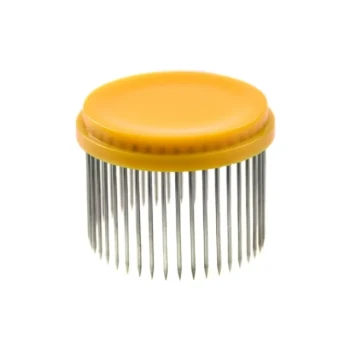
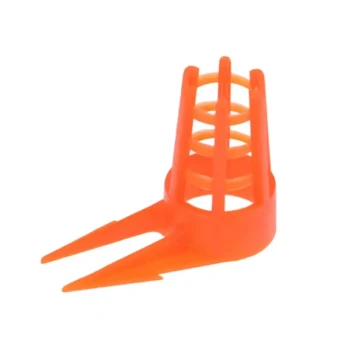
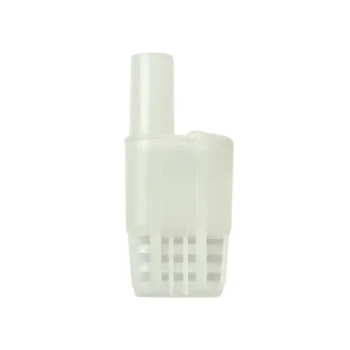
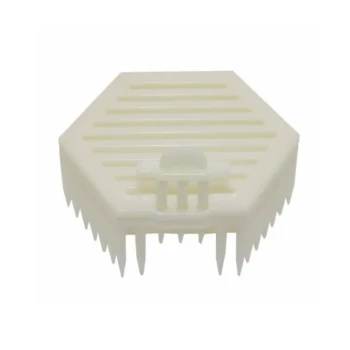
A push-in cage with a queen excluder is a precision research instrument used to isolate a queen honeybee on a specific section of comb to strictly control the timeline of egg-laying. By physically confining the queen to a small area, researchers can mandate that all eggs within that patch are laid within a specific window—typically 24 hours—guaranteeing age synchronization.
The push-in cage solves the problem of temporal variability in the hive. It permits the natural care of the queen by worker bees while restricting her movement, providing researchers with a controlled batch of eggs necessary for developmental benchmarks.
The Mechanics of Control
Precise Spatial Confinement
The primary mechanical function of the push-in cage is to delineate a specific boundary on the comb.
By pressing the cage into the wax, the queen is physically prevented from wandering across the frame. This forces her to lay eggs solely within the enclosed cells, creating a localized sample set for study.
Selective Permeability
The cage utilizes "queen excluder" material or spacing in its design.
This specific spacing is critical because it allows smaller worker bees to pass through the barrier freely to feed and groom the queen. This ensures the queen remains healthy and socially integrated with the colony despite her confinement.
Experimental Applications
Synchronization for Developmental Studies
In biological research, knowing the exact age of an organism is often a prerequisite for valid data.
Because the queen is confined for a known duration (e.g., 24 hours), any egg found inside the cage after release is guaranteed to be within that specific age range. This eliminates guesswork regarding the developmental stage of the brood.
Environmental Stress Testing
The push-in cage is vital for experiments measuring how hives react to external pressures.
By creating a controlled cohort of eggs, researchers can subject the hive to environmental stressors and measure the impact on a specific generation of bees. This isolates variables better than observing a naturally laid, mixed-age brood pattern.
Operational Considerations and Constraints
Limited Laying Capacity
The surface area of a push-in cage is significantly smaller than the queen's natural range.
If the queen is confined for too long, she may run out of empty cells in which to lay. This requires researchers to carefully time the confinement period to match the available space within the cage.
Installation Disturbance
Unlike a standard hive-body excluder, a push-in cage requires physical manipulation of the comb itself.
The researcher must open the hive, locate the queen, and manually install the cage on a drawn comb. This process carries a slight risk of disturbing the colony or damaging the comb structure if not done with care.
Applying This to Your Research
If you are designing an experiment involving honeybee brood, choose your method based on the level of precision required:
- If your primary focus is developmental biology: Use the push-in cage to generate a "zero-hour" cohort of eggs where the exact age is the critical variable.
- If your primary focus is general hive management: Do not use a push-in cage; rely on standard full-frame queen excluders to separate brood chambers from honey supers.
- If your primary focus is locating the queen: Use a standard excluder between hive bodies to isolate her location over a 3-day period rather than using a push-in cage.
By leveraging the selective barrier of the push-in cage, you transform the chaotic nature of the hive into a controlled laboratory environment.
Summary Table:
| Feature | Function | Benefit for Researchers |
|---|---|---|
| Spatial Confinement | Isolates queen to a specific comb area | Creates localized, easy-to-track sample sets |
| Selective Permeability | Allows workers to pass; blocks the queen | Ensures queen health via natural social care |
| Temporal Control | Mandates laying within a fixed window | Guarantees age-synchronized brood (e.g., 24h) |
| Selective Barrier | Minimizes physical movement of queen | Enables controlled environmental stress testing |
Elevate Your Beekeeping Efficiency with HONESTBEE
Precision is the backbone of successful beekeeping, whether you are conducting advanced biological research or managing a large-scale commercial apiary. HONESTBEE is dedicated to supporting commercial apiaries and distributors with a comprehensive wholesale selection of professional-grade beekeeping tools, machinery, and essential consumables.
From specialized hardware like hive-making and honey-filling machines to a full spectrum of hive management equipment and unique honey-themed cultural merchandise, we provide the high-quality tools you need to optimize your production and scale your business.
Ready to upgrade your apiary’s performance? Contact us today to explore our wholesale offerings and discover how our expertise can drive your success.
References
- Sarah R. Preston, Clare C. Rittschof. The impacts of maternal stress on worker phenotypes in the honey bee. DOI: 10.1007/s13592-019-00680-1
This article is also based on technical information from HonestBee Knowledge Base .
Related Products
- Premium Wood and Steel Push In Queen Cage
- Professional Round Push-In Queen Cage with Metal Tines
- Wood and Mesh Push-In Queen Cage
- Durable Plastic Push In Queen Bee Cage
- Professional Bamboo Queen Isolation Cage
People Also Ask
- What advantages do push-in queen cages offer? Boost Acceptance Rates for Artificially Inseminated Queens
- What is a push-in queen cage and how does it differ from a standard queen cage? Boosting Your Queen Acceptance Rates
- What is a push-in queen cage and how does it differ from standard cages? Achieve Higher Queen Acceptance Rates
- How can a beekeeper obtain a push-in queen cage? DIY vs. Professional Sourcing Guide
- When is a queen introduced with a push-in cage ready for full release? Key Signs for Maximum Colony Acceptance