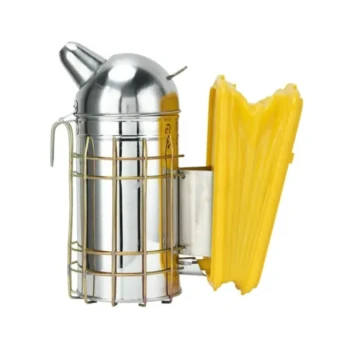
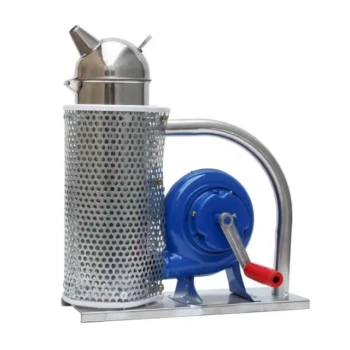
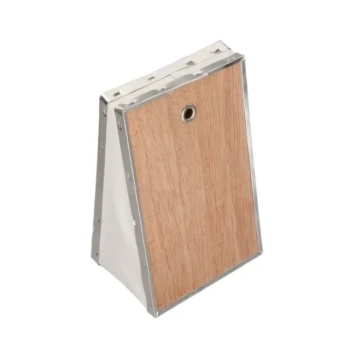
An industrial-grade bee smoker serves as a thermodynamic delivery system. In the context of Varroa destructor fumigation, its primary function is to burn carriers saturated with plant essential oils, effectively converting these liquid treatments into smoke containing active volatile substances.
The smoker acts as a conversion engine, transforming botanical treatments into a pervasive aerosol that penetrates the hive’s deepest crevices to ensure full contact with parasitic mites.
The Mechanics of Volatile Delivery
Thermodynamic Conversion
The core mechanism of the smoker is controlled combustion. It burns a carrier material—often dried botanical matter—that has been saturated with essential oils.
Through this process, the device utilizes heat to release insecticidal compounds from the oils. This converts the treatment from a static liquid or solid state into a dynamic, airborne form.
Generating Active Smoke
The output is not merely smoke, but a carrier for active volatile substances. The smoker facilitates pyrolysis, breaking down the material just enough to vaporize the active ingredients without destroying their chemical potency.
This results in the production of tiny aerosol particles. These particles act as vehicles for the acaricidal (mite-killing) components of the essential oils.
Ensuring Comprehensive Coverage
Deep Hive Permeation
The primary advantage of using a smoker is its ability to bypass physical barriers. Unlike contact strips, the smoke generated permeates every corner of the beehive.
It flows freely through the hive environment, utilizing the physical properties of gas expansion to fill the total volume of the box.
Targeting the Bee Cluster
Varroa mites often hide within the tight spaces of the bee cluster or within comb gaps. The smoker forces the active ingredients into the gaps within the bee cluster.
This ensures that the treatment makes full contact with mites parasitizing adult bees. The high permeability allows the treatment to reach areas that manual spraying or static strips might miss.
Understanding the Operational Factors
The Importance of Controlled Output
While effective, the smoker relies on standardized and quantitative output. As noted in technical assessments, the device must function as a directional delivery tool.
It allows for the localized and precise application of treatment. However, the user must ensure the combustion remains controlled to maintain a steady release of volatiles rather than a rapid, destructive burn.
Diffusion Characteristics
The effectiveness of the fumigation depends on the smoke's diffusion characteristics. The smoker is designed to pressurize the smoke sufficiently to distribute it uniformly.
If the smoke pressure is too low, it may not penetrate deep crevices; if too high, it could disrupt the colony unnecessarily. The device balances these needs to maximize insecticidal efficacy.
Making the Right Choice for Your Goal
When integrating a smoker into your Varroa management strategy, consider your specific objective:
- If your primary focus is maximum eradication: Prioritize the permeation capability of the smoker to ensure the volatile smoke reaches mites hiding in the center of the bee cluster.
- If your primary focus is research or dosage testing: Rely on the smoker’s ability to provide a standardized output, allowing you to measure the exact diffusion and efficacy of specific botanical fumigants.
The bee smoker is not just a tool for calming bees; it is a sophisticated instrument for the thermodynamic dispersion of miticides.
Summary Table:
| Feature | Mechanism | Benefit for Varroa Control |
|---|---|---|
| Thermodynamic Conversion | Controlled combustion of essential oil carriers | Transforms liquid treatments into active volatile aerosols. |
| Aerosol Generation | Pyrolysis-based vaporization | Creates fine particles that carry acaricidal compounds to mites. |
| Deep Permeation | Gas expansion and pressure | Reaches every corner, gap, and crevice within the beehive. |
| Cluster Penetration | Forced air delivery | Ensures contact with mites hiding inside the dense bee cluster. |
| Directional Output | Pressurized and localized application | Allows for standardized, quantitative dosing for maximum efficacy. |
Scale Your Apiary Operations with HONESTBEE Precision Equipment
Efficient Varroa destructor management is critical for the success of commercial apiaries and distributors. HONESTBEE provides the industrial-grade beekeeping tools and machinery you need to ensure colony health and operational productivity. From high-output smokers and hive-making machines to advanced honey-filling systems and essential consumables, our comprehensive wholesale portfolio is designed to support the growth of large-scale beekeeping businesses.
Ready to upgrade your equipment inventory?
Contact us today to discuss your wholesale needs and discover how our specialized beekeeping hardware and cultural merchandise can add value to your professional operation.
References
- دلال مصلح الجدعاني دلال مصلح الجدعاني. فاعلية استخدام بعض الزيوت العطرية النباتية لمكافحة حلم الفاروا Varroa destructor في نحل العسل Apis mellifera L.. DOI: 10.4197/sci.30-2.6
This article is also based on technical information from HonestBee Knowledge Base .
Related Products
- Heavy Duty 12V Oxalic Acid Evaporator Vaporizer for Bee Varroa Mite Treatment Beekeeping Fumigator Atomizer
- 12V Bee Mite Removal Evaporator Oxalic Acid Vaporizer for Bee Fumigation Treatment 180W Atomization
- Professional Bee Smoker with Elongated Spout and Durable Bellows for Beekeeping
- Heavy-Duty Bee Smoker with Durable Plastic Bellows for Beekeeping
- Miniature Stainless Steel Bee Smoker for Beekeeping
People Also Ask
- How can oxalic acid treatment be applied effectively when capped brood is present? Master the 3-Stage Vapor Protocol
- What are the main advantages of using oxalic acid vaporization for Varroa mite control? Achieve 90%+ Efficacy Safely
- What is the process of using an oxalic acid vaporizer? A Step-by-Step Guide to Safe Varroa Control
- How can oxalic acid vaporization be used effectively in a hive that contains brood? Master Multi-Stage Mite Control
- Why is it necessary to control varroa mite infestations? Protect Your Colony with Oxalic Acid Vaporizers