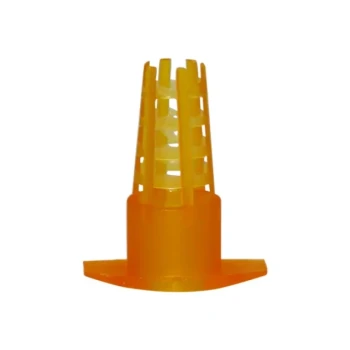
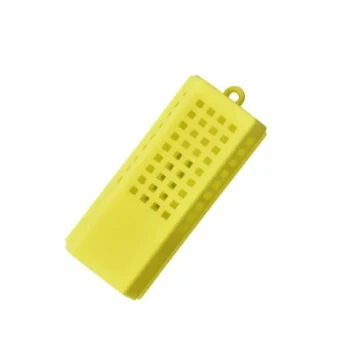
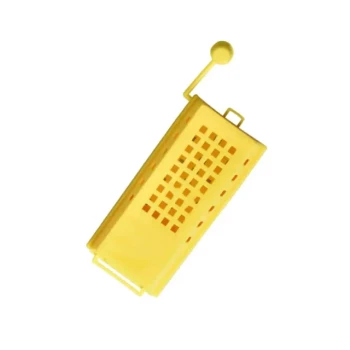
Plastic queen cell cups are specialized artificial vessels designed to replicate the natural environment of a developing queen bee. Their primary function is to serve as a standardized "collection pool" where technicians graft larvae to trick worker bees into filling the cup with royal jelly, while simultaneously acting as a hygienic, durable container for efficient harvesting.
Core Insight: These cups serve a dual purpose: they are a biological trigger that induces bees to mass-produce food for a perceived queen, and an industrial tool that standardizes collection, ensures food safety, and allows for mechanical processing.
Simulating the Biological Environment
Triggering the Nursing Instinct
The fundamental role of the plastic cup is biological induction.
By simulating the shape and structure of a natural queen cell, the cup signals to the colony—specifically nurse bees in a queenless state—that a new queen is being reared.
This prompts the bees to deposit massive quantities of royal jelly into the cup to feed the grafted larva.
Hosting the Transferred Larvae
The cup acts as the physical housing for the grafted worker bee larvae.
Technicians place larvae of a specific age into these cups, which serves as the anchor point for the bees to accept the graft and begin their nursing duties.
Operational Efficiency and Hygiene
Preventing Contamination
A critical advantage of plastic cups, particularly those made of food-grade plastic, is the maintenance of purity.
Unlike wax, which can absorb contaminants, high-quality plastic ensures the royal jelly remains pure and free from external pollutants.
Standardization for Scale
Plastic cups provide a uniform shape and size, which is impossible to achieve perfectly with natural beeswax.
This standardization transforms royal jelly production from an artisanal task into a scalable operation, allowing for precise yield weighing and consistent results across thousands of colonies.
Streamlining Extraction
The rigid structure of plastic facilitates mechanical or semi-mechanical collection.
Because the cups do not deform, the royal jelly can be extracted losslessly, and the cups can be easily cleaned and reused for subsequent production cycles.
Understanding the Trade-offs
Durability vs. Acceptance
While plastic provides superior durability and ease of cleaning, it faces a biological hurdle.
Worker bees naturally prefer beeswax; consequently, pure industrial plastic cups often have lower "acceptance rates" compared to natural wax cells, meaning bees may reject the grafted larvae.
The Hybrid Solution
To mitigate rejection while maintaining durability, many producers use wax-coated plastic cups.
This approach provides the mechanical strength of plastic with the biocompatible texture of wax, significantly increasing the volume of royal jelly deposited by the bees.
Making the Right Choice for Your Goal
When selecting equipment for royal jelly production, the choice of cup material impacts both workflow and yield.
- If your primary focus is Operational Efficiency: Prioritize high-quality food-grade plastic cups, as they allow for rapid cleaning, mechanical harvesting, and long-term reusability.
- If your primary focus is Maximum Acceptance: Utilize wax-coated plastic cups, which combine the durability of industrial tools with the biological appeal required for high larval acceptance rates.
Success in royal jelly production relies on balancing the biological preferences of the bee with the sanitary and mechanical requirements of modern harvesting.
Summary Table:
| Feature | Function in Royal Jelly Production | Benefit to Beekeepers |
|---|---|---|
| Biological Mimicry | Simulates a queen cell to trigger nursing instincts | Induces mass production of royal jelly |
| Larvae Housing | Provides a secure anchor point for grafted larvae | Increases graft acceptance and success rates |
| Food-Grade Material | Non-porous surface prevents absorption of impurities | Ensures high purity and food safety standards |
| Rigid Structure | Maintains shape during mechanical extraction | Allows for faster, lossless jelly collection |
| Standardization | Uniform size across all production frames | Facilitates scalable and predictable yields |
Scaling Your Royal Jelly Production?
As a professional distributor or commercial apiary, your success depends on the reliability and hygiene of your equipment. HONESTBEE specializes in empowering large-scale operations with premium food-grade beekeeping tools and advanced machinery.
Whether you need high-acceptance queen cell cups, specialized hive-making machines, or efficient honey-filling solutions, our comprehensive wholesale portfolio is designed to maximize your efficiency and output.
Partner with HONESTBEE to elevate your apiary's performance.
Contact Our Wholesale Experts Today
References
- A. Hussain, Amr Badwy. Effect of Different Seasons on the Royal Jelly Production Under Nasr City Conditions – Cairo - Egypt. DOI: 10.21608/eajbsa.2020.110603
This article is also based on technical information from HonestBee Knowledge Base .
Related Products
- JZBZ Type Wide Base Plastic Queen Cell Cups for Base Mounting and Queen Rearing
- Clear Black Plain Polystyrene Queen Bee Grafting Cell Cups No Lug for Bee Queen Cup
- High-Efficiency 20-Cell Silicone Mold for Beeswax Bee Queen Cup Production
- Plastic Chinese Queen Grafting Tool for Bee Queen Rearing
- Brown Nicot Queen Cell Cups for Breeding Queen Bees Beekeeping
People Also Ask
- What is the primary function of commercial plastic queen cell cups? Driving Efficiency in Mass Queen Rearing
- What are the primary advantages of using plastic queen cell cups? The Industrial Choice for High-Efficiency Apiaries
- What technical advantages do commercial plastic queen cell cups offer? Scale Your Queen Rearing for Maximum Efficiency
- What is the function of standardized plastic Queen Cell Cups? Boost Efficiency in Commercial Larval Grafting
- Why are standardized plastic queen cell cups preferred? Boost Commercial Queen Rearing Efficiency