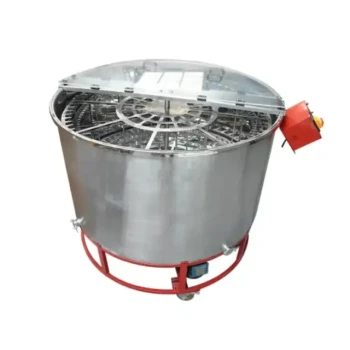
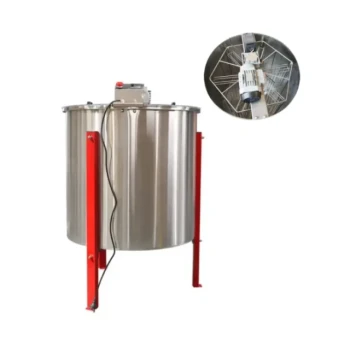
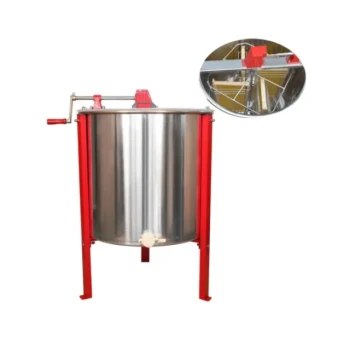
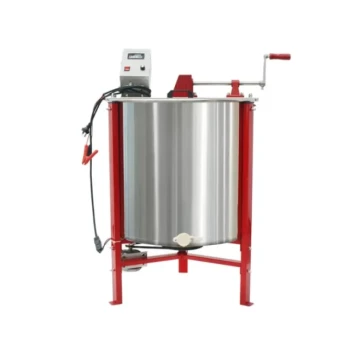
The general process for extracting honey with an extractor relies on centrifugal force to separate liquid honey from the wax comb without destroying the frame. It is a systematic workflow involving uncapping the sealed cells, spinning the frames in a drum, and filtering the resulting flow for purity.
Success in extraction is defined by maximizing yield while preserving the comb. By ensuring frames are completely uncapped and balanced within the extractor, you allow the bees to reuse the empty frames immediately, significantly speeding up future production.
Phase 1: Preparation and Uncapping
Removing the Frames
The process begins at the hive. You must carefully remove the frames filled with capped honey.
Before bringing frames to your extraction area, use a bee brush to gently wipe away any lingering bees. This prevents introducing live bees into your processing space.
Exposing the Honey
Honey is sealed behind wax caps, which must be removed for the honey to flow.
Use an uncapping knife (hot or cold) or a specialized fork to slice or scratch off the wax layer sealing each cell. This exposes the stored honey, preparing it for the centrifugal force of the extractor.
Phase 2: The Extraction Phase
Loading the Extractor
Place the uncapped frames vertically into the extractor's baskets.
It is critical to distribute the weight evenly inside the drum. An unbalanced load can cause the extractor to wobble violently during the spin cycle.
The Spinning Process
Activate the extractor by turning the hand crank or switching on the electric motor.
The drum should spin for approximately 5 to 6 minutes to fling the honey out of the cells and onto the inner walls of the drum.
Managing Frame Orientation
The type of extractor you use dictates the workflow during the spin.
If using a tangential extractor, you must stop halfway through, physically flip the frames, and spin again to empty the second side. If using a radial extractor (or reversible motor), you simply reverse the spin direction to clear both sides of the comb.
Phase 3: Collection and Sanitation
Draining and Filtering
Once the frames are empty, gravity pulls the honey down the inner walls to the bottom of the drum.
Open the honey gate (typically 1 1/2 inch) at the base of the extractor. Allow the honey to flow into a collection bucket.
Removing Impurities
As the honey drains, it should pass through a strainer or filtration system.
A multi-micron system (ranging from 200 to 600 microns) is ideal. This removes wax bits and debris while allowing pollen and the honey itself to pass through cleanly.
Understanding the Trade-offs
Speed vs. Comb Integrity
While centrifugal force is efficient, spinning too fast too early can be destructive. If the heavy honey is forced out too violently, it can "blow out" the wax foundation, destroying the comb. Start slowly and build speed gradually.
Sanitation vs. Convenience
The final step—cleaning—is often the most neglected but is technically vital.
You must thoroughly clean the extractor after every use. Failing to do so not only degrades the equipment but risks spreading disease between colonies if the equipment is shared or reused without sanitation.
Making the Right Choice for Your Goal
- If your primary focus is efficiency and volume: Prioritize an electric extractor with a radial basket design to eliminate the manual labor of flipping frames.
- If your primary focus is budget or small-scale hobbyist beekeeping: A manual, tangential extractor is sufficient, though it requires more physical effort and time to flip frames mid-cycle.
Mastering the extraction process is the bridge between a healthy hive and a high-quality harvest.
Summary Table:
| Extraction Stage | Key Equipment | Primary Goal | Duration/Spec |
|---|---|---|---|
| Uncapping | Uncapping Knife/Fork | Expose honey by removing wax seals | Entire frame surface |
| Spinning | Extractor (Manual/Electric) | Use centrifugal force to empty cells | 5 - 6 minutes |
| Orientation | Radial vs Tangential | Ensure honey is cleared from both sides | Flip frames if Tangential |
| Filtration | 200-600 Micron Strainer | Remove wax particles and debris | Multi-micron system |
| Sanitation | Warm Water / Food-grade Cleaner | Prevent disease and maintain equipment | Post-extraction |
Scale Your Honey Production with HONESTBEE
At HONESTBEE, we specialize in empowering commercial apiaries and distributors with the high-performance tools needed to streamline your harvest. Whether you are looking for high-capacity radial extractors, automated honey-filling machines, or specialized hive-making equipment, our comprehensive wholesale portfolio has you covered.
Why partner with us?
- Full-Spectrum Supply: From heavy machinery to essential industry consumables.
- Commercial Grade: Durable hardware designed for high-volume efficiency.
- Global Support: Tailored solutions for professional beekeepers and distributors.
Ready to upgrade your extraction facility or expand your product line? Contact us today to discuss your wholesale needs and see how our expertise can drive your business growth.
Related Products
- HONESTBEE 72 Frame Industrial Electric Honey Extractor for Beekeeping
- Commercial Electric 12 Frame Honey Extractor Spinner Motorized Honey Extractor
- HONESTBEE 3-Frame Manual Acrylic Honey Extractor
- electric honey extractor honey centrifuge 3 frame honey extractor stainless steel honey frame extractor
- HONESTBEE 6 Frame Self Reversing Electric Honey Extractor for Beekeeping
People Also Ask
- What is the importance of balancing honeycomb frames within a honey extractor? Ensure Stability and Protect Machinery
- How is honey separated from the frames after they are uncapped? Efficient Extraction Methods for High Yields
- What are the main benefits of using a honey extractor? Maximize Yields and Protect Your Honeycomb
- What are the recommended methods for removing honey from the honeycomb? Top Extraction Techniques for Maximum Efficiency
- How do manual honey extractors compare to electric honey extractors? Choosing the Right Tool for Your Apiary Growth