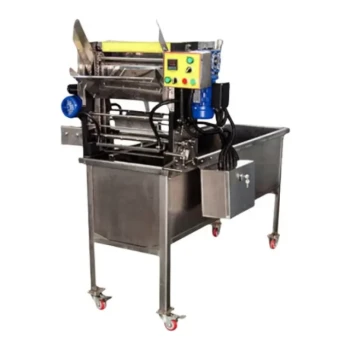
Automated honey filling equipment serves as the critical final checkpoint for organic integrity. By utilizing high-hygiene designs and closed-loop operations, these systems prevent secondary contamination during the vulnerable post-processing stage. This technology is essential for ensuring that the purity established at the hive is maintained through to the final jar, satisfying the strict traceability and safety requirements of premium retail channels.
Organic honey loses its value if contamination occurs during packaging. Automated equipment bridges the gap between raw production and commercial retail by enforcing a sterile, traceable, and standardized filling environment that manual processing cannot guarantee.
Preserving Purity Through Sanitary Design
Eliminating Secondary Contamination
The primary risk to organic honey during post-processing is secondary contamination. Manual handling introduces variables—from human contact to environmental exposure—that can compromise the product's organic status. High-hygiene automated equipment removes these risks by isolating the honey from external factors.
The Role of Food-Grade Materials
To comply with organic standards, the machinery itself must not alter the chemical composition of the product. Automated systems utilize food-grade stainless steel for all pump bodies and pipelines. This ensures that the honey travels through a neutral, sterile pathway that prevents chemical leaching or interaction.
Closed-Loop Operations
Automated fillers employ closed-loop operations to move honey from bulk storage to individual jars. This sealed environment is critical for maintaining hygiene levels that meet food safety regulations. It prevents airborne particulates and biological contaminants from entering the workflow.
Meeting Regulatory and Market Standards
Ensuring Traceability
For organic honey, proving the origin of the product is as important as the quality of the product itself. Automated systems offer precise metering and data capabilities that support food safety traceability requirements. This data trail is often a prerequisite for obtaining organic certification labels.
Accessing Premium Retail Channels
Premium retailers demand more than just good honey; they demand standardization. Automated equipment provides the standardized packaging support necessary for shelf consistency. Without the precise volume control and uniform sealing provided by automation, organic producers often struggle to enter high-end commercial markets.
Protecting Chemical and Physical Properties
Minimizing Oxidation and Moisture
Honey is hygroscopic, meaning it absorbs moisture from the air, which can lead to fermentation or spoilage. The controlled environment of automated fillers reduces contact with atmospheric moisture. Furthermore, by minimizing air exposure, the equipment helps preserve the honey's natural antioxidant activity and prevents increases in acidity caused by oxidation.
Handling Viscosity with Care
Different organic honeys, such as fluid blossom or thick chestnut honey, have vastly different flow rates. Automated machines adjust to these specific viscosities to fill jars without excessive heating or agitation. This preserves the nutritional components and physical texture that consumers expect from a raw, organic product.
Understanding the Trade-offs
The Maintenance Imperative
While automation prevents human contamination, the machines themselves can become contamination vectors if not maintained. Complex pump systems and nozzles require rigorous cleaning protocols. If residue is left in the pipelines between batches, it can ferment or cross-contaminate subsequent runs, negating the benefits of the technology.
Complexity and Cost
Implementing high-end traceability and closed-loop systems represents a significant capital investment. For smaller organic apiaries, the cost of industrial-grade stainless steel equipment may outweigh the immediate benefits of increased throughput. The shift to automation requires a business model capable of supporting large-scale commercial distribution.
Making the Right Choice for Your Goal
To maximize the value of your organic honey, align your equipment choice with your specific strategic objectives:
- If your primary focus is Regulatory Compliance: Prioritize machines with advanced data logging and traceability features to satisfy organic certification audits.
- If your primary focus is Product Integrity: Select equipment with a fully closed-loop design and anti-drip nozzles to minimize oxygen exposure and preserve nutrient levels.
- If your primary focus is Market Expansion: Invest in high-speed, standardized metering systems that ensure the visual consistency required by major retail chains.
Automation is not merely a tool for speed; it is the infrastructure that transforms raw organic honey into a trustworthy, shelf-ready commodity.
Summary Table:
| Feature | Impact on Organic Honey Quality | Benefit to Producers |
|---|---|---|
| Sanitary Design | Eliminates secondary contamination and chemical leaching | Ensures compliance with organic certification |
| Closed-Loop System | Minimizes oxidation and moisture absorption | Preserves natural antioxidants and prevents spoilage |
| Precise Metering | Provides uniform volume and standardized packaging | Enables access to premium retail channels |
| Traceability Data | Documents the journey from hive to jar | Simplifies food safety audits and labeling |
| Viscosity Control | Maintains nutritional profile without overheating | Protects physical texture and raw honey properties |
Elevate Your Honey Production with HONESTBEE
Transitioning to automated systems is the key to scaling your organic honey business while protecting its purity. HONESTBEE specializes in serving commercial apiaries and distributors with a comprehensive wholesale portfolio. From high-precision honey-filling machines and hive-making hardware to a full spectrum of beekeeping tools and essential consumables, we provide the industrial infrastructure you need to succeed.
Ready to professionalize your packaging and meet premium market standards?
Contact HONESTBEE Today for Custom Equipment Solutions
References
- Cristina Bianca Pocol, Aurica Chirsanova. Organic Beekeeping Practices in Romania: Status and Perspectives towards a Sustainable Development. DOI: 10.3390/agriculture11040281
This article is also based on technical information from HonestBee Knowledge Base .
Related Products
- Fully Automatic Honey Filling Packaging Machine for Processing Line
- Automatic Honey Filling and Filtering Machine for Beekeeping Bottle Filling
- Precision Automated Packaging Turntable Honey Spoon Filling Sealing Packing Machine
- Precision Durable Efficient HONESTBEE Rotary Honey Filling Machine
- Semi Automatic Small Honey Bottle Filling Machine Honey Filler
People Also Ask
- Why are fully automatic honey filling and packaging lines essential? Boost Your Honey's Market Value and Quality
- What is a fully-automatic honey filler? Streamline Your Production with High-Precision Automation
- How do automated honey filling and packaging machines affect profitability? Boost Margins with HONESTBEE Technology
- How do automated honey filling and packaging machines contribute to the market value of honey products? Maximize Your ROI
- How do industrial-grade automated honey filling and packaging machines mitigate the risk of physical contamination?