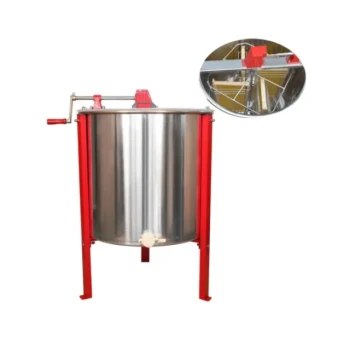
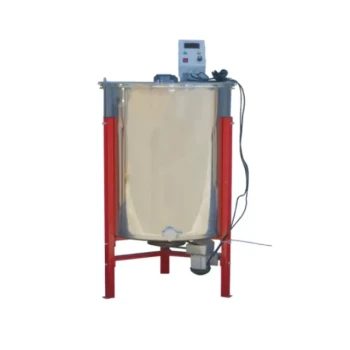
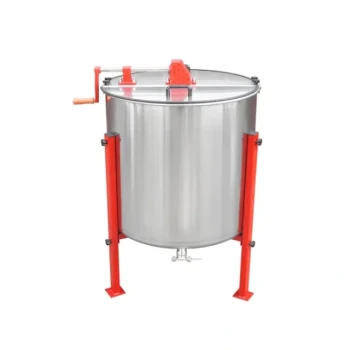
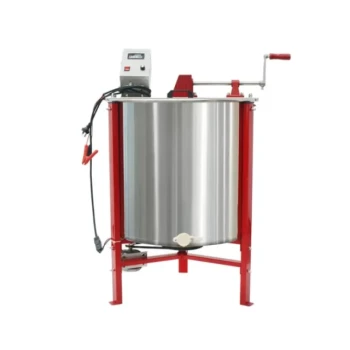
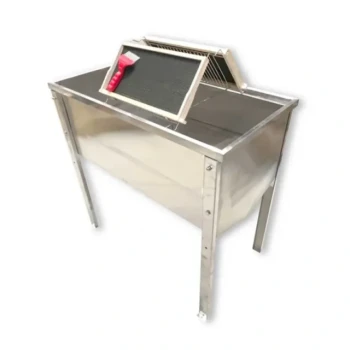
A honey extractor operates on the principle of centrifugal force to remove honey from the comb without destroying it. For the most efficient operation, it is recommended to use a model capable of holding at least four frames at a time.
Core Insight: While smaller units exist, a four-frame capacity acts as the efficiency threshold for most beekeepers. This capacity allows you to process a significant volume of honey rapidly, balancing the physical effort of extraction with the yield from multiple hives.
The Mechanics of Extraction
Harnessing Centrifugal Force
The extractor functions by spinning frames inside a drum or barrel. This rotation creates centrifugal force, which flings the liquid honey out of the wax cells and onto the inner walls of the drum.
Non-Destructive Harvesting
Because this force is applied evenly, the wax comb remains intact. This is a critical advantage over other methods, as it allows beekeepers to return the drawn comb to the hive, saving the bees the energy required to rebuild it.
Vertical Integration
Frames are placed vertically into baskets or holders within the drum. Gravity allows the honey that hits the walls to flow down to a "honey gate" or spigot at the bottom for collection.
Optimizing for Efficiency
The Four-Frame Standard
To maximize your workflow, the primary recommendation is to select an extractor that accommodates at least four frames. While two-frame manual models exist, the time savings provided by a four-frame unit significantly streamlines the harvesting process.
Multi-Hive Capability
A single extractor is a versatile tool designed to service multiple beehives. You do not need separate equipment for different colonies; a properly sized unit can handle the harvest from an entire apiary in batches.
Material Selection for Longevity
Efficiency is also about maintenance. The best models are constructed from stainless steel. This material is resistant to rust and moisture, ensures a long service life, and is easy to clean—a vital factor for food hygiene.
Stability
Ensure the legs of the unit are also made of thick stainless steel. High-speed spinning creates vibration; sturdy legs stabilize the unit, preventing breakage and making the work safer.
The Extraction Workflow
Preparation
Before the frames enter the extractor, you must use a bee brush to gently remove any lingering bees. Next, the wax cappings must be removed from the cells to allow the honey to flow freely.
The Spinning Cycle
Once the frames are loaded vertically, spin them for approximately 5 to 6 minutes. This duration is sufficient to empty the cells without applying excessive force that might damage the comb.
Reversing for Complete Extraction
Honey is stored on both sides of a frame. After the first cycle, you must reverse the spinning direction to extract the second side. In tangential models, this often requires physically removing and flipping the frames by hand.
Understanding the Trade-offs
Manual vs. Motorized Power
Manual extractors use a hand crank. They are cost-effective and available in 2 to 4-frame sizes, making them suitable for hobbyists. However, they require significant physical effort.
Motorized extractors use an electric motor. They offer speed, convenience, and precise speed control, which helps protect delicate combs from damage. They are ideal for commercial operations or beekeepers with many hives who value time over initial cost.
Capacity Constraints
While radial extractors can hold anywhere from 4 to over 100 frames, tangential extractors typically cap out at 3 to 6 frames. If you choose a tangential model, you must accept the workflow interruption of manually flipping frames halfway through the process.
Making the Right Choice for Your Goal
- If your primary focus is efficiency and speed: Choose a motorized radial extractor with a capacity of at least 4 frames to automate the spinning and eliminate manual flipping.
- If your primary focus is budget and small-scale hobbying: A manual stainless steel extractor (2 to 4 frames) is sufficient, provided you are prepared for the physical labor involved.
- If your primary focus is durability: Prioritize a unit made entirely of stainless steel, including the drum and the legs, to ensure stability and resistance to corrosion.
Select the capacity that matches your future growth, not just your current hive count.
Summary Table:
| Feature | Manual Honey Extractor | Motorized Honey Extractor |
|---|---|---|
| Core Principle | Centrifugal Force | Centrifugal Force |
| Recommended Capacity | 2–4 Frames | 4–100+ Frames |
| Power Source | Hand Crank | Electric Motor |
| Best Material | Stainless Steel | Stainless Steel |
| Key Advantage | Cost-effective / Portable | High speed / Labor-saving |
| Recommended For | Hobbyists (1-5 hives) | Commercial Apiaries / Scaling |
Maximize Your Harvest Efficiency with HONESTBEE
At HONESTBEE, we specialize in empowering commercial apiaries and beekeeping distributors with high-performance tools and machinery. Whether you need a 4-frame manual starter or a high-capacity motorized honey-filling production line, our comprehensive wholesale offering has you covered.
Why partner with HONESTBEE?
- Industrial Durability: Our extractors and hive-making machines are built with premium stainless steel for long-term ROI.
- Complete Supply Chain: From specialized machinery to essential industry consumables and honey-themed cultural merchandise.
- Tailored Solutions: We understand the unique needs of large-scale operations and distributors.
Ready to upgrade your extraction workflow or stock your distribution center? Contact us today to receive a custom quote and catalog!
Related Products
- HONESTBEE 4 Frame Manual Self Reversing Honey Extractor for Beekeeping
- Manual Hand Crank 4 Frame Honey Extractor Centrifuge for Beekeeping
- Electric 4 Frame Tangential Honey Extractor
- Professional 4 Frame Self Reversing Electric Honey Extractor for Beekeeping
- Stainless Steel Manual 8 Frame Radial Honey Extractor Machine for Beehives
People Also Ask
- What is the primary function of a DC motor in a self-reversing honey extractor? Master Precision Honey Extraction
- What are the disadvantages of a manual honey extractor? Overcome Efficiency Bottlenecks in Your Apiary
- What is a manual honey extractor? The Essential Guide to Cost-Effective Beekeeping for Beginners
- Why are manual extractors popular among beginner beekeepers? A Guide to Starting Simple & Saving Money
- Which type of honey extractor is generally more durable? Focus on Material & Build Quality for Longevity