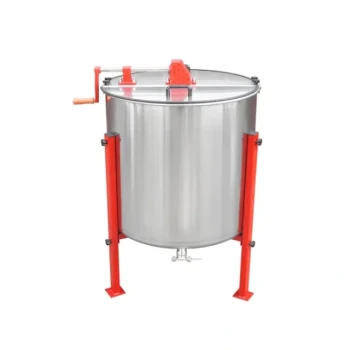
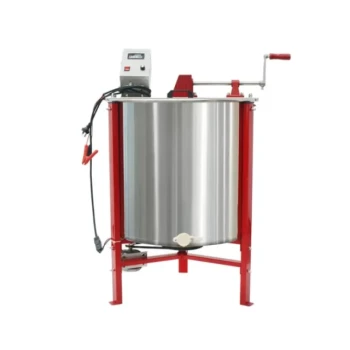
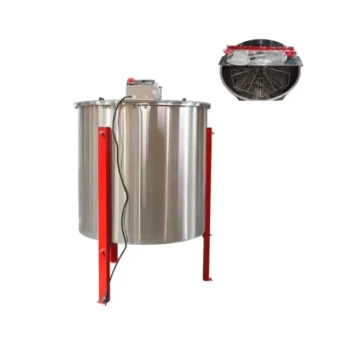
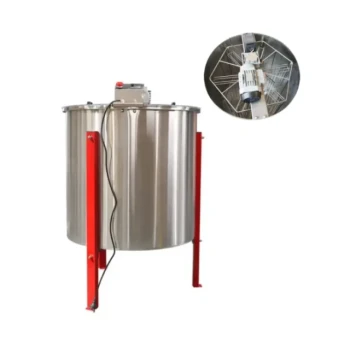
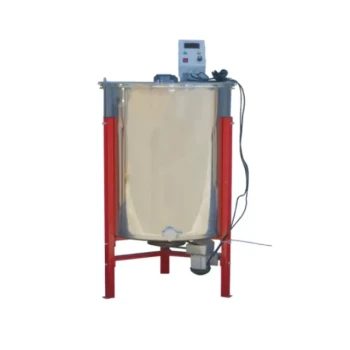
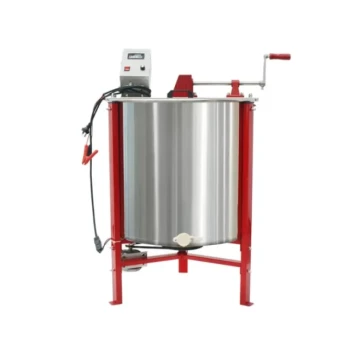
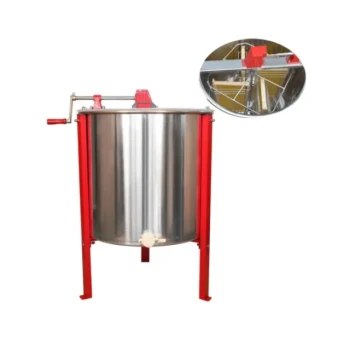
The primary advantage of a radial honey extractor is the ability to extract honey from both sides of a frame simultaneously without stopping the machine. By aligning the frames like the spokes of a wheel, radial extractors utilize centrifugal force to draw honey out of both sides of the comb in a single continuous operation.
This design eliminates the labor-intensive need to manually flip frames, which is a required step in tangential extraction. Consequently, radial extractors significantly reduce the time and physical effort required per batch, making them the superior choice for efficiency.
The core value of a radial extractor is workflow optimization: it transforms extraction from a multi-step, stop-and-start process into a "load it and leave it" operation, allowing beekeepers to process higher volumes with less manual intervention.
The Mechanics of Simultaneous Extraction
The "Spoke" Orientation
Unlike tangential extractors where the comb face sits flat against the drum wall, radial extractors hold frames perpendicular to the wall.
The frames are positioned like the spokes of a bicycle wheel. The top bar of the frame faces the outer wall of the drum, while the bottom bar faces the center axis.
Utilizing Centrifugal Force
As the drum spins, centrifugal force acts outwards from the center. Because of the "spoke" alignment, this force pulls the honey upward and outward from the cells on both sides of the mid-rib simultaneously.
This allows the honey to flow freely out of the comb without the honey on the inner side being pressed against the wire or foundation, which can happen in tangential models.
Operational Efficiency and Workflow
Eliminating the "Flip"
In a standard tangential setup, you can only spin one side of the frame at a time. The operator must spin the first side, stop the machine, pull the frame out, flip it, and re-insert it to spin the second side.
To prevent heavy honey from breaking the wax comb, tangential users often have to perform a complex "spin, flip, spin, flip, finish" routine. Radial extractors remove this entire sequence. Once you load the frames and close the lid, the process runs to completion without interruption.
Scalability for Beekeepers
Because the process is continuous, radial extractors are far better suited for managing multiple hives. While they are available in manual models, they are most often motorized to handle larger batches.
This efficiency makes them the standard for commercial beekeepers or serious hobbyists who value their time over the lower upfront cost of equipment.
Understanding the Trade-offs
Extraction Thoroughness vs. Speed
While radial extractors are faster, tangential extractors can technically be more thorough. Because the comb face is perpendicular to the force in a tangential model, it can sometimes extract a slightly higher percentage of honey from the frame.
However, for most beekeepers, the time saved by using a radial model far outweighs the negligible amount of honey left behind.
Cost and Complexity
Radial extractors are generally more expensive than their tangential counterparts. They are precision instruments often designed for larger capacities.
For a hobbyist with only one or two hives, the speed advantage of a radial extractor may not justify the higher price tag compared to a simple, affordable tangential unit.
Making the Right Choice for Your Apiary
Choosing between these extractor types ultimately comes down to the number of hives you manage and how much you value your time.
- If your primary focus is efficiency and volume: You should invest in a radial extractor to automate the process and eliminate the physical labor of flipping frames.
- If your primary focus is budget and small-scale maintenance: You are likely better served by a tangential extractor, which offers a lower barrier to entry for managing just a few colonies.
The right tool is the one that balances your budget with the reality of your harvest workload.
Summary Table:
| Feature | Radial Honey Extractor | Tangential Honey Extractor |
|---|---|---|
| Primary Mechanism | Frames arranged like spokes; spins both sides at once | Frames flat against the drum; spins one side at once |
| Labor Intensity | Low (No manual flipping required) | High (Requires stopping and flipping frames) |
| Processing Speed | Fast; continuous operation | Slow; multi-step process |
| Best Suitability | Commercial apiaries and serious hobbyists | Small-scale hobbyists (1-2 hives) |
| Extraction Efficiency | High volume, time-saving | High thoroughness for individual frames |
Scale Your Honey Production with HONESTBEE
Are you ready to transform your harvest from a labor-intensive chore into a streamlined operation? HONESTBEE specializes in supporting commercial apiaries and distributors with high-performance beekeeping machinery.
From advanced radial honey extractors and honey-filling machines to durable hive-making equipment and essential industry consumables, we provide the full spectrum of tools you need to grow your business. Our wholesale solutions are designed to reduce your physical labor and maximize your output.
Take your apiary to the next level—contact us today for wholesale inquiries and expert equipment advice!
Related Products
- 24 Frame Honey Extractor Commercial Radial Honey Frame Extraction Machine
- Stainless Steel Manual 8 Frame Radial Honey Extractor Machine for Beehives
- 6 Frame Manual Stainless Steel Honey Extractor Beekeeping Equipment
- HONESTBEE 8 Frame Electric and Manual Three Use Honey Extractor
- Electric 4 Frame Tangential Honey Extractor
People Also Ask
- How does a radial honey extractor leverage the natural structure of a honeycomb? Optimize Your Apiary's Efficiency
- How do modern honey extraction machines improve harvest efficiency? Boost Your Yield with Radial Technology
- Why must the head of the honey comb be placed near the center axis? Protect Your Comb During Radial Extraction
- Why is the width of iron rings varied for radial honey extractor tilt? Optimize Your Harvest with Precise Engineering
- What are the operational differences between radial and tangential honey extractors? Maximize Your Harvest Efficiency