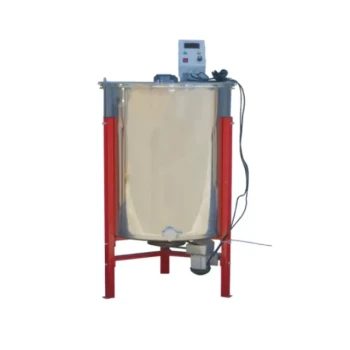
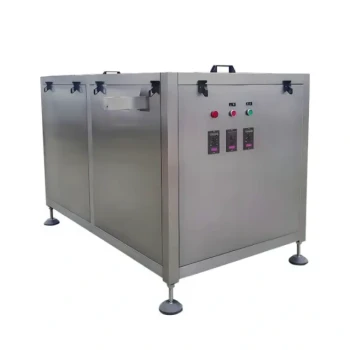
The primary function of an industrial centrifuge is to extract liquid honey from uncapped, broodless honeycombs utilizing high-speed rotational force. Unlike passive gravity drainage, this machine applies mechanical energy to forcibly expel honey from the comb cells, significantly increasing both the speed of extraction and the total volume of honey recovered.
By replacing slow gravitational flow with rapid physical separation, the centrifuge maximizes production efficiency and yield while maintaining the biological integrity of the honey and the structural integrity of the beeswax frames.
The Mechanism of Extraction
Generating Centrifugal Force
The machine spins honeycomb frames at high velocities within a drum. This rotation creates a powerful outward force that overcomes the natural viscosity of the honey, pulling it cleanly away from the wax cells.
Purely Physical Separation
This process relies entirely on physical motion rather than chemical solvents or excessive heat. It effectively separates the liquid honey from the solid wax structure without altering the fundamental composition of the product.
Efficiency and Conservation
Maximizing Recovery Rates
Natural gravity methods often leave significant honey residues inside the comb. Centrifuges ensure a near-complete extraction, minimizing waste and maximizing the total yield per hive.
Protecting the Honeycomb Structure
A critical advantage of this method is that the wax frame remains physically intact during spinning. Because the structure is not crushed or destroyed, beekeepers can return the empty frames to the hive for immediate reuse.
Enhancing Apiary Productivity
Reusing frames saves bees the immense energy and time required to rebuild wax combs. This allows the colony to focus immediately on refilling the cells, significantly boosting production efficiency for commercial apiaries.
Preservation of Quality
Maintaining Bioactivity
Industrial centrifuges operate effectively without the need for heating. This preserves heat-sensitive nutritional components, such as natural enzymes and proteins, which are vital for maintaining the honey's quality and "raw" status.
Ensuring Hygiene and Purity
The machinery facilitates extraction within a controlled, enclosed environment. This supports food safety compliance and provides high-purity samples necessary for accurate pollutant residue analysis.
Operational Considerations and Trade-offs
Energy Consumption
Generating sufficient rotational speed requires significant power. Consequently, the centrifuge is typically the primary energy-consuming component in the honey extraction line.
Strict Pre-processing Requirements
The process is not effective on raw, sealed frames. Honeycombs must be "uncapped" (wax seals removed manually or mechanically) and must be strictly broodless (free of larvae) before they can be processed.
Making the Right Choice for Your Operation
Incorporating a centrifuge transforms honey harvesting from a passive task to an active, high-efficiency process.
- If your primary focus is Commercial Scalability: Prioritize the machine's ability to preserve honeycomb frames, as reusing drawn comb is the single biggest factor in increasing future harvest speeds.
- If your primary focus is Product Quality: Leverage the centrifuge's cold-process capability to market your product as raw and bioactive, retaining all original enzymatic values.
The industrial centrifuge is the definitive tool for scaling honey production without sacrificing the biological quality of the harvest.
Summary Table:
| Feature | Benefit in Honey Extraction |
|---|---|
| Mechanism | High-speed centrifugal force replaces slow gravity drainage |
| Recovery Rate | Near-complete extraction, minimizing honey residue in cells |
| Frame Preservation | Keeps wax frames intact for immediate reuse by bee colonies |
| Honey Quality | Cold-process extraction preserves enzymes and raw bioactivity |
| Efficiency | Significant reduction in processing time for commercial scales |
| Purity | Enclosed environment ensures food safety and hygienic standards |
Scale Your Honey Production with HONESTBEE
Are you ready to elevate your commercial apiary's efficiency? At HONESTBEE, we specialize in empowering commercial apiaries and distributors with professional-grade honey extraction machinery and beekeeping tools.
Our industrial centrifuges and honey-filling machines are engineered to maximize your yield while preserving the biological integrity of your harvest. From specialized hive-making hardware to essential industry consumables, we provide the full spectrum of equipment needed to grow your business.
Unlock your apiary's potential—Contact HONESTBEE Today to discuss our wholesale solutions and customized machinery.
References
- Federica Litrenta. Safety and Toxicological Risk Assessment of Northern Algerian Honeys. DOI: 10.3390/agriculture15232421
This article is also based on technical information from HonestBee Knowledge Base .
Related Products
- Manual Hand Crank 4 Frame Honey Extractor Centrifuge for Beekeeping
- electric honey extractor honey centrifuge 3 frame honey extractor stainless steel honey frame extractor
- Professional 4 Frame Self Reversing Electric Honey Extractor for Beekeeping
- Fully Automatic High Speed Centrifugal Bottle Unscrambler
People Also Ask
- What are some tips for achieving efficient honey extraction with a centrifuge extractor? Maximize Your Yield & Efficiency
- What is the proper procedure for maintaining a centrifuge honey extractor? Expert Tips for Longevity and Hygiene
- What are the advantages of using a centrifuge honey extractor? Maximize Yields and Protect Your Honeycombs
- Which type of honey extractor is generally more durable? Focus on Material & Build Quality for Longevity
- What is a manual honey extractor? The Essential Guide to Cost-Effective Beekeeping for Beginners