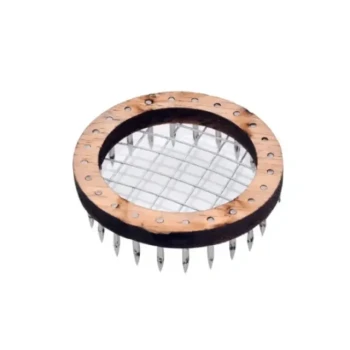
The primary function of converting a standard hive frame with horizontal wooden bars is to create a stable, multi-tiered structure specifically designed for the mass production of queen cells. This modification transforms a general-purpose frame into a specialized "grafting frame" that securely holds rows of artificial queen cups, allowing for the organized rearing and management of multiple queens within a single hive.
By compartmentalizing the open space of a standard frame, these horizontal bars provide the necessary rigidity and spacing to support high-volume grafting. This ensures that delicate queen cells remain secure and accessible for evaluation throughout their development.
The Mechanics of a Queen-Rearing Frame
Structural Stability for Delicate Cells
The most critical role of the horizontal wooden bars is to provide a rigid anchor for artificial queen cups. Without this modification, securing individual cups in a vertical position would be precarious.
The bars prevent the cups from shifting, tilting, or falling out during the delicate grafting process. This stability is equally vital when the frame is handled during inspections or while it sits within the hive environment.
Enabling Mass Production
A standard frame is designed for a continuous sheet of comb, which is inefficient for rearing individual queens. Horizontal bars break the frame’s internal space into distinct "horizontal zones" and "vertical layers."
This layering allows a beekeeper to stack multiple rows of cells in one frame. It maximizes the use of hive resources, enabling the simultaneous production of a large number of queen cells in a compact area.
Facilitating Systematic Evaluation
The use of removable bars supports the precise positioning of larvae. Because the cells are arranged in orderly rows, beekeepers can easily assess larval acceptance rates at a glance.
This organization simplifies the quality control process. You can evaluate the size and health of the resulting queen cells without disturbing the rest of the hive or the other rows on the frame.
Standardized Spacing for Nurse Bees
Beyond structural support, the bars dictate the physical distance between developing queens. Proper spacing is essential for biological success.
The bars ensure that worker bees (nurse bees) have sufficient room to maneuver around each cup. This access allows them to build out the wax efficiently and feed the larvae without the overcrowding that can lead to neglected cells.
Operational Considerations and Trade-offs
Loss of General Utility
It is important to recognize that modifying a frame in this way renders it unusable for standard honey or brood production. The frame becomes a dedicated tool solely for queen rearing.
Increased Maintenance
The addition of wooden hardware introduces more surface area and crevices. These components require regular cleaning to remove propolis and burr wax, ensuring the bars remain removable and the cups sit level.
Optimizing Your Grafting Strategy
To get the most out of your modified queen-rearing frames, consider your specific production goals:
- If your primary focus is mass production: Utilize the maximum number of vertical layers the frame permits to increase the volume of queens produced per hive cycle.
- If your primary focus is strict quality control: Limit the number of cells per bar to ensure nurse bees can lavish maximum resources on each individual larva for superior queen quality.
The horizontal bar modification is the industry standard for turning a chaotic biological process into a managed, scalable system.
Summary Table:
| Feature | Function in Queen Rearing | Benefit to Beekeeper |
|---|---|---|
| Horizontal Bars | Creates a multi-tiered, rigid anchor system | Securely holds rows of artificial queen cups |
| Layered Structure | Breaks open space into vertical zones | Enables mass production within a single frame |
| Standardized Spacing | Ensures room for nurse bee maneuvers | Maximizes larval feeding and cell development |
| Systematic Layout | Organizes cells into orderly rows | Simplifies quality control and acceptance checks |
Elevate Your Apiary’s Productivity with HONESTBEE
At HONESTBEE, we understand that precision is the backbone of successful queen rearing and commercial honey production. As a dedicated partner to commercial apiaries and distributors, we provide a comprehensive wholesale range of professional-grade beekeeping tools, specialized machinery, and essential consumables.
Whether you are scaling up with hive-making and honey-filling machines or need high-quality components for grafting and queen management, our portfolio is designed to enhance your operational efficiency. Let us help you streamline your workflow and secure your supply chain.
Ready to scale your beekeeping business? Contact us today to explore our wholesale solutions!
References
- Azza Helmy, Aml A. A. Abdelmawla. THE EFFECT OF GENETIC ORIGIN OF THE GRAFTED LARVAE AND REARING COLONIES ON THE ACCEPTANCE RATE, WEIGHT AND CELL LENGTH OF APIS MELLIFERA QUEENS.. DOI: 10.21608/fjard.2016.191277
This article is also based on technical information from HonestBee Knowledge Base .
Related Products
- JZBZ Langstroth Queen Rearing Frame for Beekeeping
- Portable Bee Mating Hive Boxes Mini Mating Nucs 8 Frames for Queen Rearing
- Professional Wooden Requeening Frame for Beekeeping
- Jenter Queen Rearing Kit Complete Set for Bee Breeding
- Premium Nicot Style Queen Rearing Kit with Hair Roller Bee Cages
People Also Ask
- Why use finishing colonies for queen cell capping? Secrets to Superior Queen Quality and Performance
- How do queen rearing frames and grafting needles function together? Master the Doolittle Method for High-Quality Queens
- What is the purpose of queen rearing frames? Master Controlled Queen Production for Your Apiary
- What are the functions of queen rearing frames and artificial queen cells? Master Bee Genetic Improvement
- What roles do professional queen rearing frames and artificial queen cells play? Scaling Your Queen Bee Production