The uncapping tank and sieve system serves as the critical staging and purification station in a sanitary honey harvest. Its primary purpose is to provide a dedicated workspace for removing wax seals from honeycomb frames, capturing the resulting honey-wax mixture, and mechanically filtering the final product to remove impurities before storage.
By isolating the messy process of uncapping and integrating immediate filtration, this system maximizes honey yield and ensures the final product is free of wax particles without requiring thermal processing that could damage the honey.
The Role of the Uncapping Tank
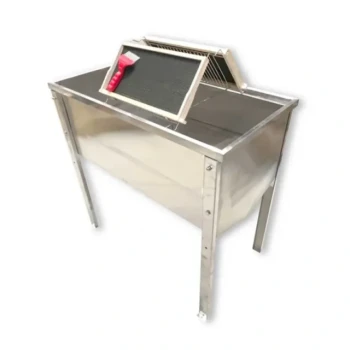
The uncapping tank addresses the immediate logistical challenge of harvesting: handling sticky frames while removing their wax seals.
Establishing a Stable Workspace
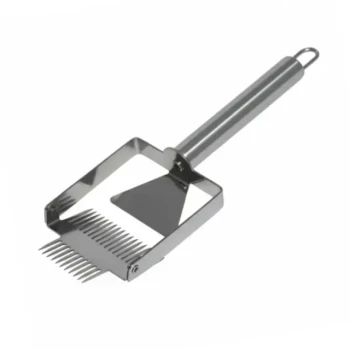
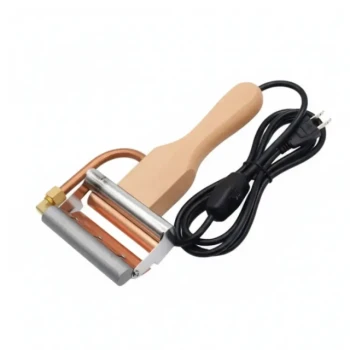
Uncapping requires precision tools, such as cold knives or scratchers, to remove the wax operculums (caps) sealing the honey cells.
The tank provides a secure mount or crossbar to hold the heavy frames in place during this manual labor. This containment prevents honey from spilling onto the floor and ensures hygiene standards are maintained.
Separation of Wax and Honey
When the wax caps are sliced off, they fall directly into the tank. These "cappings" are wet with high-quality honey.
The tank is designed to hold these cappings, allowing gravity to pull the honey off the wax. The honey pools at the bottom for collection, while the beeswax remains separated, ready to be processed as a valuable byproduct.
Pre-Extraction Staging
Before frames can enter a centrifugal extractor, the cells must be opened. The tank acts as the prerequisite station for this step.
It allows the beekeeper to uncap multiple frames efficiently, creating a buffer of prepared frames ready for the extractor, thereby smoothing out the workflow.
The Role of the Sieve System
Once honey is collected—either draining from the uncapping tank or flowing from an extractor—it must be purified.
Progressive Filtration
The system typically employs a double sieve mechanism. This involves two distinct layers of mesh.
The top sieve features a coarse mesh to catch large chunks of beeswax and accidental debris. The bottom sieve uses a much finer mesh to trap small particles and impurities that passed through the first layer.
Preserving Nutritional Integrity
Using a sieve is a mechanical separation method, distinct from thermal filtering.
By relying on gravity and mesh size rather than heat, the sieve removes solids without cooking the honey. This preserves heat-sensitive enzymes and proteins, maintaining the honey's classification as raw and preserving its quality.
Understanding the Trade-offs
While essential for quality, this system introduces specific bottlenecks that operators must manage.
The Gravity Bottleneck
Passive uncapping tanks and gravity sieves are slow. Honey is viscous, and waiting for cappings to drain or honey to pass through a fine mesh takes time.
Temperature Sensitivity
The efficiency of the sieve is highly dependent on ambient temperature.
If the honey is cold, it becomes thick and may clog the fine mesh of the sieve rapidly. This can halt the entire extraction workflow, forcing the operator to stop and clean the screens frequently.
Making the Right Choice for Your Goal
Selecting and utilizing this equipment depends on the scale and intent of your operation.
- If your primary focus is Efficiency: Prioritize an uncapping tank with a large capacity to allow cappings to drain overnight, preventing the need to pause extraction to clear the workspace.
- If your primary focus is Quality: Utilize a gravity-fed double sieve system exclusively, avoiding pumps or heat, to ensure the most natural and enzyme-rich final product.
The uncapping tank and sieve system is the bridge between the raw hive and the finished jar, ensuring that purity and yield are balanced effectively.
Summary Table:
| Component | Primary Function | Key Benefit |
|---|---|---|
| Uncapping Tank | Dedicated frame workspace & wax capping collection | Prevents waste; isolates honey from beeswax cappings |
| Stabilizing Bar | Secures heavy frames during manual uncapping | Improves ergonomics and safety during the harvest |
| Coarse Sieve | First-stage mechanical filtration | Removes large wax chunks and hive debris |
| Fine Sieve | Final-stage mechanical filtration | Captures small impurities while preserving raw honey enzymes |
| Gravity Drain | Passive honey recovery | Maximizes yield without requiring expensive machinery |
Maximize Your Honey Production with HONESTBEE
At HONESTBEE, we specialize in empowering commercial apiaries and distributors with professional-grade honey processing solutions. From high-capacity uncapping tanks and double sieve systems to advanced honey-filling machines and hive-making hardware, we provide the full spectrum of tools needed to scale your operations.
Ready to enhance your yield and product quality? Partner with us for comprehensive wholesale supply and specialized machinery. Contact our experts today to build your custom equipment package.
Related Products
- Stainless Steel Uncapping Tank with Stand and Strainer
- Plastic Honey Uncapping Tub Tank for Beekeeping
- Portable Uncapping Tank Holder Uncapping Bench for Beekeeping
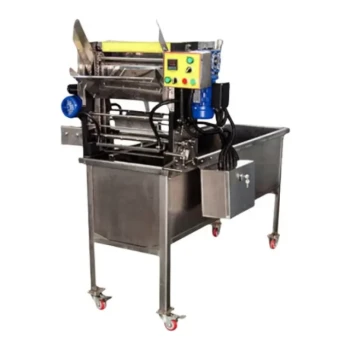
- Automatic Honey Frame Uncapper Machine for Beekeeping
- Professional Extra-Wide Uncapping Fork with Bent Tines for Beekeeping
People Also Ask
- What is an uncapping tank used for in honey harvesting? Maximize Your Honey Yield and Minimize Waste
- What are the functional advantages of using a dedicated uncapping tank during honey processing? Maximize Your Honey Yield
- What size uncapping tank do I need? Find the Perfect Fit for Your Apiary
- What are the features of the processing tanks offered? Engineered for Purity and Efficiency
- What types of stainless steel processing tanks are used for honey? Essential Equipment for Quality Honey Production