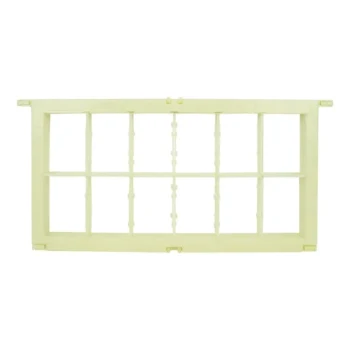
Deep frames serve as the primary nursery and living quarters for the honeybee colony. As the largest frame size available, they are specifically designed to fit into "deep supers," which form the bottom boxes or main body of the hive. Their crucial function is to provide a massive, uninterrupted surface area for the queen to lay eggs and for workers to store the pollen and nectar required to feed the developing brood.
The deep frame is the industry standard for the "hive body" because it mimics the natural biological needs of the colony. Its large vertical surface area allows the queen to establish a consistent laying pattern without the interruptions caused by smaller, segmented frames.
The Biological Function of Deep Frames
The Primary Brood Chamber
The central purpose of a deep frame is to house the colony's population growth. Because deep frames are the largest option, they provide the necessary real estate for the queen to lay thousands of eggs.
This creates a dedicated "brood chamber" at the bottom of the hive. A standard box holds 8 to 10 of these frames, acting as the nursery where larvae are raised from egg to emergence.
Localized Resource Storage
Deep frames are not just for eggs; they act as the colony's immediate pantry. The large surface area allows worker bees to store distinct bands of pollen and nectar around the perimeter of the brood pattern.
This ensures that "nurse bees" have immediate access to food resources needed to feed the larvae, without having to travel to upper boxes to retrieve supplies.
Structural Role and Management
acting as the Hive's Skeleton
Structurally, frames function like the studs in the wall of a house. Deep frames provide the internal rigidity needed to support heavy wax combs that might otherwise collapse under their own weight.
Whether using a plastic/wax foundation or going "foundationless," the deep frame provides the four-sided boundary that dictates where bees build.
Facilitating Inspection
Before moveable frames were invented, checking a hive meant cutting out comb and destroying the colony's structure. Deep frames hang vertically on a rabbet in the hive body, maintaining a precise "bee space" between them.
This allows the beekeeper to lift out heavy combs of brood to check the queen's health and the colony's development without damaging the hive's infrastructure.
Understanding the Trade-offs
The Weight Factor
The most significant downside to deep frames is their weight. When a deep frame is fully filled with honey and brood, it is heavy; a full box of deep frames can weigh upwards of 80 pounds.
Not Ideal for Honey Harvest
Because deep frames are primarily used for brood rearing, they are rarely used for harvesting honey for human consumption.
Harvesting from deep frames complicates the process, as you risk extracting honey mixed with brood cocoons, and the heavy boxes are difficult to lift during harvest season.
Making the Right Choice for Your Goal
While deep frames are the standard for the hive body, understanding how to utilize them depends on your physical capabilities and management style.
- If your primary focus is establishing a new colony: Use deep frames for your bottom one or two boxes to give the queen maximum room to expand the population rapidly.
- If your primary focus is ergonomic management: Consider that once deep frames are full, you will likely only move individual frames rather than lifting the entire heavy box at once.
- If your primary focus is honey production: Limit deep frames to the bottom brood boxes and use smaller (medium or shallow) frames for the upper "honey supers" to make harvesting easier.
Deep frames remain the fundamental building block of a standard hive, prioritizing the colony's reproductive health over the beekeeper's ease of lifting.
Summary Table:
| Feature | Purpose | Benefit for the Colony |
|---|---|---|
| Large Surface Area | Brood Rearing | Allows the queen a consistent, uninterrupted laying pattern. |
| Vertical Depth | Resource Storage | Provides immediate access to pollen and nectar for nurse bees. |
| Standardized Size | Structural Integrity | Acts as the hive's skeleton, supporting heavy wax combs. |
| Removable Design | Hive Inspection | Enables health checks without damaging the colony's infrastructure. |
Scale Your Apiary with HONESTBEE Professional Equipment
As a commercial apiary or distributor, your success depends on the health and productivity of your colonies. HONESTBEE is dedicated to supporting your growth by providing a comprehensive wholesale range of premium beekeeping tools and industrial machinery.
From high-durability frames and hive-making machinery to specialized honey-filling systems and cultural merchandise, we deliver the hardware and consumables necessary for large-scale operations. Let us help you optimize your production and streamline your management.
Ready to elevate your beekeeping business? Contact HONESTBEE Today for a Wholesale Quote
Related Products
- 3.5L Plastic Beehive Frame Feeder Deep Frame Water Feeder for In Hive Use
- Assembled Wooden Bee Frames with Beeswax Foundation Ready to Use by HONESTBEE
- Heavy Duty Castellated Iron Frame Spacer for Honey Supers
- Wooden Bee Hive Frames for Beekeeping and Wholesale
- Precision Stainless Steel Frame Cleaner for Hive Grooves and Corners
People Also Ask
- What are the technical advantages of using frame feeders for beehives? Maximize Efficiency and Colony Survival
- Can plastic frames be used in any type of beehive? Maximize Your Apiary Efficiency with Durable Solutions
- What are the technical functions and design requirements of plastic feeders? High-Performance Sourcing for Distributors
- What are the advantages of feeding bees inside the hive? Top Benefits for Colony Security and Health
- Are plastic bee hive frames good? A Guide to Modern Durability vs. Natural Appeal