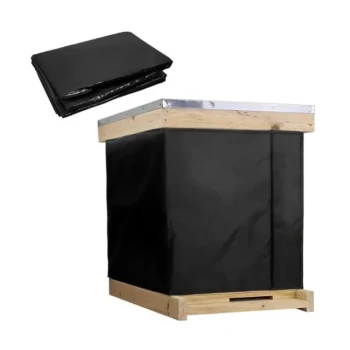
Mesh insulator bags act as a critical isolation and collection mechanism specifically designed to validate the success of thermotherapy treatments. Their primary purpose is to contain the treated comb within the colony, allowing bee larvae to emerge naturally while mechanically trapping any Varroa mites that detach or die, preventing them from being lost to the hive floor or removed by worker bees.
Accurate calculation of mite mortality rates is impossible if the "evidence" disappears. Mesh insulator bags solve this by creating a closed system that separates the biological outcome (emerging bees) from the experimental data (fallen mites).
The Mechanics of Data Collection
Maintaining Colony Conditions
For thermotherapy studies to be valid, the treated capped brood must complete its development cycle.
The mesh bags allow the test combs to be returned to the colony immediately after heating. This ensures the developing larvae remain in a suitable, temperature-regulated environment necessary for successful emergence.
Trapping the Biological Evidence
The structure of the bag is designed to capture specific fallout.
As the treatment takes effect, mites may die immediately from the heat or fall off the bees shortly after emergence. The high-density mesh ensures these mites collect at the bottom of the bag rather than falling into the hive where they cannot be counted.
Calculating Efficacy
The Role in Clearance Rate Analysis
The ultimate goal of using these bags is to generate a precise "mite clearance rate."
By physically isolating the comb, researchers can count the exact number of dead or fallen mites relative to the total population on that specific comb.
Preventing Data Corruption
Without the bag, the colony's natural behaviors would corrupt the data.
Worker bees are hygienic; they naturally remove dead debris and mites from the hive. The bag prevents these "clean-up" bees from removing the mite carcasses, preserving the total count for analysis.
Methodological Considerations
The Importance of Mesh Density
The effectiveness of this method relies entirely on the density of the mesh used.
The reference specifies "high-density" mesh bags. If the mesh is too coarse, mites could slip through the gaps, leading to undercounting and false efficacy results.
Isolation vs. Integration
While the bag isolates the mites, it must not fully isolate the brood from the colony's heat and pheromones.
The bag acts as a selective barrier—keeping the mites in while allowing the environmental benefits of the colony through.
Making the Right Choice for Your Goal
If you are designing a protocol for testing mite treatments, the use of insulator bags dictates the reliability of your results.
- If your primary focus is Data Integrity: Use high-density mesh to prevent hygienic bees from removing dead mites, ensuring your mortality count represents the true efficacy of the heat treatment.
- If your primary focus is Brood Viability: Ensure the bags are returned to the colony immediately after treatment so that larvae can emerge in a stable, thermally regulated environment.
By strictly isolating the fallout while integrating the comb, you transform a general observation into a quantifiable scientific metric.
Summary Table:
| Function | Purpose | Key Benefit |
|---|---|---|
| Biological Containment | Traps emerging bees and falling mites | Ensures 100% of mite fallout is captured for counting |
| Hygienic Barrier | Prevents worker bees from removing debris | Protects data integrity from colony 'clean-up' behavior |
| Environmental Integration | Allows pheromones and heat to pass through | Maintains brood viability during the development cycle |
| Mesh Density | High-density material construction | Prevents microscopic mites from escaping through the weave |
Maximize Your Apiary Productivity with HONESTBEE
At HONESTBEE, we understand that precision is the difference between a thriving colony and a loss. We cater to commercial apiaries and distributors by providing a comprehensive wholesale range of professional-grade beekeeping tools, specialized hive-making machinery, and essential consumables.
Whether you need advanced honey-filling machines to scale your operations or high-quality hardware to maintain data integrity in your mite treatments, we have the expertise to support your growth. Partner with a global leader in beekeeping solutions.
Contact HONESTBEE Today to discuss our wholesale offerings and how we can add value to your business.
References
- Vítězslav Bičík, Hana Sádovská. The effectiveness of thermotherapy in the elimination of Varroa destructor. DOI: 10.1515/cszma-2016-0032
This article is also based on technical information from HonestBee Knowledge Base .
Related Products
- Conical Nylon Honey Strainer Filter Bag for Beekeeping and Honey Filtration
- Professional Insulated Winter Hive Wrap for Beekeeping
People Also Ask
- What is the primary function of specialized filtering bags in honey purification? Enhance Quality & Equipment Life
- What are the primary functions of using muslin cloth or stainless steel filters? Ensure Pure and Marketable Honey
- What are the benefits of using a honey strainer for beekeepers? Achieve Clean, High-Quality Honey Efficiently
- What is the primary function of a honey strainer in beekeeping? Achieve Commercial Purity & Visual Clarity
- What can I use to strain honey? A Beekeeper's Guide to Choosing the Right Filter