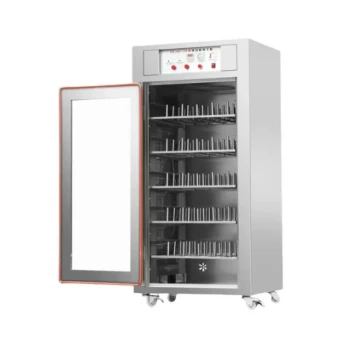
The role of a spray dryer equipped with an air dehumidification system is to create the specific environmental conditions necessary to convert liquid honey into a stable powder. By integrating an external dehumidifier, the system significantly reduces the relative humidity of the process air before it enters the drying chamber. This intervention is critical for preventing the powder from becoming sticky, adhering to the machine's internal walls, or forming unusable clumps.
Honey is naturally hygroscopic, meaning it aggressively absorbs moisture from the surrounding air. The dehumidification system controls this variable, ensuring that the processed extract remains a free-flowing solid rather than reverting to a sticky syrup during the drying process.
The Challenge of Drying Honey
Managing High Hygroscopicity
Honey extracts contain high levels of simple sugars, which are extremely hygroscopic. This means they possess a strong natural tendency to absorb moisture from the atmosphere. Without intervention, honey particles will re-absorb humidity immediately during the drying process, preventing them from solidifying.
The Risk of Wall Deposition
When honey particles retain moisture, they become sticky or "tacky." As these particles circulate within the spray dryer, they are liable to stick to the inner walls of the drying chamber. This creates significant product loss and disrupts the continuous operation of the machinery.
The Dehumidification Solution
Creating a Controlled Atmosphere
The integrated dehumidification system treats the intake air before it interacts with the honey spray. By removing moisture externally, the system ensures the drying medium is capable of rapid moisture evaporation. This allows the dryer to operate effectively even in humid ambient conditions.
Ensuring Free-Flowing Powder
The primary output goal is a free-flowing powder rather than a caked solid. Dry air ensures that the surface of each particle dries sufficiently to prevent cohesion. This prevents the powder from clumping together in the collection vessel, ensuring a uniform final product.
Operational Considerations
Complexity and Maintenance
Adding an external dehumidification system increases the mechanical complexity of the spray drying line. Operators must monitor the dehumidifier as closely as the dryer itself to ensure consistent performance. Failure in the dehumidification unit leads almost immediately to product caking and system blockages.
Energy Implications
Conditioning air to low humidity levels requires additional energy input. While this ensures high product quality, it is a factor that impacts the overall operational cost of the production line. However, this cost is generally outweighed by the prevention of waste and downtime caused by sticky product.
Optimizing Your Production Strategy
To achieve the best results in honey powder production, consider how the dehumidification system aligns with your specific goals.
- If your primary focus is Production Yield: Ensure the dehumidification system is sized correctly to prevent wall adhesion, which is the leading cause of material loss.
- If your primary focus is Product Stability: Prioritize maintaining consistently low humidity levels to prevent clumping, ensuring the powder remains shelf-stable after packaging.
Control the air moisture, and you control the quality of the honey powder.
Summary Table:
| Feature | Impact of Dehumidification System | Result for Honey Powder |
|---|---|---|
| Hygroscopicity Management | Neutralizes honey's natural moisture absorption | Prevents reversion to sticky syrup |
| Wall Deposition | Keeps particles dry and non-tacky | Reduces product loss and machine downtime |
| Particle Consistency | Ensures rapid surface evaporation | Produces a uniform, free-flowing powder |
| Atmospheric Control | Allows operation in humid ambient conditions | Reliable production regardless of climate |
Elevate Your Honey Processing with HONESTBEE
Transitioning from liquid honey to a premium powder requires precision and the right industrial technology. At HONESTBEE, we specialize in supporting commercial apiaries and distributors with high-performance machinery, including advanced honey-filling and processing equipment designed to handle the most challenging materials.
Whether you are scaling up your production line or seeking reliable wholesale beekeeping tools and machinery, our expert team provides the technical hardware and industry consumables needed to ensure your success. Don't let humidity hinder your production yield—leverage our expertise to achieve superior product stability and efficiency.
Ready to optimize your honey powder production? Contact HONESTBEE Today to Discuss Your Equipment Needs
References
- Radosław Bogusz, Dorota Pietrzak. The Effect of Honey Powder Addition on Chosen Quality Properties of Model Chicken Products. DOI: 10.3390/foods13244163
This article is also based on technical information from HonestBee Knowledge Base .
Related Products
- 0.5T Capacity Honey Dehumidifier Dryer with Vacuum Heating and Thickening Filtering Machine
- High Quality Honey Dehumidifier Dryer Thickening Machine for Beekeeping
- Economy Small Scale Honey Dryer Dehumidifier Thickening Machine
- Honey Concentrating Vacuum Heating Thickening Machine Dehumidifier for Honey
- Honey Concentrating and Filtering Dehumidifier Machine 2T Capacity for Honey
People Also Ask
- What is the primary function of professional dehumidification equipment in honey processing? Stability & Quality
- How to dry up honey? The Safe Guide to Stabilizing Honey and Preventing Fermentation
- What is the process for using a dehumidifier to lower honey's moisture content? Expert Drying Techniques
- How to decrease moisture in honey? Prevent Fermentation and Ensure Long-Term Quality
- How to remove humidity from honey? Protect Your Harvest from Fermentation