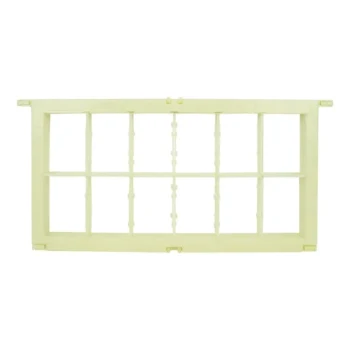
Standardized beehive frames function as the fundamental unit of measurement for apiary science. They serve as a uniform physical reference that allows technicians to precisely estimate colony strength, brood area, and resource reserves by subdividing the occupied frame area into tenths or percentages. This physical consistency is what transforms subjective observation into accurate, comparable phenotypic data across different regions and generations.
The Essential Insight By providing a constant physical variable, standardized frames ensure that any observed differences in performance are attributable to the genetics and health of the bee colony, rather than inconsistencies in their housing structure.
The Mechanics of Quantitative Evaluation
Precision Through Subdivision
The primary method for evaluating performance involves visual segmentation. Technicians subdivide the area of a standardized frame into percentages or tenths to calculate exact coverage.
Measuring Key Metrics
This grid-like approach allows for the precise quantification of critical production traits. Evaluators can accurately measure colony strength, the size of the brood area, and the volume of honey and pollen reserves.
Establishing a Baseline
Because the physical dimensions of the frame are constant, these measurements create a reliable baseline. This allows for valid comparisons between current stock and future generations.
Ensuring Scientific Validity
Eliminating Structural Bias
In comparative research, variations in hive volume or material can skew results. Using frames with uniform specifications effectively eliminates experimental bias caused by the container itself.
Isolating Biological Variables
Standardization ensures that differences in data, such as humidity regulation or honey yield, are attributed to the biological characteristics of the subspecies or local climate factors. This increases the repeatability and scientific validity of field experiments.
Cross-Regional Comparison
Standardized hardware creates a common language for researchers across different geographical regions. It ensures that a "full frame" in one study represents the same biomass and effort as a "full frame" in another.
Practical Applications in Breeding and Management
Enabling Systematic Breeding
Standardized frames are vital for large-scale genetic improvement, particularly in developing mite-resistant lines. They allow for the efficient monitoring of hygienic behavior and yield without the interference of variable comb structures.
Facilitating Population Grading
In systems like the Langstroth hive, standardization enables "bee population grading." Technicians can quantitatively assess the number of adult bees versus brood frames to make data-driven decisions regarding winter management.
Enhancing Controllability
Unlike traditional fixed-comb hives, modern movable frames allow for internal inspection and manipulation. This supports standardized management practices, such as adding combs or supplemental feeding, which directly influences production outcomes.
Understanding the Trade-offs
The Human Element in Estimation
While the frames are standardized, the method of subdividing area into tenths often relies on visual estimation by a technician. This introduces a potential margin of error that requires rigorous training to minimize.
Biological vs. Structural Limits
Standard frames control the physical space, but they cannot control external variables. Evaluating performance requires distinguishing between frame-limited capacity (the hive is full) and resource-limited capacity (the bees cannot find forage).
Making the Right Choice for Your Goal
To maximize the value of standardized frames in your operation, consider your primary objective:
- If your primary focus is Scientific Research: Adhere strictly to uniform material and dimensional specifications to eliminate all physical variables and ensure publication-grade repeatability.
- If your primary focus is Commercial Breeding: Use standardization to implement "population grading," allowing you to rapidly identify and select colonies with superior hygienic behavior and mite resistance.
- If your primary focus is Production Management: Leverage the modular nature of the frames to perform regular internal inspections, ensuring timely interventions for feeding or disease control.
Standardization turns the beehive from a simple shelter into a precision instrument for biological assessment.
Summary Table:
| Metric Evaluated | Role of Standardized Frames | Key Benefit |
|---|---|---|
| Colony Strength | Subdivides frame area into tenths for biomass estimation | Precise population grading |
| Brood Area | Provides a constant physical baseline for area calculation | Accurate reproductive tracking |
| Resource Reserves | Quantifies honey and pollen volume by coverage percentage | Improved winter management |
| Genetic Traits | Eliminates structural bias to isolate biological variables | Validates breeding programs |
| Data Consistency | Creates a common language for cross-regional studies | High scientific repeatability |
Maximize Your Colony Performance with HONESTBEE
At HONESTBEE, we understand that precision starts with the right equipment. As a leading partner for commercial apiaries and distributors, we provide a comprehensive wholesale range of high-quality, standardized beekeeping tools and machinery designed to turn your operation into a data-driven success.
Whether you need specialized hive-making machinery, honey-filling equipment, or a full spectrum of essential industry consumables, we offer the durability and consistency required for both large-scale production and rigorous scientific evaluation.
Ready to elevate your apiary's efficiency? Contact us today to explore our wholesale solutions and see how our hardware can support your breeding and management goals.
References
- G. Jevtić, B. Dinić. Heritability of production characteristics of regional populations of honey bees from Serbia. DOI: 10.2298/gensr1201047j
This article is also based on technical information from HonestBee Knowledge Base .
Related Products
- Wooden Bee Hive Frames for Beekeeping and Wholesale
- Professional Galvanized Steel Frame Rest for Beehives
- Assembled Wooden Bee Frames with Plastic Foundation for Durability and Convenience by HONESTBEE
- HONESTBEE Wired and Assembled Wooden Bee Frames Foundation for a Thriving Hive
- Plastic Bee Frame Beekeeping Hive Frames for Wholesale
People Also Ask
- How do wooden and plastic hive frames compare in terms of durability? Wood vs. Plastic Longevity & Repairability
- How does balancing the number of frames impact hive productivity? Optimize Your Apiary's Biological Output
- What are the main considerations when choosing between wooden and plastic bee hive frames? Optimize Your Apiary's Efficiency
- How should beehive frames be maintained to prolong their lifespan? 5 Pro Tips for Durable Beekeeping Equipment
- Can I reuse old beehive frames? Save Money and Boost Hive Productivity