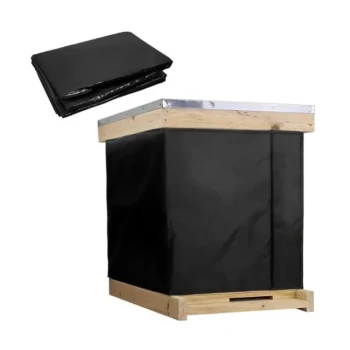
Industrial-grade dry wood shavings primarily function as a high-density thermal fill material within hive insulation jackets. By utilizing the naturally porous structure of wood, these shavings create a substantial thermal barrier that increases the overall thermal resistance of the beehive enclosure.
The core technical value of this material lies in its ability to arrest convective heat loss through porosity. By trapping air within the cellular structure of the wood, the shavings enable the bee cluster to retain self-generated heat efficiently, which is a critical factor for survival in sub-zero environments.
The Mechanics of Thermal Resistance
The Role of Porosity
The effectiveness of wood shavings is derived from their porous nature. Wood is cellular; when dry, these cells become microscopic pockets of stagnant air.
Because air is a poor conductor of heat, these trapped pockets act as a buffer. They interrupt the transfer of thermal energy from the warm interior of the hive to the cold exterior.
Reducing Convection
The primary physical method by which these shavings protect the hive is by reducing heat loss via convection.
In uninsulated hives, wind and cold air currents strip heat away from the hive walls. The layer of shavings acts as a break, preventing this rapid air movement from influencing the internal temperature.
Operational Impact on the Hive
Retaining Cluster Heat
Honeybees do not heat the entire hive; they heat the bee cluster. The insulation provided by the shavings helps retain this specific, localized heat.
By minimizing the rate at which heat escapes the cluster's vicinity, the bees consume fewer energy reserves (honey) to maintain life-sustaining temperatures.
Performance in Sub-Zero Environments
The reference emphasizes the material's utility in sub-zero environments. In these extreme conditions, the temperature differential between the inside and outside of the hive is greatest.
Without the high thermal resistance provided by the shavings, the colony's metabolic heat generation would be insufficient to combat the external freeze, leading to colony failure.
Critical Considerations and Trade-offs
The Moisture Vulnerability
The primary reference explicitly specifies dry wood shavings. This implies a critical operational constraint: moisture management.
If the shavings absorb water, the air pockets responsible for insulation are replaced by liquid, which conducts heat far more rapidly than air. Wet shavings effectively bridge the thermal gap rather than blocking it, rendering the insulation useless.
Volume and Density
To function as an effective filling material, the shavings must be packed with sufficient density to prevent settling.
If the shavings settle over time, gaps will form in the insulation jacket (thermal bridging), creating cold spots that compromise the hive's overall thermal integrity.
Optimizing Hive Protection Strategy
To effectively utilize wood shavings for insulation, you must prioritize the integrity of the material.
- If your primary focus is maximum thermal retention: Ensure the insulation jacket is filled to capacity to maximize the volume of porous material surrounding the hive.
- If your primary focus is reliability: You must ensure the outer layer of the jacket is waterproof to maintain the "dry" state required for the shavings to function as an insulator.
By maintaining the dryness and density of the wood shavings, you convert a simple byproduct into a critical survival mechanism for your apiary.
Summary Table:
| Feature | Technical Function | Impact on Hive Survival |
|---|---|---|
| Porosity | Traps stagnant air pockets | Creates a high-density thermal barrier |
| Convection Control | Arrests rapid air movement | Minimizes heat loss from the bee cluster |
| Density Management | Prevents settling/gaps | Eliminates cold spots and thermal bridging |
| Moisture Shield | Keeps shavings dry | Maintains critical insulation performance |
Scale Your Apiary Operations with HONESTBEE
Optimizing hive survival is just the beginning. HONESTBEE empowers commercial apiaries and distributors with a comprehensive wholesale portfolio designed for professional success. From specialized hive-making and honey-filling machinery to a full spectrum of beekeeping tools and essential industry consumables, we provide the hardware you need to thrive.
Ready to enhance your efficiency? Contact our expert team today to discuss how our high-performance equipment and honey-themed cultural merchandise can add value to your business.
References
- Stephen Petersen. The History Of Beekeeping In Alaska. DOI: 10.1080/0005772x.2014.11417574
This article is also based on technical information from HonestBee Knowledge Base .
Related Products
- Professional Insulated Winter Hive Wrap for Beekeeping
- Langstroth Solid Bottom Board for Beekeeping
- Yellow Plastic Bucket Pail Perch for Beekeeping
- Wholesales Dadant Size Wooden Bee Hives for Beekeeping
- Stainless Steel Honey Bee Smoker Hive and Honeycomb Smoker for Beekeeping
People Also Ask
- What are the steps to properly wrap a beehive for winter? Ensure Your Colony Survives the Cold
- When is the best time to wrap a beehive for winter? A Guide to Perfect Winterization Timing
- How do professional insulation wraps provide protection for bee colonies? Optimize Winter Survival & Energy Efficiency
- What are the technical benefits of using winter wraps for beehive insulation? Boost Colony Survival & Hive Health
- What are the benefits of using insulated covers for hives? Ensure Colony Survival and Health