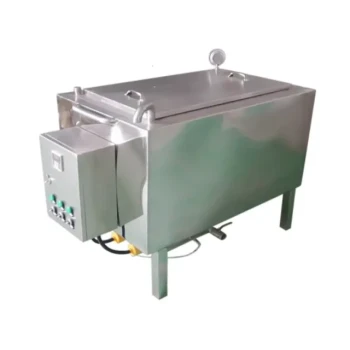
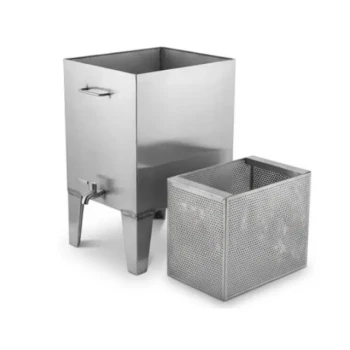
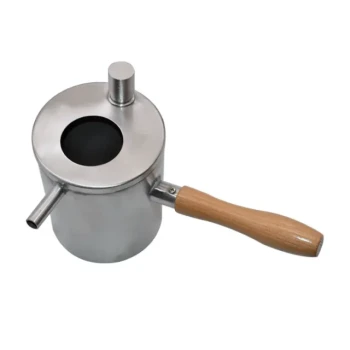
High-precision heating and stirring equipment is the fundamental requirement for creating stable, high-quality beeswax emulsions. By maintaining temperatures between 80°C and 90°C and providing continuous mechanical agitation, this equipment ensures that solid beeswax is completely dissolved and thoroughly homogenized with edible oils or medicinal carriers. This precise control is vital to prevent thermal degradation, ensuring the final product maintains a uniform physical structure and consistent barrier performance.
High-precision thermal and mechanical control is the only way to achieve molecular-level homogenization while protecting the sensitive biological properties of beeswax. Without this level of accuracy, emulsions suffer from inconsistent concentrations, oxidation, and loss of commercial value.
Achieving Molecular Homogeneity and Stability
The Necessity of Precise Thermal Dissolution
Beeswax requires a specific temperature range—typically between 80°C and 90°C—to reach a fluid state suitable for emulsification. High-precision equipment reduces the viscosity of the wax effectively, allowing it to blend seamlessly with various dopants or oils. This process eliminates internal concentration gradients, which is essential for products requiring accurate concentration baselines, such as those used in pharmaceuticals or spectral analysis.
Mechanical Agitation and Uniform Distribution
Continuous stirring during the heating phase ensures that different components, even those with varying polarities, achieve molecular-level homogenization. This is particularly critical when adding active agents like pesticide powders or medicinal extracts to a liquid wax matrix. Without constant, high-precision stirring, the active ingredients would settle or clump, leading to inconsistent product performance across different batches.
Eliminating Compositional Gradients
Long-term stability in beeswax emulsions relies on the removal of composition gradients within the mixture. Maintaining a constant temperature (such as 90°C) for extended periods—sometimes up to three hours—ensures a reliable basis for quantitative prediction models and industrial consistency. This level of control ensures that every molded sheet or bottled emulsion meets the exact specifications required by the end-user.
Protecting Material Integrity and Commercial Grade
Preventing Thermal Degradation and Oxidation
Beeswax is highly susceptible to oxidative discoloration and the loss of aromatic compounds when exposed to excessive or uneven heat. High-precision equipment keeps temperatures strictly above the melting point but safely below the threshold for thermal damage. This protection ensures the beeswax retains its natural light yellow color, which is a key quality indicator for high-value cosmetic and industrial applications.
Maintaining Biological Activity and Spreadability
For pharmaceutical-grade creams and soaps, the "biological activity" of the wax must remain intact to provide therapeutic efficacy. Precise temperature regulation prevents the loss of heat-sensitive active ingredients and ensures the final emulsion has optimal spreadability. If the wax is overheated, the resulting film may become brittle or lose its protective barrier properties.
Standardization for Global Markets
Distributors and wholesalers must provide equipment that allows manufacturers to meet strict cosmetic or pharmaceutical-grade standards. Consistent thermal processing ensures uniform physical-chemical properties across every batch. This reliability is a core component of premium trading services, as it minimizes the risk of product rejection in highly regulated markets.
Understanding the Trade-offs and Pitfalls
Precision vs. Operational Throughput
While high-precision equipment offers superior quality, it often requires slower heating cycles to avoid "hot spots" that cause localized degradation. Rapid, high-heat melting may increase volume, but it significantly risks the aromatic and color integrity of the beeswax. Finding the balance between speed and precision is a common challenge in high-volume production environments.
Maintenance and Calibration Requirements
The sophisticated sensors and stirring mechanisms in high-precision units demand regular calibration and professional maintenance. Failure to maintain these systems can lead to "temperature drift," where the actual heat deviates from the display. For B2B resellers, offering equipment with robust after-sales support and easy calibration is essential to prevent costly production downtime for clients.
How to Apply This to Your Sourcing Strategy
Choosing the right equipment is a strategic decision that impacts the entire supply chain, from production efficiency to end-user satisfaction.
- If your primary focus is Pharmaceutical or Cosmetic Grade: Invest in equipment with a temperature variance of less than ±0.5°C to ensure the preservation of biological activity and color.
- If your primary focus is Industrial Scale Production: Prioritize high-torque stirring mechanisms that can handle varying viscosities without fluctuating in speed or heat output.
- If your primary focus is Market Versatility: Look for "one-stop" systems that offer programmable thermal profiles, allowing your clients to switch between purification (65-70°C) and emulsification (80-90°C) seamlessly.
Expertly controlled thermal processing is the bridge between raw beeswax and a high-value, market-ready emulsion.
Summary Table:
| Key Feature | Technical Requirement | Impact on Final Product |
|---|---|---|
| Precise Heating | 80°C - 90°C Range | Prevents oxidation; preserves natural color and biological activity. |
| High-Torque Stirring | Continuous Agitation | Ensures molecular-level homogeneity; prevents clumping of active agents. |
| Thermal Stability | Constant Temp (up to 3hrs) | Eliminates compositional gradients for consistent industrial grading. |
| System Calibration | Variance < ±0.5°C | Meets strict cosmetic and pharmaceutical-grade global standards. |
Scale Your B2B Operations with HONESTBEE
Maximize your profit margins and supply reliability with HONESTBEE, your premier one-stop partner for professional beekeeping machinery and industrial equipment. We provide distributors and wholesalers with a comprehensive, full-spectrum product portfolio—from high-precision emulsion tools and honey-filling machines to essential consumables.
Why Partner with HONESTBEE?
- Deep Industry Expertise: Specialized hardware designed for commercial apiary success.
- Premium Trading Services: Dedicated customer support and rapid response times.
- Efficient Fulfillment: Ultra-fast delivery to keep your supply chain moving.
Ready to elevate your inventory with market-leading equipment? Contact our wholesale team today to discuss OEM/ODM support and bulk pricing!
References
- Khosrou Abdi, S. Habtamu. Improving shelf life of nectarine fruit (Prunus persica) by beeswax coating and cold storage application. DOI: 10.5897/ajfs2018.1780
This article is also based on technical information from HonestBee Knowledge Base .
Related Products
- Electric Flatting and Embossing Machine with Tray for Beekeeping
- Beeswax Machine Press Embosser Wax Foundation Mold Printer Bee Hive Equipment Making Sheet
- Fully Automatic Beeswax Embossing Machine Foundation Mill
- Economy Manual Beeswax Embossing Mill Wax Foundation Machine Roller
- Manual Beeswax Flat Sheet Machine for Beeswax Processing
People Also Ask
- What are the advantages of implementing a pulley and belt drive system in beeswax foundation machinery? Master Quality.
- What are the primary technical challenges faced by beeswax foundation production machinery? Tackling Lipophilic Residues
- How does the beeswax flatting and embossing machine prepare the wax for processing? Achieve Perfectly Uniform Wax Sheets
- What is the purpose of the beeswax flatting and embossing machine? Boost Hive Efficiency & Honey Production
- What are the sequential stages of operation for a beeswax flatting and embossing machine? Master High-Quality Wax Sheets