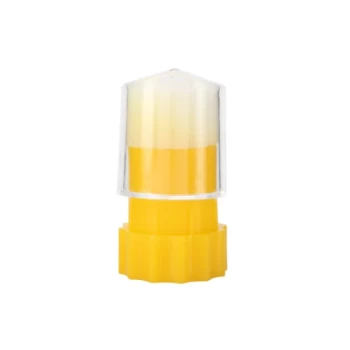
The technical significance of using marking materials lies in the ability to transition from aggregate colony observation to precise, individual-level tracking. By assigning a unique identifier to specific bees, researchers can isolate subjects to generate microscopic evidence regarding behavior, rather than relying on generalized swarm data.
The application of marking materials is the only reliable method for obtaining continuous, granular data on specific bees. It enables the accurate calculation of pollination efficiency and foraging rhythms by facilitating the measurement of trip duration, visitation rates, and handling times.
Deriving Precise Behavioral Metrics
Measuring Foraging Rates
To understand the work rate of a pollinator, you must calculate the number of inflorescences visited per unit of time.
Marking specific bees allows an observer to follow a single subject through a patch of flowers without confusion. This continuous tracking provides an exact count of flower visits, establishing a definitive speed for that individual's foraging activity.
Tracking Trip Duration
General observation cannot distinguish when a specific bee leaves the hive and when that exact bee returns.
Individual identification solves this by allowing researchers to clock the duration of individual foraging trips. This metric is vital for estimating the range a bee travels and the time investment required to secure resources.
Analyzing Handling Time
A critical component of pollination mechanics is the "stay time," or how long a bee lingers on a single inflorescence.
Marked individuals allow for the measurement of this interaction down to the second. This data reveals the physical efficiency of the bee in manipulating the flower to access nectar or pollen.
The Broader Analytical Impact
Quantifying Pollination Efficiency
The combination of visitation rates and stay times provides a composite view of pollination efficiency.
By analyzing the microscopic evidence provided by marked bees, researchers can determine if a species is an effective pollinator or if it spends excessive time handling flowers with minimal return.
Establishing Foraging Rhythms
Bees do not always forage continuously or consistently; they follow specific patterns.
Continuous tracking of marked individuals reveals these foraging rhythms. It helps researchers understand the temporal patterns of activity, distinguishing between periods of high activity and rest for specific foragers.
Understanding the Methodological Trade-offs
The Requirement for Continuous Tracking
The primary constraint of this method is the labor intensity required for continuous tracking.
To gain value from the markings, the observer must maintain visual contact with the specific bee to record the sequence of behaviors. Losing sight of the marked individual disrupts the data timeline, potentially invalidating the calculation of trip duration or visitation rates.
Sample Size vs. Depth of Data
Focusing on marked individuals inherently favors depth of data over breadth.
While you gain precise "microscopic evidence" for the marked bees, you are limiting your dataset to those specific individuals. Researchers must ensure that the behaviors of the marked bees are representative of the larger population.
Making the Right Choice for Your Goal
Using marking materials is not merely a labeling exercise; it is a data isolation strategy. To determine if this approach suits your study, consider your specific analytical needs:
- If your primary focus is Pollination Efficiency: Use marking to measure specific stay times and visitation rates to calculate how effectively the bee interacts with the plant.
- If your primary focus is Behavioral Ecology: Use marking to track trip durations and frequencies to map out the foraging rhythms and time budgets of the species.
Individual identification converts a chaotic biological system into a structured, measurable dataset.
Summary Table:
| Metric Category | Data Obtained via Marking | Technical Significance |
|---|---|---|
| Foraging Rates | Inflorescences visited per minute | Establishes definitive speed of foraging activity. |
| Trip Duration | Precise departure and return times | Vital for estimating travel range and time investment. |
| Handling Time | Seconds spent per single flower | Reveals physical efficiency in nectar/pollen extraction. |
| Efficiency | Composite stay-time & visitation | Quantifies the effectiveness of the pollinator species. |
| Rhythms | Temporal patterns of activity | Distinguishes between periods of high activity and rest. |
Elevate Your Apiary Operations with HONESTBEE
Precision in bee research and management starts with the right tools. At HONESTBEE, we specialize in supporting commercial apiaries and distributors with a comprehensive range of professional-grade equipment. Whether you are looking for advanced hive-making and honey-filling machinery or essential beekeeping consumables to support your research and production, our wholesale portfolio is designed to meet your demands.
Ready to scale your beekeeping business or optimize your research efficiency? Our experts are here to provide the hardware and support you need to succeed.
Contact HONESTBEE Today for a Wholesale Consultation
References
- Madhusudan Man Singh. Foraging Behaviour of the Himalayan Honeybee (<i>Apis cerana</i> F.) on Flowers of <i>Fagopyrum esculentum</i> M. and its Impact on Grain Quality and Yield. DOI: 10.3126/eco.v15i0.1940
This article is also based on technical information from HonestBee Knowledge Base .
Related Products
- Plastic Long Marker Device for Catching and Marking Bees Queen Bee Marking Tube and Cage
- Queen Bee Marking Pen POSCA Queen Marking Pens for Beekeeping Bee Markers
- Queen Bee Marking Pen UNI Medium Point for Queen and Bee Marking
- Queen Bee Marking Tube Cage Bottle Catcher Holder with Clear Plastic Plunger Marker
- Queen Bee Catcher Plastic Bee Marker Bottle with Piston Marking Tube
People Also Ask
- Where on the queen bee's body should the mark be applied? Master the Art of Safe Queen Identification
- What are the primary objectives for marking a queen bee? Master Hive Management and Data Tracking
- Why is the physical marking of a queen bee important? Ensure Precise Colony Replacement Cycle Tracking
- How do you capture and immobilize a bee for marking? Master Safe Queen Handling for Your Apiary
- What are the different methods for applying a mark to a queen bee? Master Safe and Effective Queen Marking Techniques