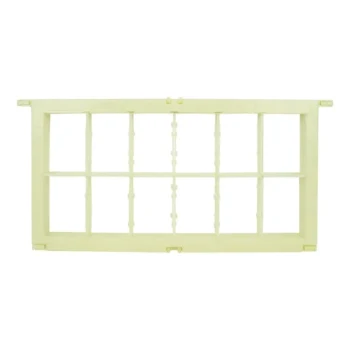
The technical significance of standardized beehive frames lies in their ability to transform complex biological populations into comparable physical units.
By acting as a fixed metric, these frames allow technicians to quantify colony coverage area objectively rather than relying on subjective observation. When these assessments are conducted periodically—specifically every 21 days to align with the worker bee development cycle—the resulting data supports critical management decisions regarding supplemental feeding and swarm control.
The core value of the standardized frame is that it functions as a calibrated instrument for biological measurement. It enables the conversion of irregular colony growth into quantifiable data, providing the baseline necessary for precise monitoring, comparative analysis, and evidence-based apiary management.
Transforming Biology into Metrics
The Frame as a Standardized Unit
In population assessment, a colony is a fluid, shifting biological mass that is difficult to measure directly. Standardized frames solve this by creating comparable physical units.
This allows for the use of specific technical algorithms to estimate population size. For example, a standard frame fully covered by bees can be calculated to represent approximately 2,000 adult bees.
Quantifying Reproductive Vitality
Beyond adult populations, standardized frames allow for the precise calculation of brood development. A double-sided brood frame, for instance, provides a known capacity of roughly 4,000 brood cells.
By measuring the area of capped brood against this standardized capacity, beekeepers can objectively quantify the colony’s biomass and future growth potential. This data drives the establishment of health thresholds for the apiary.
The Role of Timing and Consistency
Aligning with Biological Cycles
The physical standardization of the frame must be paired with temporal standardization. Assessments should be conducted every 21 days.
This specific interval is chosen to align with the development cycle of worker bees. By synchronizing measurement with the biology, technicians ensure that population fluctuations are captured accurately, rather than being skewed by daily operational noise.
Eliminating Variables in Research
For scientific applications, standardized frames are essential to create a consistent baseline. They equalize the colony size and growth space across all experimental groups.
This isolation of variables allows researchers to evaluate specific impacts—such as the effect of natural products on reproduction—without interference from hardware variations. The frame becomes a control factor, ensuring changes in egg, larva, or pupa areas are attributed to the treatment, not the environment.
Understanding the Constraints
Estimation vs. Precision
While standardized frames provide a powerful metric, they often rely on visual estimation algorithms. Translating "frame coverage" into exact bee numbers creates a proxy metric, not an absolute census.
The Human Element
Manual visual assessments of frame coverage are subject to human error and inconsistency between technicians. While the frame itself is standard, the interpretation of "full coverage" can vary, which is why some modern applications are moving toward computer-aided image processing to enhance repeatability.
How to Apply This to Your Project
To leverage standardized frames effectively, align your measurement strategy with your specific objective:
- If your primary focus is Production Management: Adhere strictly to the 21-day assessment cycle to time your supplemental feeding and swarm control based on population peaks.
- If your primary focus is Scientific Research: Ensure all hive structures are identical to eliminate hardware variables, allowing you to isolate the impact of treatments on brood surface area.
Standardization turns the art of beekeeping into a measurable science, giving you the control to manage what you can finally measure.
Summary Table:
| Metric Type | Technical Value | Standard Reference Unit |
|---|---|---|
| Population Density | Converts bee mass into counts | ~2,000 adult bees per full frame |
| Reproductive Vitality | Quantifies brood development | ~4,000 brood cells per double-sided frame |
| Temporal Alignment | Synchronizes with biology | 21-day assessment cycle |
| Research Control | Eliminates hardware variables | Uniform frame dimensions across groups |
| Management Goal | Evidence-based decision making | Objective health & swarm thresholds |
Scale Your Apiary Operations with HONESTBEE Precision
To manage a commercial apiary effectively, you need more than just tools—you need precision-engineered equipment that supports scientific colony management. HONESTBEE specializes in serving commercial apiaries and distributors with a complete wholesale range of beekeeping solutions.
From standardized hives and frames that ensure accurate population assessment to high-efficiency honey-filling machines and hive-making hardware, we provide the technical foundation your business needs to grow. Whether you are stocking essential consumables or investing in industrial machinery, our portfolio is designed to maximize your productivity and yield.
Ready to upgrade your commercial beekeeping infrastructure?
Contact HONESTBEE Today to discuss our wholesale offerings and discover how our comprehensive equipment range can streamline your operations.
References
- Ömer Yılmaz, Ahmet Güler. The Impact of Cannabis sativa and Helianthus annuus Plants on Honey bee Colonies (Apis mellifera L.): Varroa destructor Infestation and Performances. DOI: 10.51458/bstd.2023.35
This article is also based on technical information from HonestBee Knowledge Base .
Related Products
- Wooden Bee Hive Frames for Beekeeping and Wholesale
- Professional Galvanized Steel Frame Rest for Beehives
- Assembled Wooden Bee Frames with Plastic Foundation for Durability and Convenience by HONESTBEE
- HONESTBEE Wired and Assembled Wooden Bee Frames Foundation for a Thriving Hive
- Plastic Bee Frame Beekeeping Hive Frames for Wholesale
People Also Ask
- How do wooden and plastic hive frames compare in terms of durability? Wood vs. Plastic Longevity & Repairability
- How does balancing the number of frames impact hive productivity? Optimize Your Apiary's Biological Output
- What are the main considerations when choosing between wooden and plastic bee hive frames? Optimize Your Apiary's Efficiency
- How should beehive frames be maintained to prolong their lifespan? 5 Pro Tips for Durable Beekeeping Equipment
- Can I reuse old beehive frames? Save Money and Boost Hive Productivity