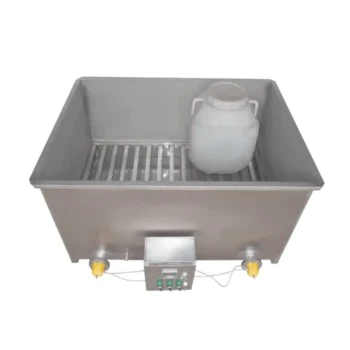
Regular honey processing is a multi-stage industrial procedure designed to standardize the product's texture and appearance. While it begins with standard extraction methods, the defining steps for regular honey are the application of high heat (pasteurization) and rigorous filtration to remove impurities.
The core objective of processing regular honey is to stabilize the product. By applying heat and filtration, producers destroy yeast to prevent fermentation and remove solids, resulting in a clear, smooth liquid with an extended shelf life.
From Hive to Extractor
Before the specific refining steps that define "regular" honey occur, the raw material must be harvested.
Collection and Clearing
Beekeepers open the hive frames, often using smoke to calm and clear the bees. The inner hive is removed, and any remaining bees are gently swept away using brushes or air blowers.
Uncapping the Comb
Honey is stored behind wax caps within the comb. To access it, processors "uncap" the honeycomb by slicing these wax seals open with a specialized knife.
Centrifugal Extraction
The uncapped frames are placed into a honey extractor. This machine spins the frames rapidly, using centrifugal force to pull the liquid honey out of the comb structure.
The Refining Phase
This stage distinguishes regular honey from raw honey. The extracted liquid undergoes specific treatments to ensure it is suitable for mass distribution and long-term storage.
Pasteurization
The primary processing step for regular honey is pasteurization. This involves applying high heat to the honey to destroy naturally occurring yeast spores.
Extending Shelf Life
By killing yeast, pasteurization effectively prevents fermentation. This ensures the honey remains stable and safe to eat for a much longer period than untreated varieties.
Filtration
After heating, the honey is passed through filters. This process removes fine particles, including wax debris, pollen, and other impurities introduced during extraction.
Clarification
Filtration also removes air bubbles trapped in the viscous liquid. The result is the transparent, golden aesthetic that consumers typically associate with supermarket honey.
Understanding the Trade-offs
Processing honey involves a balance between stability and natural composition.
Texture vs. Integrity
The heating process makes the honey smoother and significantly delays crystallization. However, this high heat alters the honey's state compared to its raw counterpart.
Aesthetic Uniformity
Regular honey is processed to look consistent on the shelf. The removal of debris and bubbles ensures every bottle has the same clear appearance, but this requires stripping out solid elements that some consider beneficial.
Making the Right Choice for Your Goal
Depending on how you intend to use or store the product, the level of processing matters.
- If your primary focus is storage and convenience: Regular honey is the superior choice, as pasteurization ensures it remains liquid and resists spoiling for a long time.
- If your primary focus is natural composition: You may wish to avoid regular honey, as the high-heat processing and filtration remove natural elements found in raw varieties.
By understanding the mechanics of pasteurization and filtration, you can make an informed decision about which type of honey belongs in your pantry.
Summary Table:
| Processing Stage | Action Taken | Primary Benefit |
|---|---|---|
| Extraction | Centrifugal spinning of uncapped frames | Separates liquid honey from the wax comb |
| Pasteurization | Application of high-heat treatment | Destroys yeast to prevent fermentation and spoilage |
| Filtration | Removal of pollen, wax, and air bubbles | Creates a clear, smooth, and aesthetically uniform liquid |
| Stabilization | Controlled cooling and bottling | Delays crystallization and ensures long-term shelf stability |
Scale Your Honey Production with HONESTBEE
Are you looking to streamline your honey processing workflow? HONESTBEE provides commercial apiaries and distributors with professional-grade solutions tailored for efficiency. From high-capacity honey-filling machines and specialized hive-making hardware to a full spectrum of beekeeping tools and industry consumables, we empower your business to deliver premium quality at scale.
Our value to you:
- Comprehensive Wholesale Offering: A one-stop shop for all beekeeping and processing machinery.
- Industrial Efficiency: Equipment designed for high-output commercial operations.
- Brand Support: Diverse honey-themed cultural merchandise to enhance your product lineup.
Ready to upgrade your facility? Contact us today to discuss how our equipment can optimize your honey production.
Related Products
- Electric Double Wall Honey Filtering Machine Purifier Equipment for Honey Processing Plant
- 0.5T Capacity Honey Dehumidifier Dryer with Vacuum Heating and Thickening Filtering Machine
- Heavy Duty Stainless Steel Honey Processing Machine Decrystallizing Tank
- Double Wall Honey Heating Stirring Homogenizer Mixing Machine with Various Capacity
- Economy Honey Homogenizer Mixer and Melting Machine for Beekeeping
People Also Ask
- What types of equipment are used in honey filtering? Build an Efficient System for Pure, Marketable Honey
- What is the process of filtering honey? A Guide to Clean, Pure, and Market-Ready Honey
- What is the overall importance of using the right equipment in honey filtering? Boost Quality & Marketability
- What role do professional honey harvesting and filtering equipment play in meeting honey market quality standards? Boost ROI
- What is a potential concern associated with filtering honey? Balancing Clarity and Pollen Preservation