Commercial beekeeping equipment must do more than extract honey efficiently—it must help producers control contamination, preserve product quality, and prove what happened to every batch. The essential capabilities include hygienic and cleanable construction, standardized movable-frame handling, controlled centrifugal extraction, multi-stage filtration, moisture and temperature management, automated filling, and reliable batch traceability. Equipment should also integrate with testing and HACCP-based quality systems so producers can demonstrate compliance with the specific requirements of each export destination.
Export-ready equipment is a quality-control system, not merely a production machine. It must prevent contamination, preserve honey’s physicochemical and sensory properties, and generate the records needed to verify safety, traceability, and consistency.
What Export Markets Require Producers to Control
Purity and contamination
International buyers expect honey to be free from visible impurities, brood material, excessive wax debris, bee remains, and environmental contaminants. Equipment must therefore control contamination from comb removal through extraction, filtration, storage, and filling.
The equipment cannot compensate for contaminated raw material or poor apiary practices. However, hygienically designed machinery can prevent avoidable contamination during processing.
Moisture, HMF, and acidity
Honey quality depends on controlling moisture content, hydroxymethylfurfural (HMF), acidity, composition, maturity, and sensory characteristics.
Export specifications vary by market, product category, and buyer. Many commercial specifications require moisture around 20% or below, while some references and market frameworks use a threshold near 21%; the applicable destination standard must always be confirmed before production.
Traceability and HACCP evidence
Export compliance requires more than a finished product that appears clean. Producers must be able to identify the source, processing date, equipment line, operators or process stages, storage conditions, and final customer or shipment associated with each batch.
This supports Hazard Analysis Critical Control Points (HACCP), Good Apiculture Practices, customer audits, and customs or certification reviews.
Equipment Capabilities That Directly Support Compliance
Standardized movable-frame hive compatibility
Movable-frame hives provide a controlled method for inspecting, removing, and transporting honey combs. They help producers harvest mature honey while reducing the risk of extracting comb containing brood or unsuitable material.
For commercial buyers, compatibility with standardized frames also improves process consistency. Frames can be handled, loaded, inspected, and recorded using repeatable procedures rather than improvised methods.
Hygienic, cleanable construction
Extractors, tanks, filters, pumps, pipes, and filling machines should use food-contact materials and hygienic construction principles. Surfaces should be smooth, accessible for inspection, resistant to corrosion, and designed to minimize areas where honey or residue can accumulate.
The system should support effective cleaning and sanitation between batches. Dead legs, inaccessible joints, difficult-to-drain sections, and unnecessary crevices create avoidable hygiene risks.
Controlled centrifugal extraction
Commercial extractors should use centrifugal force to remove ripened honey efficiently without unnecessarily damaging the beeswax structure. Consistent rotational control helps standardize extraction across different frame loads and honey varieties.
The extractor should also support safe loading, balanced operation, drainage, and separation from non-food-contact areas. These features reduce physical contamination and improve repeatability.
Multi-stage filtration
Filtration equipment should remove wax particles, bee remains, and other physical impurities before the honey enters storage or filling. A staged approach allows producers to match filtration intensity to the product and customer specification.
Filtration should be effective without unnecessarily removing desirable natural characteristics. The objective is controlled purity—not excessive processing that changes the honey’s expected sensory or biological properties.
Moisture-management capability
Equipment should support moisture control through appropriate handling, storage, and, where required, dedicated moisture-reduction systems. Excess moisture increases the risk of fermentation and spoilage.
Moisture control must be carefully managed because excessive heating can damage quality. Producers should combine process equipment with moisture testing rather than relying only on machine settings.
Precise temperature management
Processing lines should provide controlled heating where heating is necessary for pumping, filtration, or filling. Temperature control should be precise enough to maintain flow while limiting thermal degradation.
Overheating can increase HMF and reduce desirable aromas and other quality characteristics. Equipment should therefore favor measured, uniform temperature control instead of uncontrolled high-temperature treatment.
Hygienic storage and transfer
Honey tanks, pumps, valves, and transfer lines should protect the product after extraction. Closed or controlled transfer reduces exposure to dust, moisture, insects, and other environmental contaminants.
Storage tanks should be easy to drain, clean, inspect, and identify by batch. Their design should also support controlled residence times and clear separation between raw, filtered, and finished honey.
Automated filling and packaging
Automated filling equipment should deliver consistent fill volumes while limiting product exposure during bottling. It should support hygienic changeovers, controlled container handling, and accurate identification of the finished batch.
For bulk export, the system should also accommodate appropriate drums, containers, or other approved packaging formats. Packaging information must correspond with production and traceability records.
Quality Testing and Data Capabilities
Objective product verification
Export-oriented operations need testing equipment or laboratory access to verify honey composition, purity, and safety indicators. Relevant checks may include moisture, HMF, acidity, sensory properties, and other parameters specified by the destination market or buyer.
Processing machinery alone cannot prove that a batch complies. Testing provides objective evidence that process controls achieved the intended result.
Calibration and repeatability
Moisture meters, temperature sensors, scales, filling systems, and other measurement devices should be calibrated and maintained. Inaccurate instruments can create false confidence, inconsistent batches, or rejected shipments.
Distributors and resellers should ask how calibration, verification, maintenance, and replacement parts are handled. These support services are part of the equipment’s quality value.
Batch identification
Each production run should be linked to a unique batch or lot identifier. The system should make it practical to record incoming frames or raw honey, processing dates, filtration stages, test results, packaging information, and shipment details.
Digital controls are useful, but paper-based records can also support compliance if they are complete, legible, controlled, and consistently maintained. The key requirement is reliable evidence—not a particular software format.
Equipment and process records
Commercial systems should support records for cleaning, sanitation, maintenance, operating parameters, and deviations. These records help demonstrate that the equipment remained under control during production.
Equipment identification, serial numbers, service history, and replacement-component records can further strengthen audit readiness and supplier accountability.
Designing the Line Around Critical Control Points
Identify where hazards can enter
A practical HACCP-oriented line examines each stage: frame handling, uncapping, extraction, filtration, pumping, storage, filling, and packaging. The objective is to identify where physical, chemical, or microbiological hazards could be introduced or where product quality could deteriorate.
Equipment should make these control points visible and manageable. For example, accessible filters support inspection, controlled heating supports HMF management, and batch-linked filling records support traceability.
Prevent contamination by design
Prevention is more reliable than depending on final inspection. Closed transfers, hygienic surfaces, effective drainage, protected product paths, and separation between dirty and clean operations reduce the number of opportunities for contamination.
This is especially important in high-throughput facilities, where small process weaknesses can affect large volumes before an issue is detected.
Preserve product identity
Export buyers may require specific floral origins, organic status, raw-honey characteristics, or other product claims. Equipment should support segregation between batches and prevent unplanned mixing during extraction, filtration, storage, or filling.
Clear labeling, dedicated storage locations, and controlled changeovers are often as important as the machinery itself.
Understanding the Trade-offs
Higher filtration versus product characteristics
Fine or multi-stage filtration improves visual purity and removes physical impurities, but excessive processing may not suit every buyer or product claim. The correct filtration specification depends on whether the product is sold as standard filtered honey, minimally processed honey, or under a particular market designation.
Throughput versus process control
High-capacity equipment improves labor efficiency and order fulfillment, but faster processing can increase the consequences of poor cleaning, overloading, or inadequate inspection. Capacity should be matched to the producer’s actual frame volume, staffing, and quality-management capability.
Heating for flow versus thermal degradation
Moderate, controlled heating may improve pumping and filling, while excessive or prolonged heating can raise HMF and affect aroma and other quality attributes. The preferred system provides accurate temperature measurement and avoids treating heat as a substitute for proper equipment design.
Automation versus validation
Automation can improve consistency, filling accuracy, and recordkeeping. It does not eliminate the need for calibration, operator training, cleaning verification, preventive maintenance, and review of process data.
Equipment cost versus export readiness
The least expensive machine may not be the lowest-cost choice if it is difficult to clean, lacks replacement parts, or cannot support records and testing. Total ownership cost should include installation, validation, sanitation, service response, spare parts, training, and documentation.
Making the Right Choice for Your Goal
Choose equipment based on the quality risks and export requirements your operation must control.
- If your primary focus is contamination control: Prioritize food-contact construction, hygienic design, accessible cleaning, protected transfers, standardized frames, and multi-stage filtration.
- If your primary focus is product quality preservation: Select centrifugal extraction, moisture-management, and precise temperature-control systems that limit wax damage, fermentation risk, HMF formation, and sensory degradation.
- If your primary focus is export certification: Require compatibility with HACCP procedures, calibrated testing, cleaning records, maintenance documentation, and complete batch traceability.
- If your primary focus is high-volume production: Choose integrated extraction, filtration, storage, and automated filling equipment with repeatable operating parameters and sufficient capacity for your actual throughput.
- If your primary focus is distribution and resale: Source a full equipment portfolio from suppliers that can provide technical expertise, rapid response, spare parts, documentation, and coordinated order fulfillment.
- If your primary focus is serving multiple international markets: Confirm each destination’s moisture, HMF, acidity, filtration, labeling, packaging, and testing requirements before standardizing the equipment configuration.
The right commercial honey-processing system turns quality requirements into repeatable controls, measurable records, and credible evidence for international buyers.
Summary Table:
| Capability | Why It Matters | Key Considerations |
|---|---|---|
| Hygienic, cleanable construction | Prevents contamination and supports sanitation | Smooth surfaces, no dead legs, easy to clean and inspect |
| Standardized movable-frame hive compatibility | Improves process consistency and harvest control | Repeatable procedures for frame handling and inspection |
| Controlled centrifugal extraction | Efficient honey removal without damaging comb | Consistent rotational control, safe loading and drainage |
| Multi-stage filtration | Removes physical impurities while preserving quality | Match filtration intensity to product and buyer specs |
| Moisture management | Prevents fermentation and spoilage | Use testing and control; avoid excessive heating |
| Precise temperature control | Maintains flow without thermal degradation | Limit HMF formation and sensory damage |
| Hygienic storage and transfer | Protects honey after extraction | Closed transfers, easy-to-clean tanks, batch separation |
| Automated filling and packaging | Consistent volumes and hygienic bottling | Accurate fill control, proper container handling |
| Batch traceability and data recording | Provides evidence for audits and compliance | Link each batch to source, processing, and shipping records |
| Testing and calibration capabilities | Verifies product compliance | Regular calibration of meters, scales, and sensors |
Ready to ensure your honey meets international export standards?
At HONESTBEE, we supply a full spectrum of commercial beekeeping equipment designed for quality control and compliance. Our portfolio includes hygienic extractors, multi-stage filtration systems, moisture management solutions, automated filling lines, and complete traceability support. We cater to commercial apiaries, distributors, and wholesalers, offering one-stop sourcing, premium trading services, rapid response, and dedicated customer service.
Our equipment features food-contact materials, precise temperature control, and built-in batch tracking capabilities to help you achieve HACCP certification, meet export specifications, and build trust with international buyers. With ultra-fast delivery, efficient order fulfillment, and expert technical support, we partner with you to enhance your production efficiency and profitability.
Contact us today to discuss your equipment needs and discover how HONESTBEE can empower your export-ready operation. Get in touch with our team for a tailored solution.
Related Products
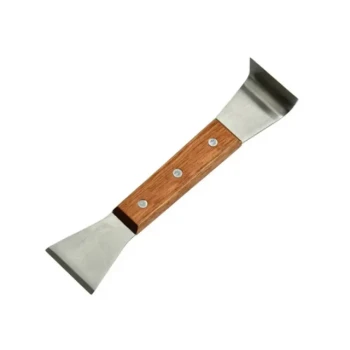
- Professional Dual-End Stainless Steel Hive Tool for Beekeeping
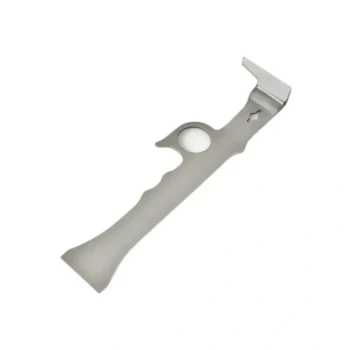
- Stainless Steel J Hook Hive Tool for Beekeeping
- HONESTBEE Classic Pry Bar Hive Tool with High Visibility Finish for Beekeeping
- HONESTBEE 15-in-1 Beekeeper Multi-Tool with Hammer and Pliers for Beekeeping
- HONESTBEE Advanced Ergonomic Stainless Steel Hive Tool for Beekeeping
People Also Ask
- What specific challenges do beekeeping hive tools address during hive maintenance? Essential Solutions for Apiaries
- Why are professional hive tools considered indispensable? Master Beekeeping Maintenance with Precision Leverage
- What is the role of professional hive tools in routine apiary maintenance? Expert Tips for Hive Health and Longevity
- What role do professional beehives and beekeeping tools play in honey prosumption? Scale yield & commercial success.
- What are the primary functions of a stainless steel hive tool? Essential Equipment for Professional Beekeeping