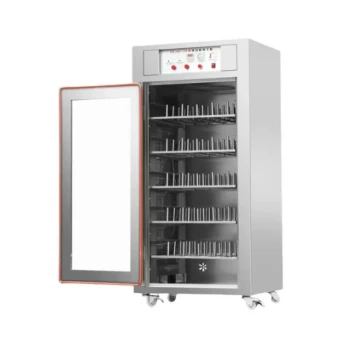
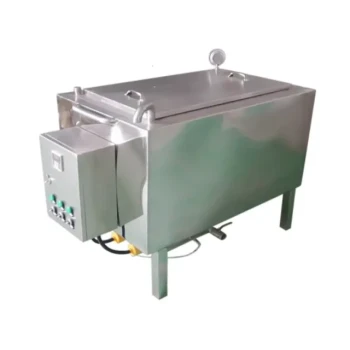
Industrial-grade drying equipment and vacuum dryers serve as the critical stabilization mechanism in the initial phase of bee bread production. Their primary function is to create a controlled environment—typically a constant 40°C thermal field or a vacuum setting—to reduce the moisture content of the bee bread and attached honeycombs to a precise range of 14.00% to 15.00%.
Core Takeaway The initial drying stage is a balancing act between preservation and degradation. Industrial dryers enable producers to lower moisture sufficiently to prevent spoilage (mold and bacteria) without exceeding thermal thresholds that would destroy the bee bread's high-value enzymes and vitamins.
The Biological Imperative: Moisture Control
The most immediate threat to raw bee bread is microbial instability. Industrial drying equipment addresses this by standardizing the water content before further processing or packaging occurs.
Precise Moisture Targeting
The goal of the initial stage is not to completely dehydrate the product, but to reach a specific equilibrium.
Equipment is calibrated to bring the moisture content of the bee bread and its honeycomb structure down to between 14.00% and 15.00%.
Stopping Microbial Activity
Raw bee bread is susceptible to rapid spoilage. By quickly reducing moisture to the 14-15% window, the equipment effectively inhibits the growth of mold and spoilage microorganisms.
This stabilization is the foundation for a commercially viable shelf life, ensuring the product remains safe for consumption or deep processing.
Preserving Bioactive Integrity
The secondary, yet equally critical, role of this equipment is nutrient preservation. Bee bread is valued for its biological activity, which is easily destroyed by improper heat treatment.
The 40°C Thermal Limit
Industrial dryers maintain a strict temperature ceiling, typically capped at 40°C.
This specific temperature is chosen because it creates a drying gradient efficiently without "cooking" the raw material.
Protecting Heat-Sensitive Compounds
Exceeding the 40°C threshold risks denaturing proteins and destroying volatile compounds.
Controlled drying ensures that heat-sensitive bioactive components, specifically enzymes and vitamins, remain active and intact in the final product.
Understanding the Trade-offs
While moisture reduction is essential, the method chosen involves distinct trade-offs between cost and process control.
Convective vs. Vacuum Environments
Convective drying (Heated Air): This method circulates a heat transfer medium to create a uniform thermal field. It is often the core choice for small to medium enterprises due to lower equipment costs, but it relies heavily on efficient air circulation to ensure uniformity.
Vacuum Drying: This creates a low-pressure environment to remove moisture. While often more expensive, it can be highly effective for sensitive materials, as the vacuum reduces the boiling point of water, allowing for efficient evaporation with minimal thermal stress.
The Risk of Imprecision
Failing to maintain the 40°C limit or the 14-15% moisture target leads to two extremes:
- Under-drying: Leaves pockets of moisture that invite fermentation and mold.
- Over-heating: Sterilizes the product to the point where it loses its nutritional premium (enzyme activity).
Making the Right Choice for Your Goal
When selecting or configuring equipment for the initial stage of bee bread production, consider your specific operational focus.
- If your primary focus is Nutrient Density: Prioritize equipment with high-precision temperature controls (never exceeding 40°C) and vacuum capabilities to maximize the retention of enzymes and vitamins.
- If your primary focus is Commercial Scalability: Focus on achieving the strict 14.00–15.00% moisture target consistently to ensure shelf stability and prevent inventory loss due to spoilage.
Ultimately, the equipment is not just removing water; it is locking in value by suspending the product in a stable, bioactive state.
Summary Table:
| Feature | Specification/Target | Impact on Bee Bread Quality |
|---|---|---|
| Moisture Content | 14.00% - 15.00% | Prevents mold, yeast fermentation, and microbial spoilage. |
| Temperature Ceiling | Maximum 40°C | Protects heat-sensitive vitamins and bioactive enzymes. |
| Drying Environment | Convective or Vacuum | Ensures uniform stabilization and efficient water evaporation. |
| Primary Goal | Biological Stabilization | Creates a commercially viable shelf life without nutrient loss. |
Scale Your Bee Bread Production with HONESTBEE
Transitioning from raw harvest to high-value commercial bee bread requires precision and the right industrial tools. At HONESTBEE, we specialize in supporting commercial apiaries and distributors with a comprehensive range of professional beekeeping machinery, including high-precision drying solutions and hive-making equipment.
How we add value to your business:
- Precision Equipment: Ensure your bee bread meets the 14-15% moisture standard while preserving 100% of its enzyme activity.
- Wholesale Expertise: Access a full spectrum of tools, from honey-filling machines to essential industry consumables.
- Global Distribution: We provide the hardware and cultural merchandise needed to scale your brand internationally.
Ready to enhance your processing efficiency? Contact our expert team today to discover how HONESTBEE can optimize your production line.
References
- Feyza ŞİMŞEK, Ceren Mutlu. ARI EKMEĞİNİN BAZI FİZİKSEL VE KİMYASAL ÖZELLİKLERİ VE SAĞLIK ÜZERİNE ETKİLERİ. DOI: 10.15237/gida.gd23038
This article is also based on technical information from HonestBee Knowledge Base .
Related Products
- High Quality Honey Dehumidifier Dryer Thickening Machine for Beekeeping
- HONESTBEE Professional Cabinet Bottle Dryer
- Professional Bee Frame Machine for Side Bar Shaping
- Electric Commercial Beeswax Melter for Factory Use
- High-Efficiency Pneumatic Bee Hive Making Machine for Rapid Box Assembly
People Also Ask
- Can you dehumidify honey? A Beekeeper's Guide to Preventing Fermentation
- How to dry up honey? The Safe Guide to Stabilizing Honey and Preventing Fermentation
- How can the moisture content of honey be reduced? A Guide to Safe, Effective Drying Methods
- How to remove humidity from honey? Protect Your Harvest from Fermentation
- How to decrease moisture in honey? Prevent Fermentation and Ensure Long-Term Quality