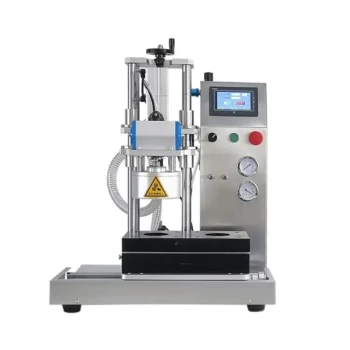
Bottle capping equipment serves a critical role in packaging lines: it ensures the precise placement and secure tightening of caps onto bottles and jars.
Designed to handle a variety of closure types—including twist-offs, screw caps, and tamper-evident lids—this machinery replaces inconsistent manual labor with standardized mechanical force. By automating the sealing process, manufacturers can ensure product integrity and prevent leaks, regardless of whether they are running a boutique operation or a high-volume facility.
Core Takeaway While the basic function of capping is simple, the consistency of the seal is vital for product safety and shelf life. The market offers a clear hierarchy of equipment—manual, semi-automatic, and fully automated—allowing businesses to scale their hardware directly alongside their production volume.
The Operational Purpose
Ensuring Seal Integrity
The primary function of this equipment is to apply the correct amount of torque to a container.
Proper tightening prevents leakage and protects the product from contamination. This consistency is difficult to achieve by hand, particularly over long production runs.
Handling Diverse Closure Types
Modern capping equipment is versatile and not limited to a single style of lid.
Systems are engineered to support various designs, including standard screw caps and twist-off lugs often found on glass jars. They also accommodate tamper-evident lids, which are essential for consumer safety and regulatory compliance.
Equipment Types by Production Scale
Manual Cappers for Small Operations
For startups or low-volume batches, manual cappers provide an accessible entry point.
These devices require an operator to physically place the bottle and trigger the tightening mechanism. They are cost-effective but rely heavily on human labor speed.
Semi-Automatic Models for Efficiency
As production demands grow, semi-automatic systems offer a balance between cost and throughput.
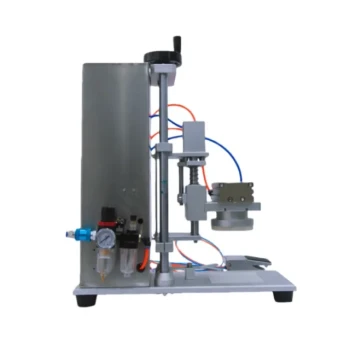
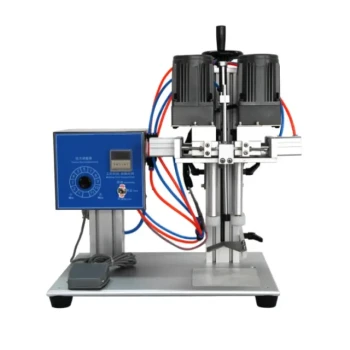
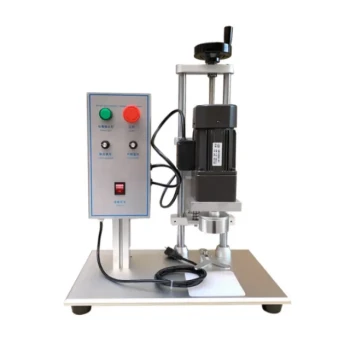
These machines typically handle the tightening cycle automatically but still require an operator to place the bottle or cap. They significantly reduce operator fatigue and increase consistency without the high capital investment of a fully robotic line.
Fully Automated Systems for Mass Production
For large-scale manufacturing, fully automated systems are the standard.
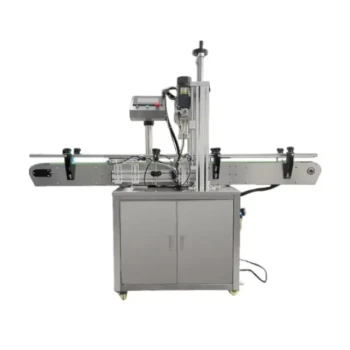
These units handle the entire process, from sorting and feeding caps to placing and tightening them at high speeds. They require minimal human intervention, maximizing output and efficiency.
Understanding the Trade-offs
Cost vs. Throughput
The most significant trade-off is between capital investment and production speed.
Manual units are inexpensive but create a bottleneck as volume increases. Conversely, automated systems solve throughput issues but require a substantial upfront financial commitment and floor space.
Flexibility vs. Speed
Highly automated systems excel at speed but can be rigid regarding changeovers.
If your product line changes container sizes or cap styles frequently, a semi-automatic model often offers more flexibility. Fully automated lines generally require downtime for retooling when switching between different bottle types.
Selecting the Right Equipment for Your Growth Phase
Choosing the right capper depends entirely on where your business currently stands and your projected growth for the next 12 months.
- If your primary focus is low-cost entry: Opt for manual cappers, which allow you to start production with minimal overhead while ensuring basic seal quality.
- If your primary focus is balancing budget and speed: Invest in a semi-automatic model, which improves consistency and reduces physical strain on workers without the expense of full automation.
- If your primary focus is maximum output: Deploy a fully automated system to eliminate labor bottlenecks and achieve the high-speed throughput required for mass market distribution.
The right equipment acts not just as a tool, but as a scalable foundation for your product's security and success.
Summary Table:
| Equipment Type | Operation Mode | Best For | Key Advantage |
|---|---|---|---|
| Manual Capper | Manual cap placement & trigger | Startups & small batches | Low cost & easy entry |
| Semi-Automatic | Manual bottle placement, auto-torque | Growing production lines | Balanced cost & efficiency |
| Fully Automated | Integrated sorting, feeding & sealing | Large-scale manufacturing | High throughput & low labor |
Elevate Your Production with HONESTBEE Packaging Solutions
Maximize your apiary's efficiency and ensure every jar is perfectly sealed with HONESTBEE. As a premier provider for commercial apiaries and distributors, we offer a complete range of professional beekeeping machinery, including high-precision honey-filling and bottle capping machines.
Whether you are scaling from boutique batches to mass distribution, our comprehensive wholesale portfolio covers everything from specialized hardware to essential industry consumables. Let us help you protect your product integrity and streamline your workflow.
Ready to upgrade your facility? Contact our experts today to find the perfect equipment for your business growth!
Related Products
- HONESTBEE Professional Benchtop Pneumatic Bottle Capping Machine Capper
- Semi-Automatic Pneumatic Bottle Capping Machine by HONESTBEE
- Automatic Inline Spindle Bottle Capping Machine for Honey Production
- Semi Automatic Electric Bottle Capping Machine
- Semi-Automatic Vacuum Capping Machine with Pneumatic Control for Glass Jars
People Also Ask
- How does a bottle capping machine work? Unlock Efficient, Consistent Sealing for Your Production Line
- What is the purpose of a bottle capping machine? Boost Efficiency and Ensure Product Integrity
- What are the categories of bottle capping machines? Choose the Right Automation for Your Line
- What is a bottle cap sealing machine? The Key to Automated, Tamper-Evident Packaging
- What are the main types of caps supported by bottle capping equipment? Threaded, Press-On, and Insertion