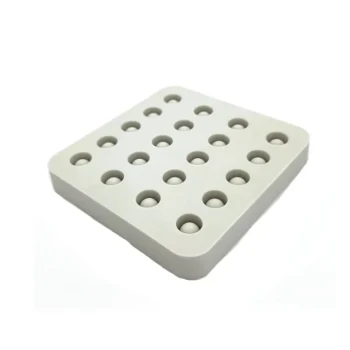
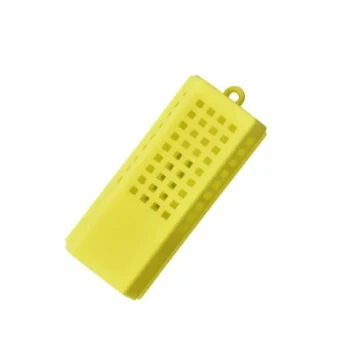
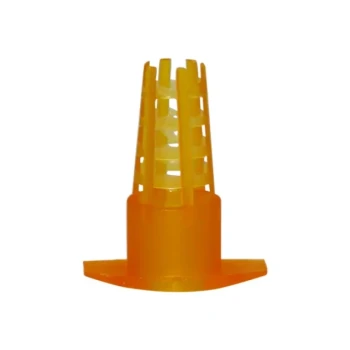
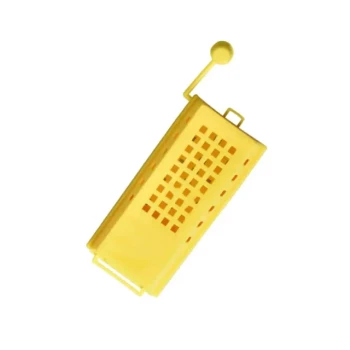
Plastic queen cells serve as essential, standardized artificial nesting chambers designed to replicate the natural queen-rearing environment while acting as durable vessels for collection. By acting as a precise housing for transplanted larvae, these cells trigger the biological instinct of nurse bees to secrete massive quantities of royal jelly, facilitating efficient, hygienic, and scalable harvesting.
The Core Insight Plastic queen cells transform royal jelly production from a sporadic biological occurrence into a controlled industrial process. They provide the uniform structure necessary to deceive the colony into mass-producing "queens," thereby maximizing royal jelly secretion while ensuring the harvest remains clean and compatible with mechanical extraction.
The Mechanism of Induced Secretion
Simulating the Natural Environment
To a bee colony, the plastic cell represents a potential future queen. The cups are engineered to mimic the specific dimensions and geometry of natural beeswax queen cells.
Triggering the Nursing Instinct
Technicians transplant (graft) young larvae—typically 1-2 days old—into these artificial cups. This placement serves as a biological trigger, compelling nurse bees in the colony to secrete royal jelly to feed what they perceive as developing royalty.
The Collection Pool
Unlike standard honeycomb cells, these plastic cups act as dedicated reservoirs. They are designed not just to house the larvae, but to accumulate the excess royal jelly deposited by workers, acting as a standardized "collection pool" for the final product.
Standardization and Operational Efficiency
Enabling Mechanization
The primary advantage of plastic over natural wax is structural uniformity. The standardized design ensures that every cell fits perfectly into harvesting frames, allowing for the use of mechanical or semi-mechanical extraction tools rather than slow manual scraping.
Ensuring Hygiene
Commercial production relies on food-grade plastic materials. This ensures the royal jelly remains free from contaminants that might be present in reused wax and facilitates thorough cleaning and sterilization between production cycles.
Predictable Yield Management
Because the cells are uniform, producers can better predict yields and manage production schedules. The durability of plastic allows for repeated use in rapid 48-to-72-hour harvest cycles without the need to rebuild cells from scratch.
Understanding the Trade-offs
Acceptance Rates
While plastic offers durability, it lacks the natural pheromones and texture of beeswax. If the plastic is new or improperly treated, the "acceptance rate"—the percentage of larvae the bees choose to feed—may be lower than with natural wax cells.
The Necessity of Coatings
To mitigate lower acceptance rates, plastic cells often require a thin coating of beeswax or must be "primed" within the hive. Without this step, the artificial nature of the material can sometimes override the biological trigger, causing bees to reject the grafted larvae.
Making the Right Choice for Your Goal
When integrating plastic queen cells into a production workflow, consider your specific operational targets:
- If your primary focus is maximum hygiene and speed: Prioritize high-quality food-grade plastic cells that support fully mechanical extraction to reduce handling time and contamination risk.
- If your primary focus is larval acceptance: Implement a "priming" protocol where plastic cells are coated in beeswax or introduced to the hive briefly before grafting to acquire the colony's scent.
Plastic queen cells are the fundamental hardware that allows beekeepers to harness natural biological instincts for reliable, commercial-scale production.
Summary Table:
| Feature | Benefit for Royal Jelly Production |
|---|---|
| Standardized Geometry | Mimics natural queen cells to trigger mass nursing instincts. |
| Structural Durability | Allows for high-speed mechanical extraction without cell damage. |
| Food-Grade Material | Ensures high hygiene standards and chemical-free collection. |
| Uniform Sizing | Facilitates predictable yields and seamless integration with frames. |
| Reusable Design | Lowers long-term overhead costs and supports rapid 48-72h harvest cycles. |
Elevate Your Royal Jelly Production with HONESTBEE
At HONESTBEE, we understand that precision is the backbone of a profitable commercial apiary. Our high-quality, food-grade plastic queen cells are engineered to maximize larval acceptance and streamline your extraction workflow.
Whether you are a distributor looking for reliable wholesale supplies or a commercial apiary seeking to upgrade your machinery and consumables, HONESTBEE provides the full spectrum of beekeeping tools—from specialized hive-making equipment to advanced honey-filling solutions. Partner with us to enhance your operational efficiency and harvest purity.
Ready to scale your production? Contact HONESTBEE today for wholesale pricing and expert guidance!
References
- Ying Wang, Baohua Xu. Effects of Sucrose Feeding on the Quality of Royal Jelly Produced by Honeybee Apis mellifera L.. DOI: 10.3390/insects14090742
This article is also based on technical information from HonestBee Knowledge Base .
Related Products
- JZBZ Type Wide Base Plastic Queen Cell Cups for Base Mounting and Queen Rearing
- Clear Black Plain Polystyrene Queen Bee Grafting Cell Cups No Lug for Bee Queen Cup
- Durable Plastic Push In Queen Bee Cage
- High Performance Plastic Queen Excluder for Beekeeping and Apiary Management
- Professional Plastic Queen Excluder for Modern Beekeeping
People Also Ask
- What are the primary advantages of using plastic queen cell cups? The Industrial Choice for High-Efficiency Apiaries
- What technical advantages do commercial plastic queen cell cups offer? Scale Your Queen Rearing for Maximum Efficiency
- What is the function of standardized plastic Queen Cell Cups? Boost Efficiency in Commercial Larval Grafting
- Why are standardized plastic queen cell cups preferred? Boost Commercial Queen Rearing Efficiency
- Why are standardized plastic queen cell cups typically used in large-scale queen bee production? Boosting Apiary Output